Economic Development (Junior Cert Geography): Revision Notes
📚Revision Notes
Economic Development
Economic Development
The economy refers to how people earn a living and how money moves within a country through the production of goods and services. We measure it using Gross National Income:
- Gross National Income (GNI): The total income earned by a country's people from both domestic and international sources. When GNI increases, it indicates economic development, meaning the country is becoming wealthier.
- GNI per Capita: This is the average income per person in a country, calculated by dividing the total GNI by the population size. It provides a measure of how much income, on average, each person receives annually.
- Limitations of GNI per Capita: While it indicates average income, it doesn't show how income is distributed among the population or reflect access to services like healthcare and education.
Human Development Index
The Human Development Index (HDI) measures peoples quality of life in a country. It is based off four indicators:
- Life Expectancy: Average years a person is expected to live, reflecting health and living conditions.
- Education: Includes mean years of schooling and expected years of schooling for children.
- Gross National Income (GNI) per Capita: Average income per person, indicating economic prosperity.
- Gender Equality: HDI also considers gender equality in education, income, and life expectancy to measure overall development. The HDI score ranges from 0 to 1, with higher scores indicating better human development.
Levels of Economic Development
Countries are either developed, quickly developing or slowly developing:
- Developed Countries:
- High levels of industry and services.
- High incomes, good healthcare, and education.
- High life expectancy and literacy rates.
- Examples: USA, Western Europe.
- Quickly Developing Countries:
- Transitioning from agriculture to industry and technology.
- Income and living standards are improving but still lower than developed countries.
- Education, health, and literacy rates are rising.
- Examples: Brazil, Russia, India, China.
- Slowly Developing Countries:
- Poorest countries, mostly in Africa.
- Depend on agriculture, with low industrial activity.
- Low incomes, poor healthcare, and education.
- Low life expectancy and literacy rates.
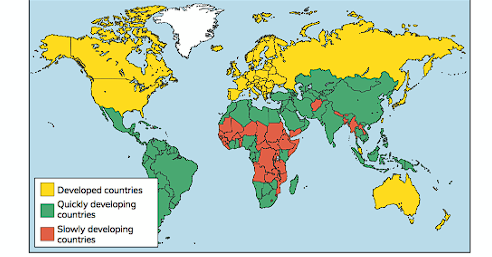
Factors influencing Economic Development:
- Colonialism:
- European powers took over colonies in Africa, Asia, and South America, exploiting their resources and land.
- Colonies were forced into unfair trade systems, where they couldn't compete with the colonial powers.
- This exploitation led to wealth in colonial powers and poverty in the colonies, which continues to affect economic development today.
- Unfair Trade:
- Colonies were made to grow cash crops (like coffee and cotton) for export, rather than food for local use.
- These crops were sold cheaply to developed countries and processed into expensive products, keeping former colonies dependent and in debt.
- The global trade system still favours richer countries (the North), creating economic imbalances.
- Debt:
- High-interest loans trap many developing countries in a cycle of debt.
- Money that could be used for healthcare and education is spent on debt repayment.
- Corrupt governments often misuse funds, worsening poverty and underdevelopment.
- War:
- Civil wars destroy infrastructure and disrupt economic activities.
- Conflicts often arise from colonial-era borders, leading to prolonged instability.
- Resources are drained by military spending, halting economic progress.
- Environment:
- Extreme climates make agriculture challenging, leading to food insecurity.
- Climate change causes droughts and floods, further reducing crop yields.
- Poor agricultural output limits economic growth and development.