Fold Mountains I (Junior Cert Geography): Revision Notes
📚Revision Notes
Fold Mountains I

Fold Mountains
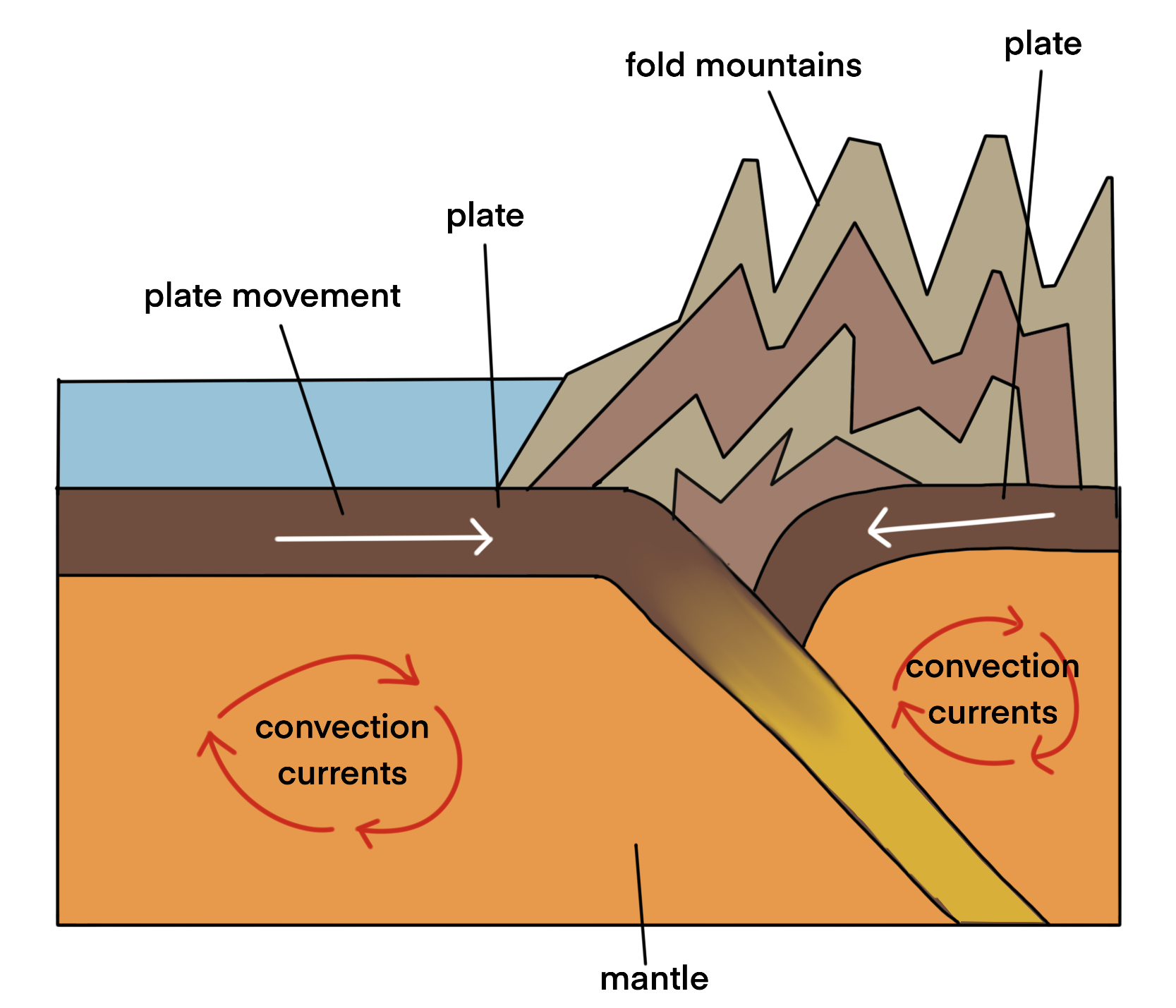
Fold mountains are mountains that form when two tectonic plates move towards each other and collide. This collision causes the land to buckle and fold, creating mountain ranges.
- The collision of plates forces sediments and rocks to crumple and push upwards, forming fold mountains.
- Anticlines are the upward folds or ridges in the mountains. They are long and narrow.
- Synclines are the downward folds or valleys between the anticlines.
- The force of the collision at these plate boundaries is so strong that it can lift the Earth's crust, creating tall mountain ranges.
- Fossils can often be found high in these mountains because the rocks that form them were once below the sea and have been lifted up.
- Examples of fold mountains include the Andes in South America and the Himalayas in Asia.
Distribution of Fold Mountains
Fold mountains are found where tectonic plates have collided. They are mostly located near plate boundaries. There have been 3 main fold mountain building periods: The Caledonian, Armorican and Alpine foldings.
- Caledonian Fold Mountains:
- Formed around 400 million years ago.
- Found in places like Donegal, Wicklow, and Scotland.
- These mountains have been worn down over time and have rounded peaks.
- Armorican Fold Mountains:
- Formed about 250 million years ago.
- In Ireland, they include ranges like the Macgillycuddy's Reeks, the Galtees, the Knockmealdowns, and the Comeraghs.
- These mountains were once as high as the Alps but have since been eroded.
- Alpine Fold Mountains:
- Formed 30 to 35 million years ago, making them the youngest and highest fold mountains.
- Examples include the Rockies in North America, the Alps in Europe, and the Himalayas in Asia.