Population Change (Junior Cert Geography): Revision Notes
📚Revision Notes
Population Change
Demographic Transition Model
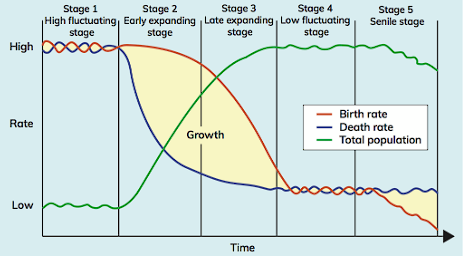
The Demographic Transition Model (DTM) illustrates how population structures change over time, showing the shifts in birth rates, death rates, and total population size as a country develops.
Stage 1: High Fluctuating Stage
- Birth and death rates are both high and unpredictable, resulting in a stable and low population size. Countries in this stage are usually undeveloped with poor healthcare and high infant mortality. Example: Somalia.
Stage 2: Early Expanding Stage
- Birth rates remain high, but death rates fall rapidly due to improvements in healthcare, food, and water. This leads to rapid population growth. Example: Nigeria.
Stage 3: Late Expanding Stage
- Birth rates begin to decline, and death rates decrease at a slower pace. Population growth slows as a result of better economic conditions and access to healthcare. Example: China and Brazil.
Stage 4: Low Fluctuating Stage
- Both birth and death rates are low and stable. Population growth stops, and the population size stabilises at a high level. This stage is typical of developed countries. Example: Ireland.
Stage 5: Senile Stage
- Birth rates drop below death rates, leading to a declining population. This stage occurs in highly developed countries where families tend to have fewer children. Example: Germany and Italy.
Factors that affect Population Change
- Food Supply: When food is abundant, populations grow as people live longer and have more children. However, food shortages or famines can lead to starvation and reduce the population. For example, population increased in European countries after 1750 due to better food, while Ireland's population decreased during the Famine.
- Improved Technology: Advances in farming, healthcare, and modern conveniences can boost population growth by improving living standards and life expectancy. However, certain technologies, like advanced warfare, can lead to population decline. For instance, Europe and North America saw population growth after the 1950s due to technological improvements.
- Healthcare: Better healthcare, including vaccines and medical technology, reduces death rates and boosts population growth. On the other hand, a lack of healthcare and clean water can lead to higher death rates and reduce the population, as seen in parts of Africa.
- War: War often leads to population decline due to deaths and the destruction of infrastructure. However, after a war, populations may increase during periods of recovery, often referred to as a baby boom. For example, Germany's population dropped significantly after World War II.
- Status of Women: In societies where women marry young and focus on family, birth rates tend to be high, increasing the population. In contrast, in modern societies where women pursue education and careers, birth rates are lower, leading to slower population growth. For instance, Ireland has seen a decline in birth rates since the 1970s.
- Education: In areas with less education, populations tend to grow as people, especially women, have more children at younger ages. In contrast, higher levels of education often lead to smaller family sizes, better family planning, and slower population growth.