Population Characteristics (Junior Cert Geography): Revision Notes
📚Revision Notes
Population Characteristics
Population Dynamics
Population dynamics refers to the changes in population size and structure over time. These changes are influenced by factors like birth rates, death rates, and migration.
The Study of Population
- The study of population is known as demography.
- As populations grow, the demand for resources, services, and jobs increases.
- Governments and organisations use population data to plan for future needs, including healthcare, education, and employment opportunities.
Population Trends
- Over time, the global population has generally increased.
- Population growth has occurred at a fluctuating rate, meaning it has increased quickly at times and more slowly at others.
- By 2018, the world's population was 7.6 billion, growing by about 80 million people per year.
Key Population Terms
- Birth Rate (BR): The number of babies born per 1,000 people each year, expressed as a percentage. For example, if 20 children are born per 1,000 people, the birth rate is 2.0%.
- Death Rate (DR): The number of deaths per 1,000 people each year, also expressed as a percentage. For example, if 15 people die per 1,000 people, the death rate is 1.5%.
- Natural Change: The difference between the birth rate and the death rate. If more people are born than die, there is a natural increase. If more people die than are born, there is a natural decrease.
Population Pyramids
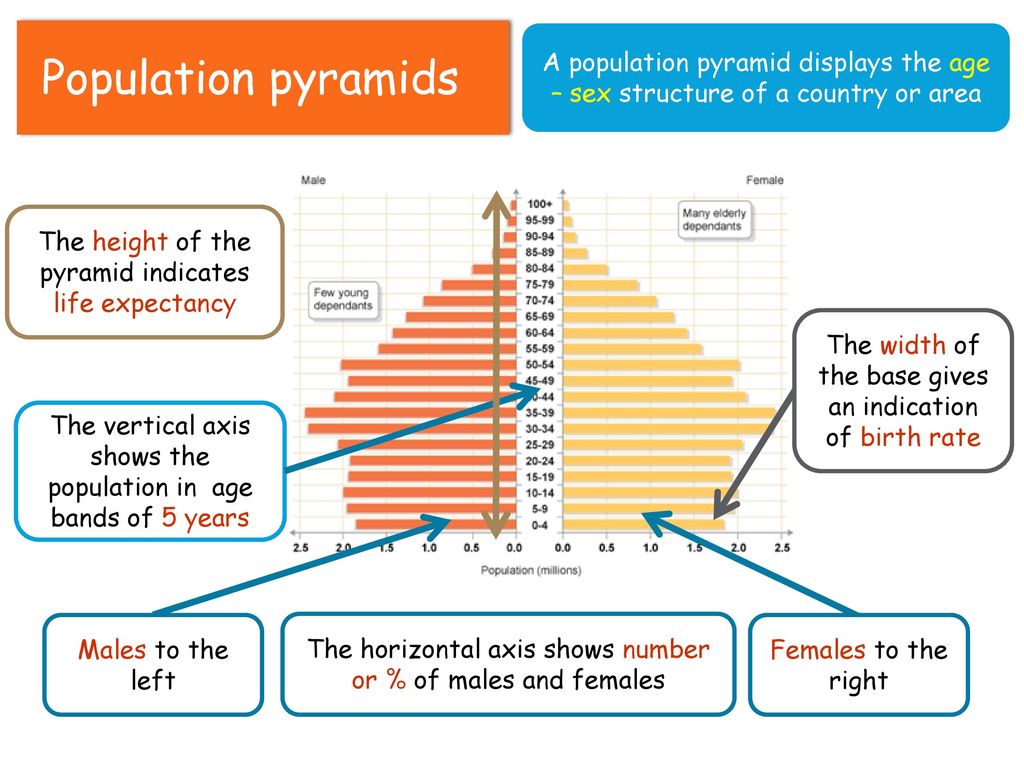
A population pyramid is a type of graph that shows the age and gender structure of a population. It helps us understand the distribution of different age groups and the number of males and females in a country.
Key Features of Population Pyramids
- Shape: The shape of the pyramid can reveal whether the population is growing, shrinking, or staying the same.
- Vertical Axis: This shows age groups, usually in 5-year intervals (e.g., 0-4, 5-9, etc.).
- Horizontal Axis: This shows the population numbers or percentages for each age group.
- Gender: Males are usually on the left, and females are on the right.
Types of Population Pyramids
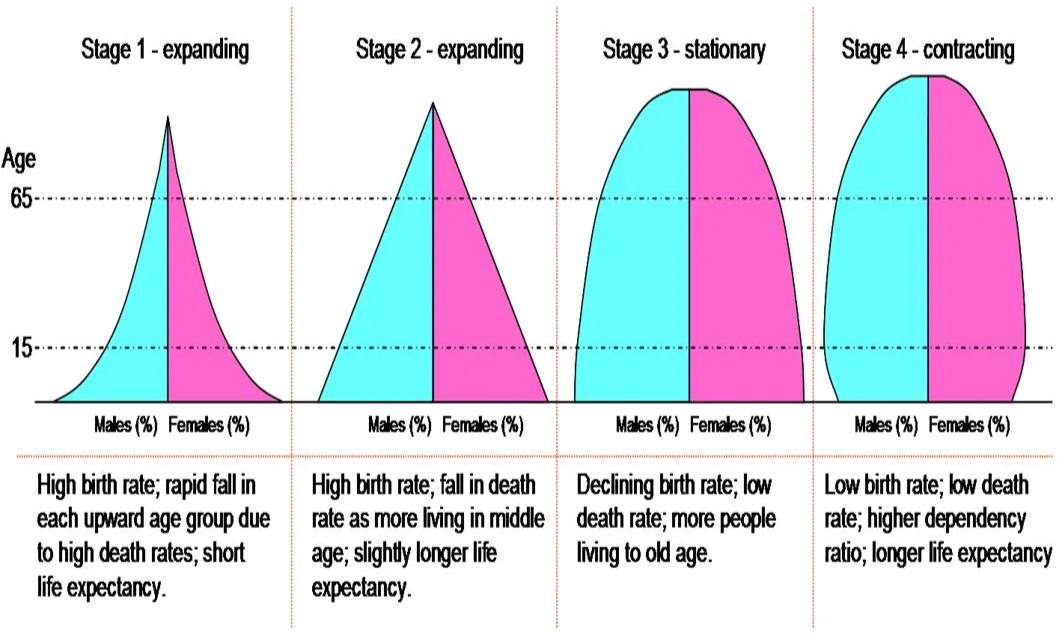
- Expanding Pyramid:
- Diagram: Wide base, narrowing at the top.
- Description: A wide base means there are many young people (0-14). As these children grow up, they will have their own children, leading to population growth.
- Life Expectancy: Few people live to 65+, so life expectancy is low.
- Natural Increase: High birth rate leads to population growth. Typical of developing countries, e.g., Tanzania.
- Example: Three-child families are common.
- Stationary Pyramid:
- Diagram: Narrow base, almost equal width throughout.
- Description: The base is narrower, meaning fewer children are being born. The population size remains stable.
- Life Expectancy: More people live to 65+, so life expectancy is higher.
- Natural Increase: Birth rate and death rate are balanced, leading to stable population size. Typical of developed countries, e.g., Ireland.
- Example: Two-child families are common.
- Contracting Pyramid:
- Diagram: Very narrow base, wider at the top.
- Description: Fewer children are being born, leading to a declining population.
- Life Expectancy: The pyramid is taller, meaning many people live to old age, so life expectancy is very high.
- Natural Increase: Low birth rate leads to population decline. Typical of highly developed countries, e.g., Germany.
- Example: One-child families are common.
Interpreting Population Pyramids
- Life Expectancy: The height and width of older age groups show life expectancy. More people living into old age suggests better health and development in a country.
- Birth Rate: The width of the base (0-4 age group) indicates birth rates. A wide base shows a high birth rate, common in developing countries, while a narrow base suggests fewer births, typical in developed countries.
- Economically Active and Dependent Groups: The 15-64 age group supports the economy by working and paying taxes. A shrinking economically active group means fewer people to support the young (0-14) and elderly (65+), which can lead to economic challenges, especially in ageing populations.