Perpendicular Lines (Junior Cert Mathematics): Revision Notes
📚Revision Notes
Perpendicular Lines
In this section, we will learn about perpendicular lines, how they relate to slope, and how to spot them on a graph. Understanding perpendicular lines is important in co-ordinate geometry, and we'll take it step by step to make sure it's clear and easy to follow.
What Are Perpendicular Lines?
Perpendicular lines are lines that meet or cross each other at a right angle, which is a 90-degree angle. Imagine the corner of a book or the way two streets intersect at a perfect "" shape—those are examples of perpendicular lines.
Here are the key points:
- Perpendicular lines meet at a 90-degree angle.
- They form a perfect "" shape where they cross.
Perpendicular Lines and Slope
To understand why perpendicular lines meet at right angles, we need to look at their slopes. The slope of a line tells us how steep the line is—whether it goes up or down as you move along it.
Here's the important rule:
- The slopes of perpendicular lines multiply together to give -1. This means that if one line has a slope , and another line is perpendicular to it with slope , then:
Note
Exam Tip:
An easy way to find the slope of a perpendicular line is to "flip it and change the sign." This means if the slope of one line is , the slope of a perpendicular line will be . This is a quick way to remember the relationship between the slopes of perpendicular lines, especially during exams.
Note
For example:
- If one line has a slope of 2, a line perpendicular to it will have a slope of -1/2.
- If one line has a slope of -3, a line perpendicular to it will have a slope of 1/3.
How to Spot Perpendicular Lines on a Graph
There are two main ways to recognise perpendicular lines:
- Check the Slopes:
- If you know the equations of the lines, you can calculate their slopes. If the slopes multiply to give -1, or if one slope is the flipped and sign-changed version of the other, the lines are perpendicular.
- Look at the Graph:
- If you're looking at a graph, perpendicular lines will always meet at a right angle. If you can see that the lines form an "" shape where they cross, they are perpendicular.
Note
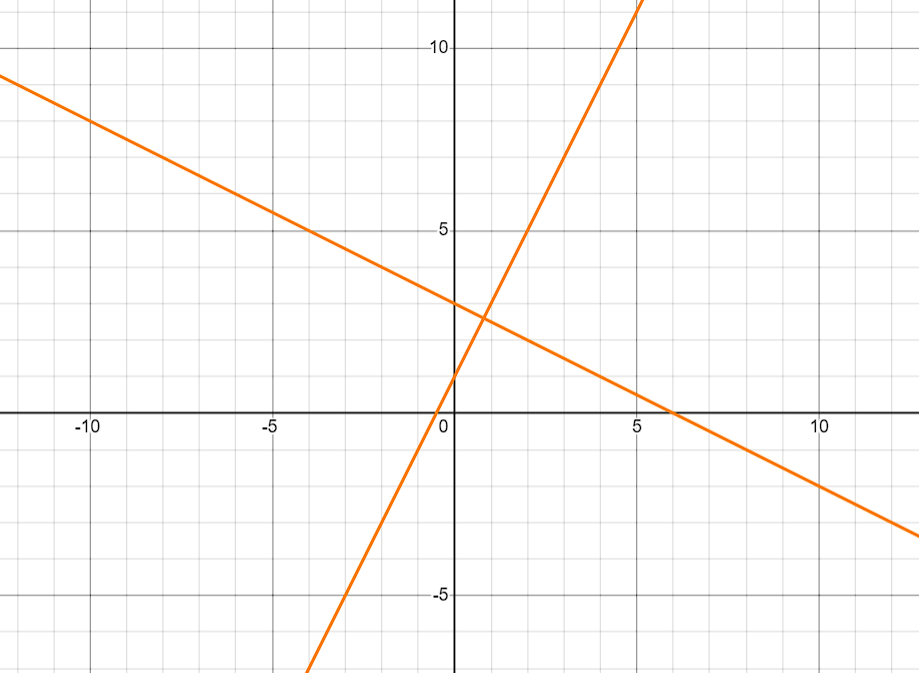
Example 1: Finding Perpendicular Lines Using Slope
Equations of the lines:
- Line 1:
- Line 2:
Step 1: Find the Slope of Each Line
- For Line 1: The equation is in slope-intercept form, where the slope is the number in front of . So, the slope of Line 1 is .
- For Line 2: The equation is also in slope-intercept form, and the slope .
Step 2: Check the Relationship Between the Slopes
- Multiply the slopes together: . Since the product of the slopes is -1, these lines are perpendicular. This confirms that they will meet at a right angle.
Alternatively, you can use the "flip it and change the sign" method:
- The slope of Line 1 is 2.
- Flip it to get and change the sign to -1/2, which is the slope of Line . This shows that the lines are perpendicular.
Note
Example 2: Spotting Perpendicular Lines on a Graph
Let's say you're looking at a graph with two lines and you want to check if they are perpendicular.
Step 1: Look for a Right Angle
Perpendicular lines will cross each other at a 90-degree angle. Look at the point where the lines meet—do they form an "" shape? If they do, the lines are perpendicular.
Step 2: Visual Check
Make sure the lines don't just look close to perpendicular—check to see if they form an exact right angle. If they do, the lines are perpendicular.
Key Points to Remember
- Slopes Multiply to -1: Perpendicular lines have slopes that, when multiplied together, give -1. An easy way to remember this is to "flip it and change the sign."
- Right Angles: On a graph, perpendicular lines always meet at a 90-degree angle.
- Visual Cues: When looking at a graph, perpendicular lines will form an "" shape where they meet.
Practice Identifying Perpendicular Lines
To get comfortable with this concept, try identifying perpendicular lines by finding their slopes and checking how they look on a graph. With practice, you'll be able to spot perpendicular lines quickly and easily!