Axes of Symmetries of Shapes (Junior Cert Mathematics): Revision Notes
📚Revision Notes
Axes of Symmetry
Axes of symmetry refer to the lines that divide a shape into two identical parts, such that one side is the mirror image of the other. If you can fold a shape along a line, and both halves match up perfectly, that line is an axis of symmetry.
Different shapes have different numbers of axes of symmetry depending on their sides and angles. Let's explore the axes of symmetry for some common shapes:
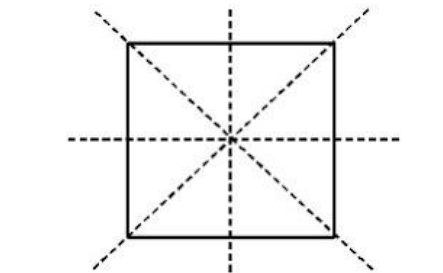
Square
A square has four axes of symmetry. These include two lines that cut through the middle of the square horizontally and vertically, as well as two diagonal lines that go from corner to corner.
Rectangle
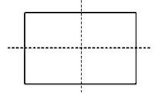
A rectangle has two axes of symmetry. These are the lines that cut through the middle of the rectangle horizontally and vertically.
Triangle
-
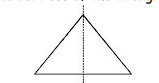
Isosceles Triangle: An isosceles triangle has one axis of symmetry, which is the line that cuts through the vertex opposite the base and bisects the base into two equal parts.
-
Equilateral Triangle: If the triangle were equilateral (all sides and angles equal), it would have three axes of symmetry. These axes would each go through a vertex and bisect the opposite side.
Circle
A circle has an infinite number of axes of symmetry. You can draw a line through the centre of a circle at any angle, and it will always divide the circle into two identical halves.
