Melodic Features (Junior Cert Music): Revision Notes
📚Revision Notes
Melodic Features
Note
Melodic features describe specific elements of a melody that can be identified by listeners.
What is Melody?
-
Melody is a series of pitches (notes) played one after another to create a musical tune.
-
Melodies are based on scales and follow patterns.
-
The shape of a melody is called its contour.
-
Melodies move in different ways.
-
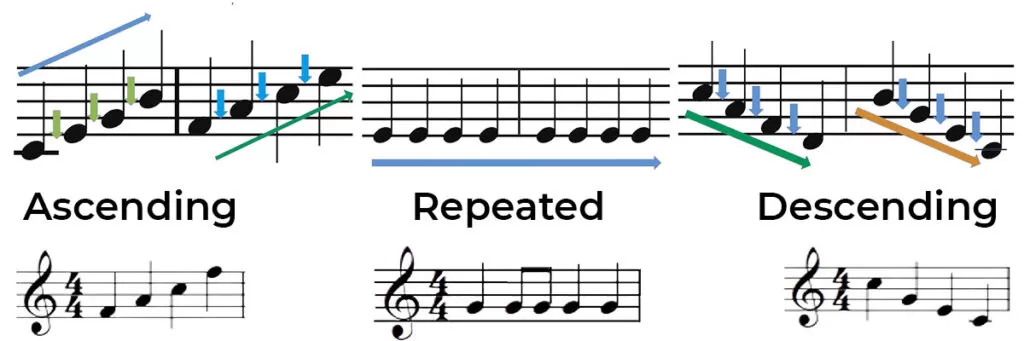
Repeated notes are heard when the same pitch is used several times in succession.
-
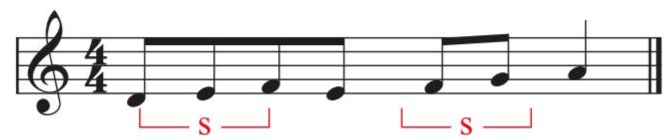
Stepwise movement is when the pitches of a melody move from one note to the next by just one step up or down.
-
Leaps are when the notes of the melody skip to, or jump up or down to a pitch that is more than one note away.

-
When melodies move by step or by leap, they are moving up or down.
-
Ascending melody: If the pitches of a melody are moving upwards from one note to the next, we have an ascending melody.
-
Descending melody: If the pitches of a melody are moving downwards from one note to the next, we have a descending melody.
-
Programme music is instrumental music composed to express an emotion, create a mood or portray a character or an aspect of nature.
-
A motif is a short, memorable musical idea that is repeated and developed throughout a piece of music.
Identifying Melodic Features in Music
- Listen carefully to the shape and movement of the melody.
- Sing the melody and notice if it moves stepwise or in leaps.
- Look at the notation:
- Notes close together? → Stepwise motion.
- Big gaps? → Leaps.
- Same notes? → Repeated notes.
Melodic Range
- Melodic range is the distance between the lowest note and the highest note in a melody.
- We describe the range in terms of the interval between these notes.
- A wide range means the notes are far apart (e.g. more than an octave).
- A narrow range means the notes are close together, with only a few steps between them.
Note
- A great example of a wide melodic range is "Bohemian Rhapsody" by Queen.
- The melody moves from very low to very high notes, with dramatic vocal leaps and pitch changes. This gives the song a powerful and expressive sound.
- "Bad Guy" by Billie Eilish has a narrow melodic range.
- The melody stays within a small range, using mostly small steps and a soft, rhythmic vocal style. This creates a cool, relaxed, and understated effect.
Melodic Sequences
- A melodic sequence is when a short musical idea is repeated, but each time it is played at a higher or lower pitch.
- Although the rhythm and shape stay the same, the pitch changes. This creates a sense of movement and helps make the melody more memorable and interesting.
- Melodic sequences are often used in both classical and popular music to develop a motif or theme.
Example
- In "Do-Re-Mi" from The Sound of Music, the melody moves up the scale using a repeating pattern. Each phrase is similar in rhythm and shape but starts on a higher pitch each time:
"Do, a deer, a female deer"
"Re, a drop of golden sun"
"Mi, a name I call myself"
- This is a clear example of a melodic sequence — the musical idea is repeated and shifted higher each time.
Melodic Ornamentation
- Melodic ornamentation is when extra notes, called ornaments, are added to a melody to make it more interesting, decorative or expressive.
Types of Melodic Ornamentation:
Trill
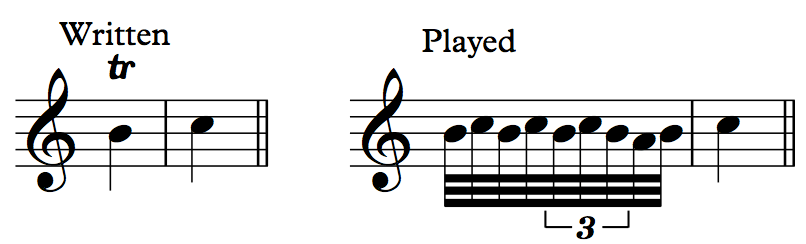
- A trill is a rapid alternation between a note and the one just above it in pitch. It creates a shaking or quivering sound.
- Trills are written using the symbol "tr" above the note.
- They are commonly used on woodwind and string instruments.
- Example: A trill on D would alternate quickly between D and E.
Glissando
- A glissando is a slide or rapid run from one note to another, passing through all the notes in between.
- It is shown as a diagonal line or a wavy line between two notes.
- Often heard on trombone, harp, or piano.
- It creates a smooth, flowing effect — like gliding across the keys.

Grace Note
- A grace note is a very short note added just before a main note to decorate it.
- It is written smaller than normal notes, with a slash through the stem.
- Grace notes are not counted as part of the main beat in the time signature.
- They are played quickly before the main note and do not take up one of the regular beats of the bar.

Note
Key Terms:
- Repeated notes are heard when the same pitch is used several times in succession.
- Stepwise movement is when the pitches of a melody move from one note to the next by just one step up or down.
- Leaps are when the notes of the melody skpi to, or jump up or down to a pitch that is more than one note away.
- Ascending melody: If the pitches of a melody are moving upwards from one note to the next, we have an ascending melody.
- Descending melody: If the pitches of a melody are moving downwards from one note to the next, we have a descending melody.
- Illustrative music is instrumental music composed to express an emotion, create a mood or portray a character or an aspect of nature.
- A motif is a short, memorable musical idea that is repeated and developed throughout a piece of music.