Pitch, Solfa and Intervals (Junior Cert Music): Revision Notes
📚Revision Notes
Pitch, Solfa and Intervals
Note
Pitch describes how high or low a sound is.
What is Pitch?
- Pitch describes how high or low a sound is.
- Instruments that can play melodies are called pitched instruments (e.g., violin, flute, piano).
- High notes are placed higher on the stave, and low notes are placed lower.
- Pitch can move up and down.
Note
A melody is a pattern of pitches that makes a tune.
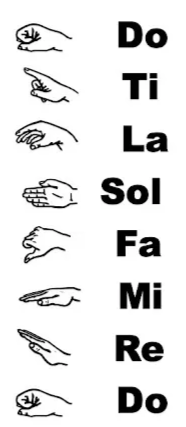
Solfa (Do-Re-Mi)
Note
Solfa is a method of learning and reading music. It assigns seven syllables—Do, Re, Mi, Fa, Sol, La, Ti—to the notes of a scale.
- Solfa (also called Tonic Solfa) is a way to name notes in a scale using syllables.
- It helps musicians sing, understand, and play melodies in any key.
What is an Interval?
- An interval is the distance in pitch between two notes. It tells us:
- How far apart the notes are
- What the relationship between them sounds like
- If the notes are played one after another, the interval is called melodic.
- If the notes are played at the same time, the interval is called harmonic.
Naming Intervals
Intervals are named using two parts:
- Number – This tells us how many letter names are between the two notes.
- Quality – This tells us whether the interval is major, minor, perfect, augmented, or diminished.
Step 1: Counting the Number
To find the number of an interval, count both notes and everything in between.
Examples:
- C to E → Count: C (1), D (2), E (3) → This is a 3rd.
- G to D → Count: G (1), A (2), B (3), C (4), D (5) → This is a 5th.
Step 2: Finding the Quality
The quality depends on how many semitones (half steps) are between the notes.
- Perfect Intervals: Unison, 4th, 5th, and Octave
- Major & Minor Intervals: 2nds, 3rds, 6ths, and 7ths
- Augmented & Diminished Intervals: When we raise a perfect or major interval, it becomes augmented. When we lower a perfect or minor interval, it becomes diminished. | Interval Type | Semitones | Example (C as the first note) | |---|---|---| | Perfect Unison (P1) | 0 | C • C | | Minor 2nd (m2) | 1 | C • C# | | Major 2nd (M2) | 2 | C • D | | Minor 3rd (m3) | 3 | C • Eb | | Major 3rd (M3) | 4 | C • E | | Perfect 4th (P4) | 5 | C • F | | Augmented 4th (A4) / Diminished 5th (d5) (Tritone) | 6 | C • F# | | Perfect 5th (P5) | 7 | C • G | | Minor 6th (m6) | 8 | C • Ab | | Major 6th (M6) | 9 | C • A | | Minor 7th (m7) | 10 | C • Bb | | Major 7th (M7) | 11 | C • B | | Perfect Octave (P8) | 12 | C • C (higher) |