Staff Notation (Junior Cert Music): Revision Notes
📚Revision Notes
Staff Notation
What is the Stave?
-
The stave is a set of five horizontal lines with four spaces in between.
-
These lines and spaces are used in music notation to show different pitches (high and low sounds).

-
Notes are placed on the lines or in the spaces of the stave.
-
Each line and space represents a different pitch.
-
We read music from left to right on the stave, which shows the order of notes over time.
-
Notes placed higher up on the stave sound higher in pitch, while notes lower down sound lower in pitch.
How Do Notes Sit on the Stave?
- Notes on a line – The note head sits on a line, and the line passes through the centre of the note.
- Notes in a space – The note head sits between two lines without crossing them.
Note
History of the Stave
The system of music notation using a stave was developed by Guido of Arezzo, an eleventh-century monk.
- He invented a method of placing symbols on lines and spaces to help singers learn Gregorian chant.
- Over time, his system was expanded to include five lines, forming the stave we use today.
- He also introduced the use of clefs to indicate starting pitches.
The Treble Clef (G Clef)
- A clef is a symbol at the start of a stave that tells musicians where to find specific pitches.
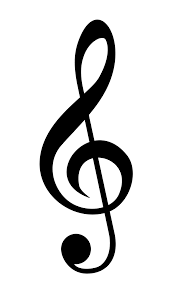
- The treble clef (𝄞) is the most common clef.
- It is also known as the G clef because it spirals around the second line of the stave, which shows the pitch G.
- Notes placed on the stave take their names from the musical alphabet.
- There are seven letters in the musical alphabet: A, B, C, D, E, F, G.
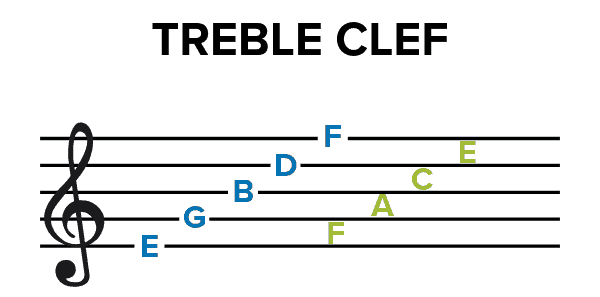
- In the treble clef (𝄞), these pitches are arranged in a specific order on the lines and spaces of the stave:
- The five lines (from bottom to top): E - G - B - D - F (Remember: "Every Good Boy Deserves Fruit")
- The four spaces (from bottom to top): F - A - C - E (Spells "FACE")
The Double Barline
-
A double barline is two vertical lines at the end of a piece of music.
-
The second line is thicker and marks the end of the piece.

-
Other double barlines may appear during a piece to show a new section or key change.