Compound Time (Junior Cert Music): Revision Notes
📚Revision Notes
Compound Time
Note
Review - Time Signatures
- A time signature indicates how many beats there are in each bar of music and what type of beats these are.
- The top number of the time signature tells us how many beats there are in each bar.
- The bottom number of the time signature tells us what type of beats they are.
- Compound time is a type of time signature where each beat is divided into three equal parts.
- What does that mean?
- In simple time, each beat divides into two (e.g. 1 & 2 &).
- In compound time, each beat divides into three (e.g. 1 la le, 2 la le).
- This gives compound time a "lilting" or "bouncy" feel — often heard in jigs, lullabies, and dances.
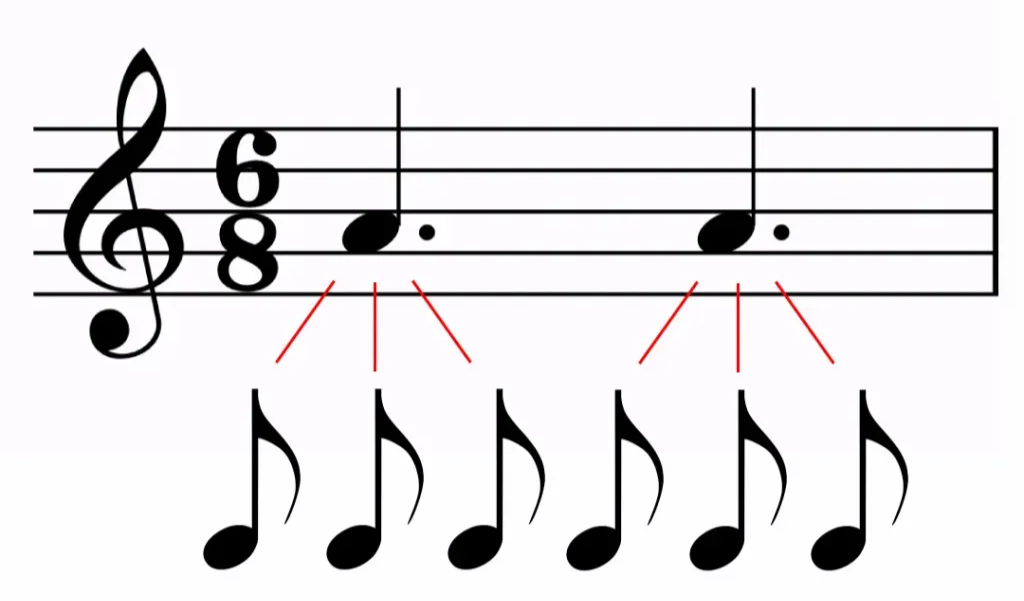
How does it work?
- In compound time each beat is a dotted note.
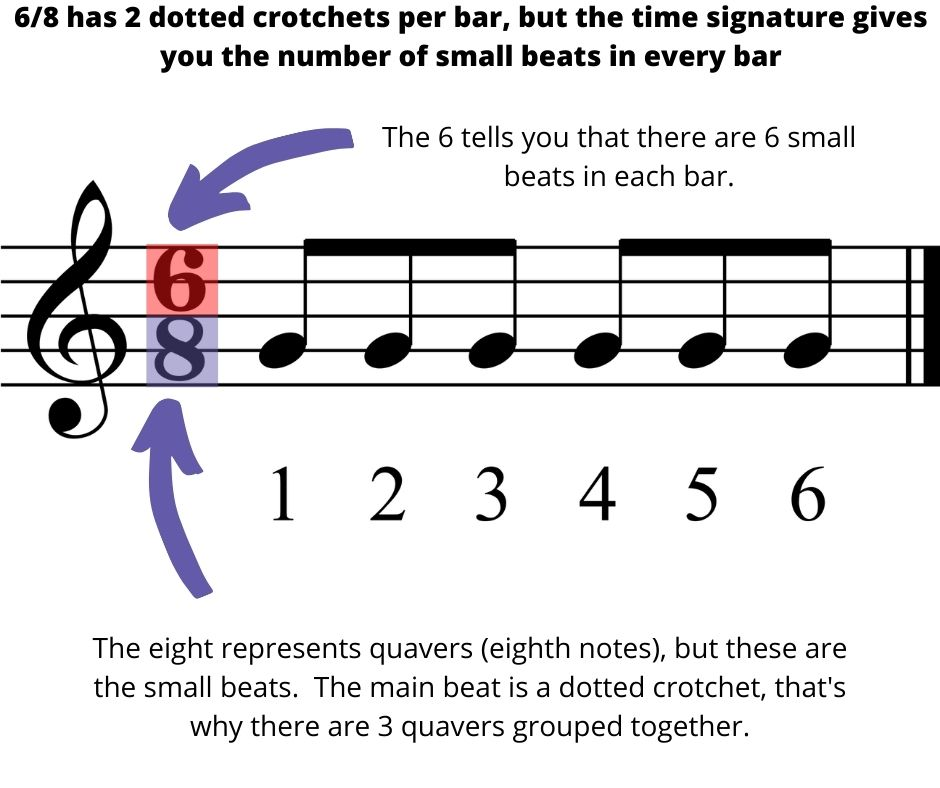
- The most common compound time signature is 6/8.
- This tells us that there are six quavers in each bar.
- These quavers are grouped in threes, so each beat is a dotted crotchet.
- Each dotted crotchet beat can be divided into three quavers or six semiquavers.
- Other compound time signatures include
- 9/8 - three dotted crotchet beats per bar.
- 12/8 - four dotted crotchet beats per bar.
- As you can see, the top number can always be divided by three in compound time.
Real-Life Example:
- Jigs in traditional Irish music are in 6/8 time.
- The rhythm feels like: "jig-i-ty, jig-i-ty"