Conducting (Junior Cert Music): Revision Notes
📚Revision Notes
Conducting
- A conductor is a musician who leads a group of performers, such as an orchestra, choir or band. They use hand gestures and movements to communicate the beat (pulse) and guide musicians through a piece of music.
- Conducting takes skill and practice to ensure all performers stay in time and follow the correct dynamics, tempo, and phrasing.
- Music is written on a stave, divided into sections by barlines.
- These sections are called bars or measures, and the number of beats in each bar is determined by the time signature.
- A time signature consists of two numbers placed at the start of a piece—the top number tells how many beats are in each bar, while the bottom number tells the type of beat.
- A conductor follows the time signature by using a specific hand pattern to indicate the beats in each bar.
- This ensures that all musicians play together, keeping the music structured and expressive.
Conducting Patterns
There are three basic patterns for conductors to master: the Two, Three, and Four patterns.
Before we begin, remember:
- The importance of the upbeat – this is a preparatory 'get ready' movement for musicians to know when a new bar is about to begin.
- The horizontal line – an imaginary but important guide for musicians following the conductor.
Common Time Signatures
The most common time signatures are:
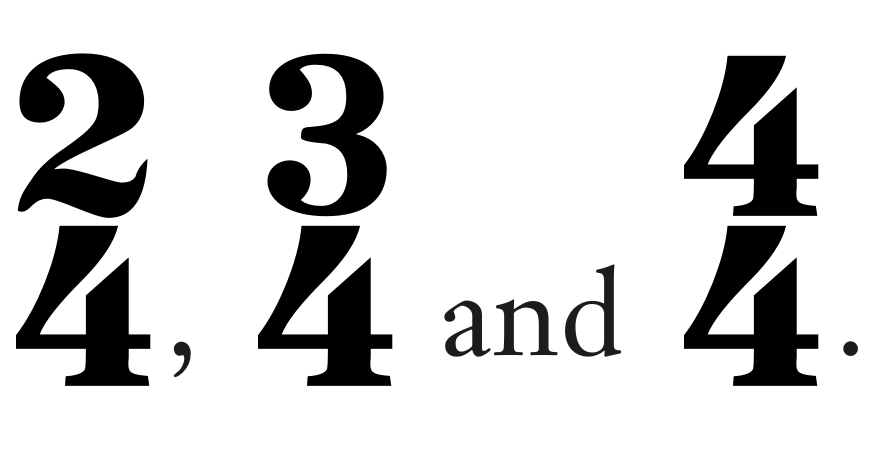
- The Two, Three, and Four conducting patterns are used to lead pieces of music in these time signatures.
- The grid below shows how each time signature is counted. Counting the pulse aloud will help you understand these time signatures.
Note
Emphasise the number 1s – this is the first beat of each bar.
| Time Signature | Beats per Bar | Counting the Pulse |
|---|---|---|
| 2/4 | 2 beats per bar | 1 2 1 2 1 2 1 2 |
| 3/4 | 3 beats per bar | 1 2 3 1 2 3 1 2 3 |
| 4/4 | 4 beats per bar | 1 2 3 4 1 2 3 4 1 2 3 4 |
Conducting Movements
Here are the three patterns:
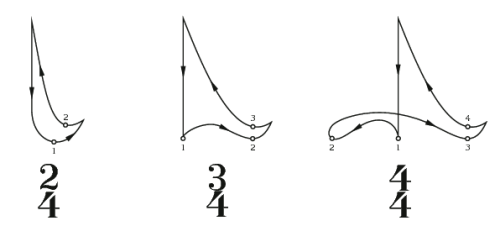
- Each time signature has a unique conducting pattern to show the musicians where each beat falls.
- The conductor's hand movements clearly indicate the strong beats (1) and weaker beats to help performers stay in time.