Structure of the Atom (Junior Cert Science): Model Answers
📚Model Answers
Atomic Structure and Electron Configuration
Sample Answer
Question 3
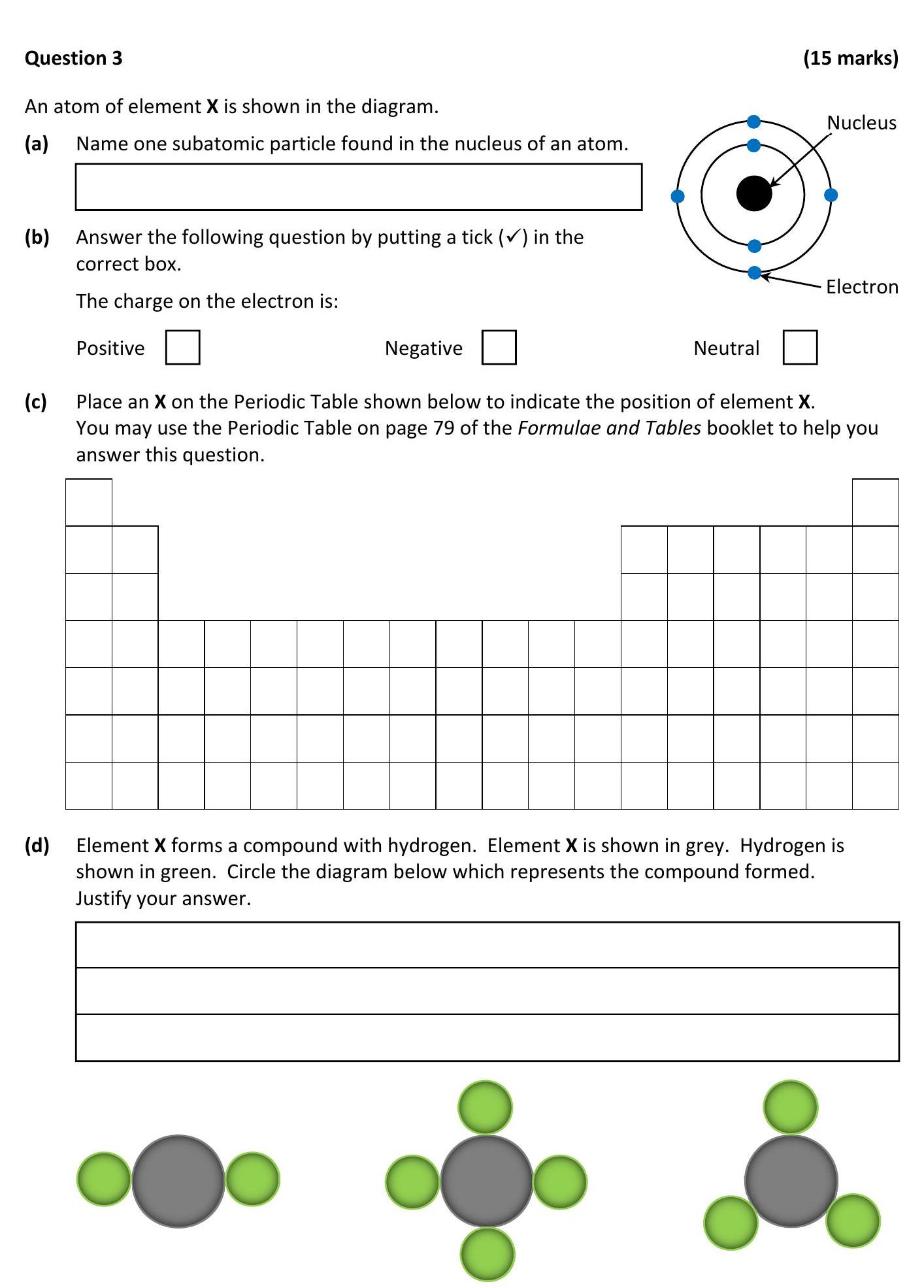
(a) Name one subatomic particle found in the nucleus of an atom.
Answer
Proton
Note
[3/3 Marks] This answer is correct as a proton is one of the subatomic particles found in the nucleus of an atom. According to the marking scheme, "proton / neutron / nucleon" are all acceptable answers.
(b) Answer the following question by putting a tick (✓) in the correct box. The charge on the electron is:
Answer
Negative ✓
Note
[3/3 Marks] This is the correct answer as electrons carry a negative electrical charge, which is a fundamental property of this subatomic particle.
(c) Place an X on the Periodic Table shown below to indicate the position of element X.
Answer
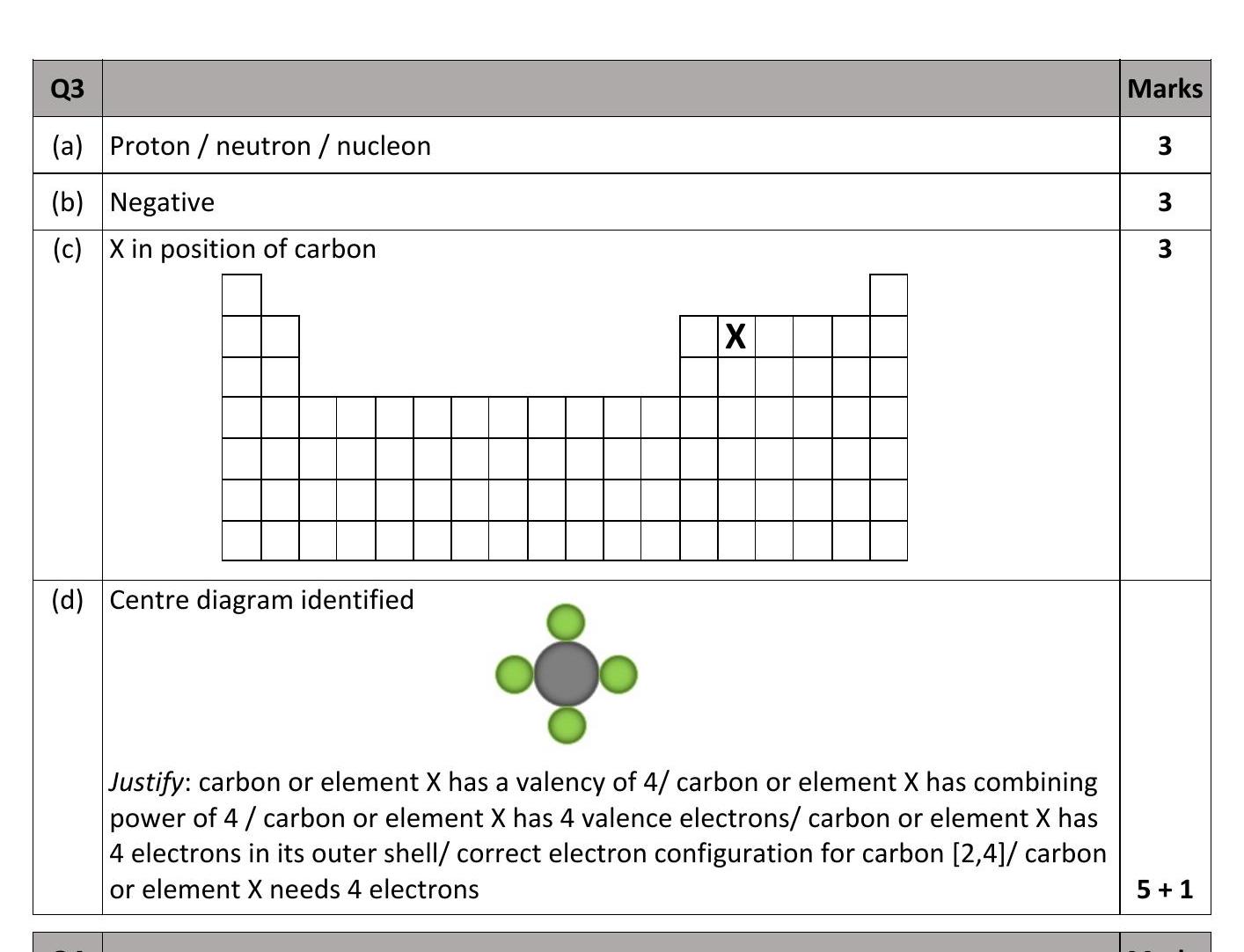
Element X should be placed in the position of carbon (C), which is in Group 14 (or IV) and Period 2.
Note
[3/3 Marks] According to the marking scheme, X should be placed in the position of carbon on the periodic table. This is correct based on the electronic structure shown in the diagram and the compound formation with hydrogen shown in part (d).
(d) Element X forms a compound with hydrogen. Element X is shown in grey. Hydrogen is shown in green. Circle the diagram below which represents the compound formed.
Answer
The centre diagram should be circled.
Justification: Carbon (element X) has a valency of 4, meaning it forms 4 bonds with other elements. In the centre diagram, the grey atom (carbon) is bonded to 4 hydrogen atoms (green), creating methane (CH₄). This is the correct structure because carbon has 4 electrons in its outer shell and forms 4 covalent bonds to achieve a stable electron configuration.
Note
[6/6 Marks] The answer correctly identifies the middle diagram and provides proper justification that carbon has a valency of 4. The marking scheme accepts explanations about carbon having 4 valence electrons, a valency of 4, forming 4 bonds, or having the electron configuration [2,4].
Marking Scheme