Structure of the Atom (Junior Cert Science): Revision Notes
📚Revision Notes
Structure of the Atom
What is an atom?
An atom is the smallest particle of an element that still has all the properties of that element. Everything around us is made up of millions of tiny atoms. Even though atoms are incredibly small, scientists have discovered that they have their own internal structure made up of even smaller particles.
Note
Atoms are so small that if you lined up 100 million atoms side by side, they would only measure about 1 centimetre! Despite their tiny size, each atom has a complex internal structure with different types of particles working together.
Subatomic particles
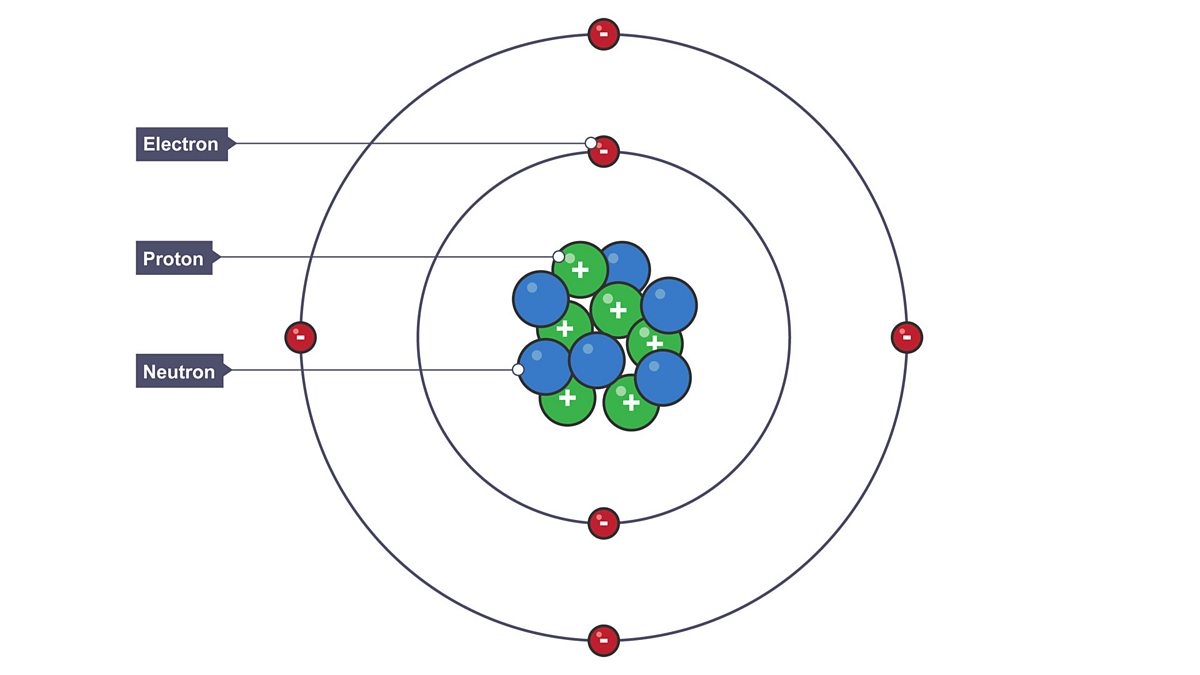
Atoms contain three different types of tiny particles called subatomic particles. Each type of particle has its own special properties and location within the atom.
The three types of subatomic particles
Protons are particles that carry a positive electrical charge. They are found at the centre of the atom in a region called the nucleus. Protons are relatively heavy particles compared to electrons.
Neutrons are particles that have no electrical charge – they are neutral. Like protons, neutrons are also located in the nucleus at the centre of the atom. Neutrons have approximately the same mass as protons.
Electrons are particles that carry a negative electrical charge. Unlike protons and neutrons, electrons are found outside the nucleus in a region called the electron cloud. Electrons are extremely light particles – much lighter than protons or neutrons.
Important
Remember the charges with PEN:
- Protons are Positive ()
- Electrons are nEgative ()
- Neutrons are Neutral ()
Properties of subatomic particles
The table above summarises the key properties of each subatomic particle. Let's look at these properties in more detail.
Location in the atom
The atom has two main regions:
- The nucleus is the central core of the atom where protons and neutrons are found. The nucleus is very small compared to the overall size of the atom. If an atom were the size of a sports pitch, the nucleus would be like a marble at the centre.
- The electron cloud is the region surrounding the nucleus where electrons move around in paths called orbits or shells. This region takes up most of the space in an atom.
Note
Size comparison: Most of an atom is actually empty space! The nucleus contains nearly all the mass but takes up only a tiny fraction of the atom's volume. The electrons orbit in the vast space around it, similar to how planets orbit the sun.
Relative mass
The relative mass tells us how heavy each particle is compared to the others.
- Protons have a relative mass of unit
- Neutrons have a relative mass of unit
- Electrons have a relative mass of unit
This means that protons and neutrons have approximately the same mass, while electrons are much, much lighter. In fact, an electron has only of the mass of a proton!
Important
Because electrons are so light compared to protons and neutrons, we usually ignore their mass when calculating the mass of an atom. Nearly all of an atom's mass comes from the protons and neutrons in the nucleus.
Relative charge
The relative charge tells us about the electrical charge on each particle.
- Protons have a relative charge of (positive)
- Electrons have a relative charge of (negative)
- Neutrons have a relative charge of (no charge)
Atoms are normally electrically neutral overall. This is because they contain equal numbers of protons and electrons, so the charges balance out and cancel each other.
Atomic number
Every element has its own unique atomic number. The atomic number tells us the number of protons in the nucleus of an atom of that element.
Example
Identifying Elements by Atomic Number
All carbon atoms have protons in their nucleus, so carbon has an atomic number of .
All aluminium atoms have protons, so aluminium has an atomic number of .
The atomic number uniquely identifies each element – no two elements have the same atomic number!
The atomic number is very important because it identifies which element an atom belongs to. If you know the atomic number, you know the element.
Since atoms are electrically neutral, the number of electrons must equal the number of protons. This means:
Mass number
The mass number of an atom tells us about the total mass of particles in the nucleus. Since nearly all of an atom's mass comes from protons and neutrons, the mass number is calculated by adding these together:
Example
Calculating Mass Number
If an atom has protons and neutrons, its mass number is:
This atom would have a mass of atomic mass units.
We use a special unit called the atomic mass unit (amu) to measure atomic masses. The mass number tells us the mass of an atom in atomic mass units.
Calculating the number of neutrons
If you know the mass number and the atomic number of an atom, you can calculate how many neutrons it has. Simply rearrange the mass number formula:
Note
Exam tip: If you find it difficult to remember this formula, just remember that the mass number is always bigger than the atomic number, so you subtract the smaller number (atomic number) from the larger number (mass number) to find the number of neutrons.
You can also remember: MAN - Mass minus Atomic gives Neutrons!
Nuclear formula
Scientists use a special notation called the nuclear formula to write down information about an atom. The nuclear formula shows both the mass number and the atomic number:
- The mass number is written at the top left of the element symbol
- The atomic number is written at the bottom left of the element symbol
Example
Reading Nuclear Formula for Aluminium
The nuclear formula for aluminium is written as:
This tells us:
- The element is aluminium (Al)
- The mass number is (top number)
- The atomic number is (bottom number)
From this information, we can work out:
- Aluminium has protons (from the atomic number)
- Aluminium has electrons (same as number of protons)
- Number of neutrons: neutrons
Structure of the first 10 elements
Let's look at how the atomic structure varies for the first elements in the periodic table:
| Element | Atomic number | Number of protons | Number of electrons | Mass number | Number of neutrons |
|---|---|---|---|---|---|
| H | |||||
| He | |||||
| Li | |||||
| Be | |||||
| B | |||||
| C | |||||
| N | |||||
| O | |||||
| F | |||||
| Ne |
Note
Notice the patterns in this table:
- The atomic number increases by one for each element
- The number of protons always equals the atomic number
- The number of electrons always equals the number of protons
- The number of neutrons is calculated by subtracting the atomic number from the mass number
Remember!
Summary
Key Points to Remember:
-
Atoms contain three types of subatomic particles: protons (positive, in nucleus), neutrons (neutral, in nucleus), and electrons (negative, in electron cloud)
-
Protons and neutrons have approximately the same mass ( unit), while electrons are much lighter ( unit)
-
The atomic number equals the number of protons, which also equals the number of electrons in a neutral atom
-
The mass number is the sum of protons and neutrons in the nucleus
-
To find the number of neutrons: subtract the atomic number from the mass number
-
The nuclear formula shows the mass number (top) and atomic number (bottom) alongside the element symbol