Rates of Reactions (Junior Cert Science): Revision Notes
📚Revision Notes
Rates of Reactions
Introduction to chemical reaction rates
Chemical reactions happen all around us, but they don't all occur at the same speed. Some reactions are incredibly fast, whilst others take a very long time to complete.
Note
The speed of chemical reactions varies enormously - from explosions that happen in fractions of a second to processes like rusting that take years. Understanding what controls these speeds is one of the most important aspects of chemistry.
Examples of reaction speeds:
- Very fast reactions: Explosions produce a large volume of gas in a fraction of a second. When hydrogen gas is ignited, a chemical reaction occurs almost instantly, creating a loud bang.
- Slow reactions: Other changes occur much more slowly. For example, an apple ripening, concrete setting, or iron rusting can take hours, days, or even longer.
Understanding what controls the speed of chemical reactions is essential in chemistry. It helps us make reactions happen faster when we need them to, or slow them down when that's more useful.

What is rate of reaction?
The rate of reaction tells us how quickly a chemical reaction occurs. We can think of it like the speed of a car - just as speed measures how fast a car travels, rate measures how fast a reaction proceeds.
Important
Definition of Rate of Reaction:
The rate of reaction is the change in concentration of any one reactant or product per unit time. In simpler terms, it measures how much of a substance appears or disappears in a given time period.
We can write this as:
This is similar to how we calculate the speed of a moving object:
For example, if a car travels metres in seconds, it has an average speed of .
Measuring rate of reaction
To measure how fast a reaction occurs, we need to track how the concentration of reactants or products changes over time. There are several ways to do this:
- Measuring gas volume - If a gas is produced, we can collect it and measure its volume at regular time intervals
- Measuring mass change - If a gas escapes, the total mass decreases, which we can measure
- Observing colour changes - Some reactions produce coloured products we can monitor
Example
Example: Measuring oxygen gas production
Consider the decomposition of hydrogen peroxide, which produces oxygen gas:
hydrogen peroxide → water + oxygen
We collect the oxygen gas in a graduated cylinder and measure its volume at regular time intervals (for example, every seconds).
Understanding rate graphs
When we plot the volume of gas produced against time, we get a graph that tells us a lot about the reaction.
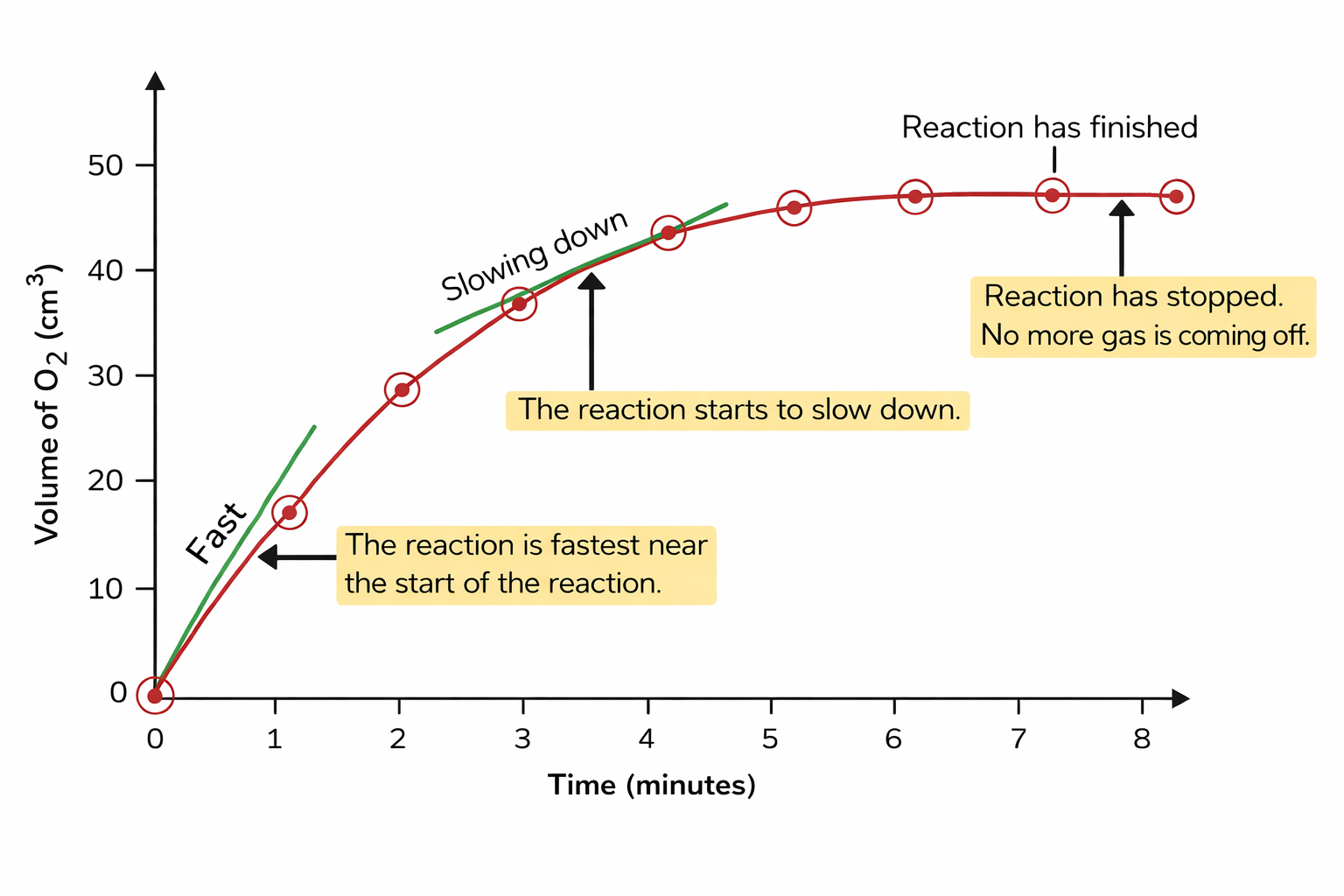
Key features of a rate graph:
- Steepest at the start - The reaction is fastest near the beginning because there are lots of reactant particles available to react
- Gradually levels off - The reaction slows down as reactants get used up, so there are fewer particles available to collide and react
- Reaches a plateau - The reaction has finished when no more gas is being produced. The line becomes flat (horizontal)
Note
The steepness of the slope (gradient) tells us how fast the reaction is occurring. A steep slope means a fast reaction, whilst a gentle slope indicates a slow reaction.
Average rate of reaction
We often want to know the overall speed of a reaction. To find this, we calculate the average rate.
Example
Worked Example: Calculating Average Rate
For the hydrogen peroxide example, if cm³ of oxygen was produced and the reaction took minutes:
This tells us that, on average, cm³ of oxygen was produced every minute.
Factors that affect the rate of a reaction
Through experiments, chemists have discovered that five main factors control how fast chemical reactions occur:
- Types of reactants - different substances react at different speeds
- Particle size (surface area) - smaller particles react faster
- Concentration - more concentrated solutions react faster
- Temperature - hotter reactants react faster
- Catalysts - special substances that speed up reactions
Let's investigate each factor in detail.
Factor 1: Types of reactants
Different substances react at different rates, even when reacting with the same chemical. This is because different elements and compounds have different chemical properties.
Experiment: Comparing magnesium and zinc
We can investigate this by reacting two different metals with the same acid.
Example
Experiment 22.1: Comparing metal reactivity
Method:
- Add a piece of magnesium ribbon to dilute hydrochloric acid in a flask
- Immediately start timing with a stopcock
- Collect the hydrogen gas produced in an inverted graduated cylinder over water
- Record the volume of hydrogen gas at regular intervals (every seconds)
- Repeat the experiment using zinc metal instead of magnesium
The chemical reactions:
Both metals react with hydrochloric acid to produce hydrogen gas:
magnesium + hydrochloric acid → magnesium chloride + hydrogen
Similarly for zinc:
zinc + hydrochloric acid → zinc chloride + hydrogen
Results:
The volume of hydrogen gas can be recorded in a table:
| Time (mins) | 0 | 0.5 | 1.0 | 1.5 | 2.0 | 2.5 | 3.0 | 3.5 |
|---|---|---|---|---|---|---|---|---|
| Volume of H₂ (cm³) |
When we plot graphs for both metals, we can compare their reaction rates:
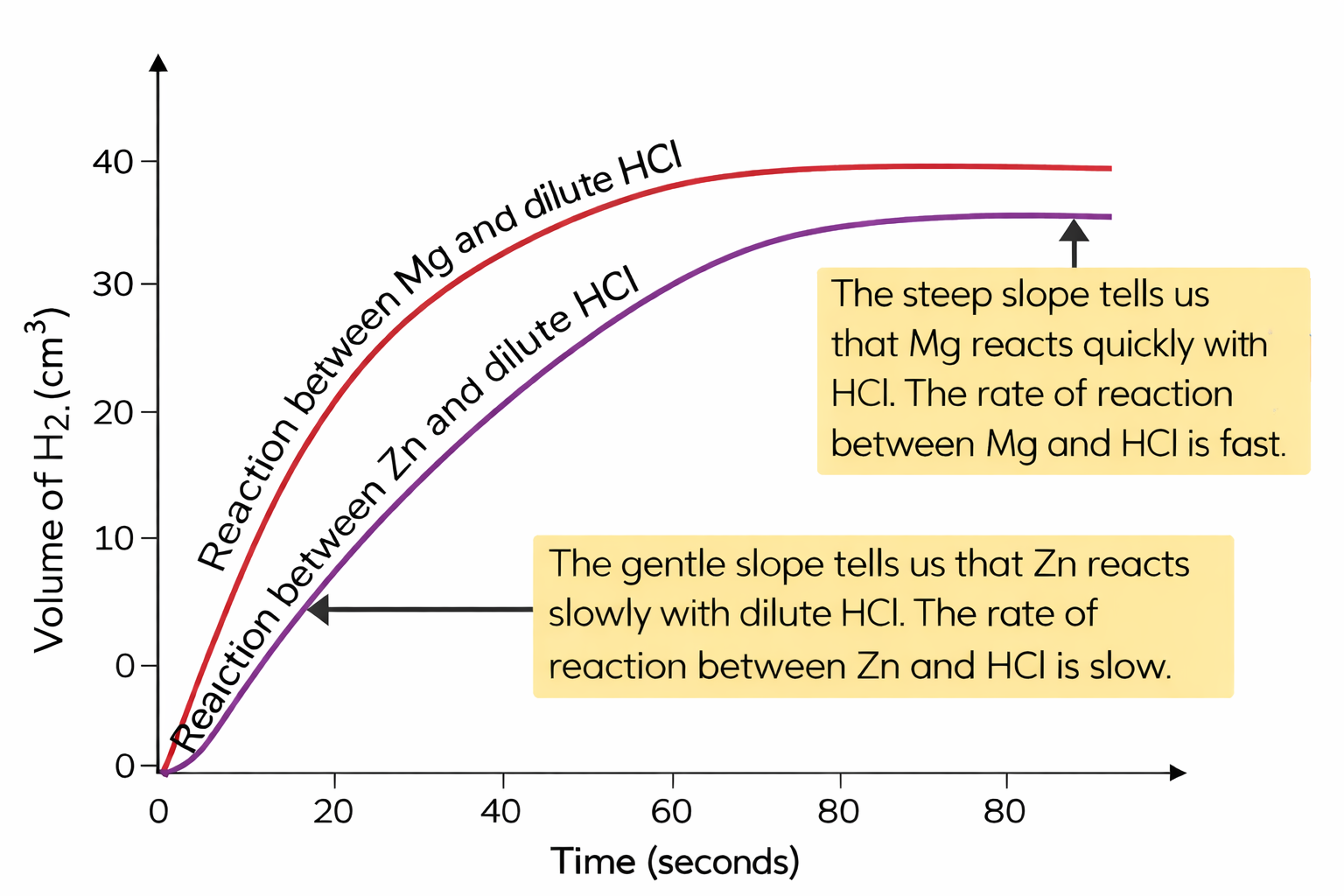
What the graph shows:
- The steep slope for magnesium shows it reacts quickly with dilute hydrochloric acid
- The gentle slope for zinc shows it reacts slowly with dilute hydrochloric acid
- Magnesium is more reactive than zinc, so it reacts much faster with the acid
Important
Conclusion: The type of reactant affects the rate of reaction
We only vary the metal, keeping everything else the same (same acid, same concentration, same temperature). This ensures a fair test - the difference in rate is due solely to the different metals used.
Test for hydrogen gas
To confirm that the gas being produced is hydrogen, we can perform a simple test:
Procedure: Bring a lighted taper (wooden splint) near the mouth of a test tube containing hydrogen gas.
Result: The hydrogen burns with a pop sound. This is a characteristic test for hydrogen gas.
Important
Safety Note: Hydrogen is extremely flammable and can form explosive mixtures with air. Always use small amounts and ensure good ventilation.
Factor 2: Particle size (surface area)
The size of solid reactant particles has a significant effect on reaction rate. Smaller particles react faster than larger ones.
Why does particle size matter?
Chemical reactions happen when particles collide with each other. For a solid to react, particles from another substance (like molecules in a solution) must collide with the solid's surface.
- Large particles have a relatively small surface area exposed to other reactants
- Small particles have a much larger total surface area exposed, allowing many more collisions to occur
Note
Think of it this way: if you break a large piece of wood into smaller pieces, they burn much faster. This is because the total surface area in contact with oxygen in the air is much greater.
Experiment: Marble chips of different sizes
We can investigate how particle size affects reaction rate by reacting marble chips of different sizes with acid.
Background: Marble is mainly calcium carbonate (CaCO₃), which reacts with hydrochloric acid to produce carbon dioxide gas.
calcium carbonate + hydrochloric acid → calcium chloride + water + carbon dioxide
Example
Experiment 22.2: Effect of particle size
Method:
- Place marble chips and hydrochloric acid in a conical flask on an electronic balance
- As the reaction proceeds, carbon dioxide escapes, so the total mass decreases
- Record the total mass at regular intervals
- Calculate the loss in mass at each time interval
- Repeat the experiment using small, medium, and large marble chips
Results:
The data can be recorded in a table:
| Time (mins) | 0 | 0.5 | 1.0 | 1.5 | 2.0 | 2.5 | 3.0 | 3.5 |
|---|---|---|---|---|---|---|---|---|
| Total mass (g) | ||||||||
| Loss in mass (g) |
We can plot two types of graph:
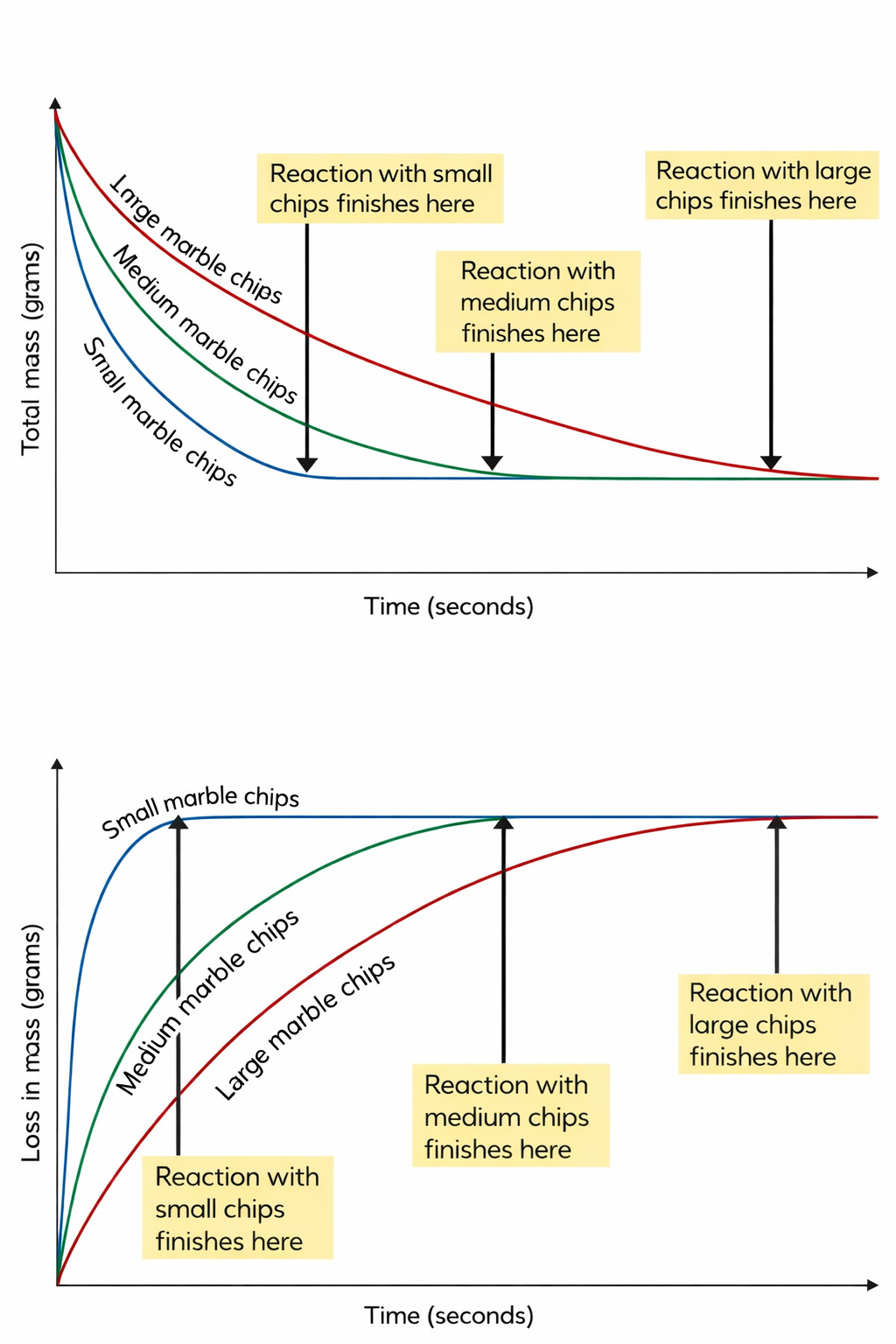
Graph 1: Total mass vs time
- All three curves decrease as carbon dioxide escapes
- Small chips show the steepest decrease (fastest reaction)
- Large chips show the gentlest decrease (slowest reaction)
Graph 2: Loss in mass vs time
- All three curves increase as more mass is lost
- Small chips show the steepest increase (fastest mass loss)
- Large chips show the gentlest increase (slowest mass loss)
Important
Conclusion: The smaller the particle size, the faster the rate of reaction.
This is because smaller particles have a greater surface area in contact with the acid, allowing more frequent collisions between reactant particles.
Test for carbon dioxide
To confirm that carbon dioxide is being produced, we can perform the limewater test:
Procedure: Bubble the gas through limewater (a clear solution of calcium hydroxide).
Result: Carbon dioxide turns limewater milky. This is a characteristic test for carbon dioxide gas.
Factor 3: Concentration
The concentration of a solution tells us how much solute is dissolved in a given volume of solvent. Changing the concentration of reactants affects the reaction rate.
How concentration affects rate
When we increase the concentration of a solution:
- There are more reactant particles in the same volume
- This means particles are more crowded together
- More frequent collisions occur between reactant particles
- The reaction proceeds faster
Experiment: Different concentrations of acid
We can investigate how concentration affects rate by reacting magnesium with hydrochloric acid of different concentrations.
The reaction:
magnesium + hydrochloric acid → magnesium chloride + hydrogen
Example
Experiment 22.3: Effect of concentration
Method:
- Add a known mass of magnesium ribbon to dilute hydrochloric acid of a specific concentration (e.g., M)
- Collect the hydrogen gas produced in an inverted graduated cylinder
- Record the volume of hydrogen at regular intervals until the reaction stops
- Repeat the experiment using different concentrations of hydrochloric acid (e.g., M and M)
- Keep the mass of magnesium and the temperature the same for a fair test
Results:
| Time (mins) | 0 | 0.5 | 1.0 | 1.5 | 2.0 | 2.5 | 3.0 | 3.5 |
|---|---|---|---|---|---|---|---|---|
| Volume of H₂ (cm³) |
When we plot the results:
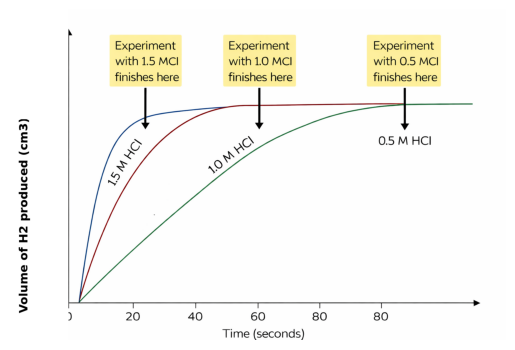
What the graph shows:
- The M HCl (highest concentration) produces the steepest curve - the reaction is fastest
- The M HCl (medium concentration) produces a medium-steepness curve
- The M HCl (lowest concentration) produces the gentlest curve - the reaction is slowest
Note
All three reactions eventually produce the same total volume of hydrogen because the same amount of magnesium is used in each case. However, the higher the concentration, the faster this total volume is reached.
Important
Conclusion: The greater the concentration, the faster the rate of reaction.
This is because a higher concentration means more acid particles are available to collide with magnesium atoms, leading to more frequent successful collisions.
Factor 4: Temperature
Temperature has a dramatic effect on reaction rates. Most chemical reactions occur much faster at higher temperatures.
How temperature affects rate
When we increase the temperature:
- Reactant particles gain more kinetic energy
- They move around faster
- Collisions between particles occur more frequently
- Collisions have more energy, making them more likely to result in a reaction
Note
As a rough rule, many reactions approximately double in speed for every increase in temperature.
Everyday example
Consider food storage: we keep food fresh for longer by storing it in a refrigerator. This is because the chemical reactions that cause food to go bad occur much more slowly at lower temperatures.
Experiment: Reaction at different temperatures
We can investigate how temperature affects rate by carrying out the same reaction at different temperatures.
Example
Experiment 22.4: Effect of temperature
Method:
- Add magnesium ribbon to dilute hydrochloric acid at a known temperature (e.g., using a water bath)
- Immediately start timing
- Record the volume of hydrogen gas produced at regular intervals
- Repeat the experiment at higher temperatures (e.g., and )
- Keep all other factors the same (same mass of magnesium, same concentration and volume of acid)
Safety note:
Important
Hydrochloric acid is corrosive and can cause burns. Handle with care, wear safety goggles, and work in a well-ventilated area.
The reaction:
magnesium + hydrochloric acid → magnesium chloride + hydrogen
Results:
| Time (mins) | 0 | 0.5 | 1.0 | 1.5 | 2.0 | 2.5 | 3.0 | 3.5 |
|---|---|---|---|---|---|---|---|---|
| Volume of H₂ (cm³) |
When we plot the results:
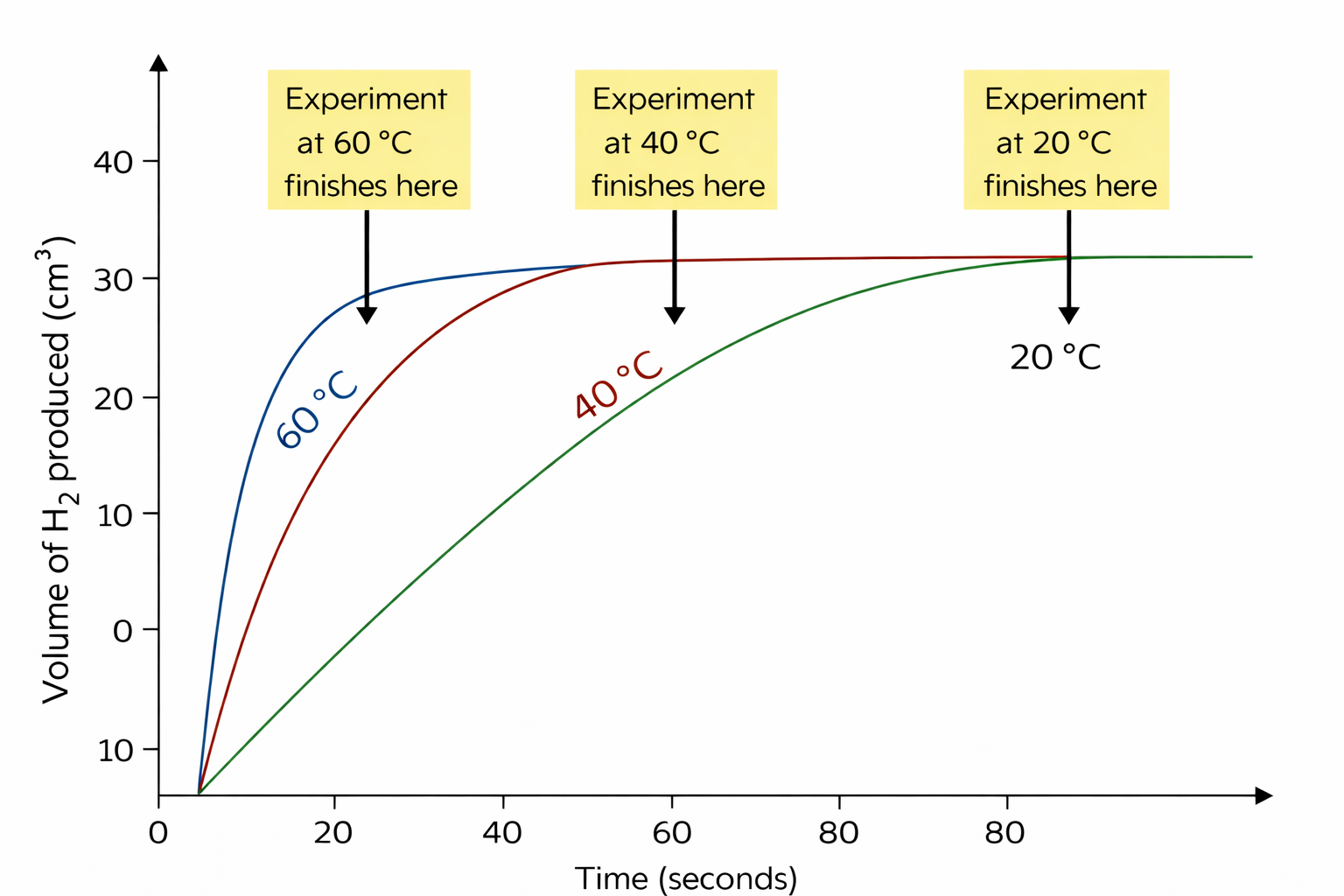
What the graph shows:
- At (highest temperature), the curve is steepest - the reaction is fastest
- At (medium temperature), the curve has a medium steepness
- At (lowest temperature), the curve is gentlest - the reaction is slowest
All three reactions finish when the same total volume of hydrogen has been produced (because we used the same amount of magnesium in each case). However, the reaction at reaches this point much sooner than the reaction at .
Important
Conclusion: The higher the temperature, the faster the rate of reaction.
This is because increased temperature gives particles more energy, resulting in more frequent and more energetic collisions between reactant particles.
Factor 5: Catalysts
A catalyst is a special substance that speeds up a chemical reaction without being used up in the process. This is a very important property - the catalyst is still there at the end of the reaction, unchanged.
Definition
Important
Definition of a Catalyst:
A catalyst is a substance that alters the rate of a chemical reaction but is not used up in the reaction.
Catalysts are incredibly useful in chemistry and industry because:
- They can be used over and over again
- They speed up reactions that would otherwise be too slow
- They can make processes more economical and efficient
Experiment: Effect of a catalyst
We can investigate how a catalyst affects reaction rate by examining the decomposition of hydrogen peroxide.
Background: Hydrogen peroxide naturally breaks down into water and oxygen, but this happens very slowly - it can take several months.
hydrogen peroxide → water + oxygen
However, when we add manganese dioxide (MnO₂) as a catalyst, the reaction speeds up dramatically.
Example
Experiment 22.5: Effect of a catalyst
Method:
- Add a small amount of manganese dioxide to dilute hydrogen peroxide solution in a conical flask
- Immediately start timing as the manganese dioxide comes into contact with the hydrogen peroxide
- Collect the oxygen gas produced in an inverted graduated cylinder over water
- Record the volume of oxygen at regular time intervals until the reaction stops
Results:
| Time (mins) | 0 | 0.5 | 1.0 | 1.5 | 2.0 | 2.5 | 3.0 | 3.5 |
|---|---|---|---|---|---|---|---|---|
| Volume of O₂ (cm³) |
Comparing with and without a catalyst:
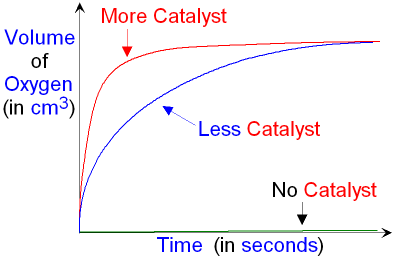
When we compare the decomposition with and without manganese dioxide:
- With catalyst (MnO₂): The reaction is very fast, producing oxygen gas rapidly. The graph shows a steep curve, and the reaction completes in just a few minutes.
- Without catalyst: The decomposition occurs extremely slowly. It would take many months for the hydrogen peroxide to completely break down. The graph would show a very gentle slope.
Note
Important notes about catalysts:
- The manganese dioxide is neither a reactant nor a product. Its formula does not appear in the chemical equation except above the arrow.
- The word "alters" in the definition means catalysts can speed up or slow down reactions, though most catalysts speed them up.
- At the end of the experiment, the manganese dioxide can be recovered and used again.
Important
Conclusion: A catalyst dramatically increases the rate of reaction without being consumed in the process.
Test for oxygen gas
To confirm that oxygen is being produced:
Procedure: Insert a glowing wooden splint (one that has just been blown out) into a test tube containing the gas.
Result: Oxygen relights the glowing splint. This is a characteristic test for oxygen gas.
Note
Oxygen is needed for burning. Pure oxygen allows substances to burn much more vigorously than in air (which is only about oxygen).
Biochemical reactions
Chemical reactions don't just happen in test tubes - thousands of them are occurring in your body right now. These reactions in living organisms are called biochemical reactions.
Definition
Important
Definition of a Biochemical Reaction:
A biochemical reaction is a process that results in the formation of one or more new substances in living cells.
Examples of biochemical reactions
Biochemistry is the branch of science that studies the chemical reactions occurring in living things. Here are some important examples:
- Cellular respiration - This occurs in every living cell. Glucose (a sugar) undergoes biochemical reactions to release energy that the organism can use. This process is essential for life.
- Photosynthesis - This occurs in green plants. Carbon dioxide and water react in the presence of sunlight to form glucose molecules. This process provides food for plants and produces the oxygen we breathe.
- Digestion - This occurs in our digestive system. Large food molecules are broken down into smaller substances that our bodies can use for energy, growth, and repair.
Enzymes: Biological catalysts
Biochemical reactions are controlled by special proteins called enzymes. An enzyme is a biological catalyst - it speeds up biochemical reactions without being used up.
Key properties of enzymes:
- They are very specific - each enzyme catalyses only one particular reaction
- The substance an enzyme acts on is called the substrate
- They work best at particular temperatures and pH levels
- Like all catalysts, they are not consumed in the reaction
Example
Example: Catalase enzyme
An enzyme called catalase speeds up the decomposition of hydrogen peroxide. Catalase is found in the liver and many other living tissues. When liver is placed in hydrogen peroxide solution, oxygen gas is rapidly produced as the enzyme breaks down the peroxide.
Factors affecting biochemical reactions
The rates of biochemical reactions are affected by several factors:
- Concentration of enzymes and substrates - higher concentrations generally increase the rate
- Temperature - biochemical reactions typically occur best at body temperature (around for humans). If temperature is too high, enzymes can be damaged (denatured) and stop working
- pH - many enzymes work only within specific pH ranges. Outside these ranges, they become inactive
Note
These factors allow organisms to control the rates of vital biochemical reactions, keeping them at optimal speeds for life processes.
Summary of factors affecting rate
We've now investigated five key factors that control reaction rates:
| Factor | Effect on rate | Explanation |
|---|---|---|
| Type of reactant | Different substances react at different speeds | Chemical properties vary between substances |
| Particle size | Smaller particles → faster reaction | Greater surface area means more collisions |
| Concentration | Higher concentration → faster reaction | More particles in same volume means more collisions |
| Temperature | Higher temperature → faster reaction | Particles move faster and collide more often with more energy |
| Catalyst | Increases rate without being used up | Provides alternative pathway requiring less energy |
Summary
Key Points to Remember:
-
Rate of reaction measures how quickly reactants are converted into products. It's calculated by dividing the change in concentration by the time taken.
-
Five factors affect reaction rates: types of reactants, particle size (surface area), concentration, temperature, and catalysts.
-
Graphs of rate typically show a steep slope at the start (fast reaction), gradually levelling off (slowing reaction), and becoming flat (reaction finished). The steeper the slope, the faster the reaction.
-
Catalysts are special substances that speed up reactions without being consumed. They can be used repeatedly. Enzymes are biological catalysts that control reactions in living organisms.
-
Biochemical reactions occur in all living things and include vital processes like cellular respiration, photosynthesis, and digestion.
-
Gas tests help identify products:
- Hydrogen burns with a pop
- Oxygen relights a glowing splint
- Carbon dioxide turns limewater milky