The Digestive System and Nutrition (Junior Cert Science): Revision Notes
📚Revision Notes
The Digestive System and Nutrition
Human nutrition
Human nutrition is concerned with the foods that are essential to the body and how the body uses those foods to support life and health.
Why do we need food?
We need food for four main reasons:
- Energy - to power all our activities and bodily functions
- Growth - especially important for children and teenagers
- Repair - to fix damaged tissues and replace old cells
- To prevent disease - certain nutrients help keep us healthy
The six main types of nutrients
Note
There are six main types of nutrients found in food that are essential for maintaining health and supporting life processes:
- Protein
- Carbohydrates
- Fats
- Vitamins
- Minerals
- Water
Each nutrient has specific functions in the body, and we need to eat a balanced diet containing all of these nutrients to stay healthy.
Functions of nutrients in the body
Different nutrients carry out different jobs in our bodies. Understanding these functions helps us appreciate why we need a varied diet.
Protein is essential for:
- Growth of the body
- Repair of damaged tissues
Healthy sources include lean meat, fish, eggs and beans.
Carbohydrates come in three forms:
- Starch - provides energy (found in brown bread, pasta, rice, potatoes)
- Sugar - provides quick energy (found in fruit)
- Fibre (roughage) - prevents constipation (found in fruit, vegetables, wholemeal cereal)
Fats are needed for:
- Making cell membranes
- Providing energy
Found in vegetable oils and oily fish.
Vitamins are required in small amounts:
- Vitamin C - helps make new cells (found in citrus fruits and blackcurrants)
- Vitamin D - maintains healthy bones and wellbeing (obtained from sunlight and dairy foods)
Minerals include:
- Calcium - builds strong bones and teeth (found in dairy foods and tinned fish)
- Iron - needed for making red blood cells (found in red meat and green vegetables)
Water is vital for:
- Maintaining body temperature at
- Transporting substances around the body
We get water from drinks, fruit and other beverages.
Testing for nutrients in food
Scientists use chemical tests to identify which nutrients are present in different foods. These tests are important for understanding what we eat.
Testing for starch
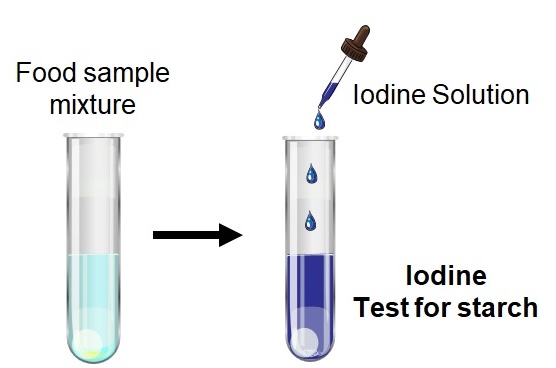
To test if a food contains starch, we use iodine solution. This test can be carried out on both liquid and solid foods.
Example
Testing for Starch in Food
Method for liquid food:
- Add a few drops of iodine solution to the food sample in a test tube
- If starch is present, the iodine solution turns blue-black
- If no starch is present, the iodine remains brown-orange
Method for solid food:
- Place the food sample on a clock glass
- Add a few drops of iodine solution to the food
- If starch is present, the food turns blue-black where the iodine touches it
Important
Exam tip: Remember that iodine solution is brown-orange in colour, and only turns blue-black when starch is present.
Testing for glucose
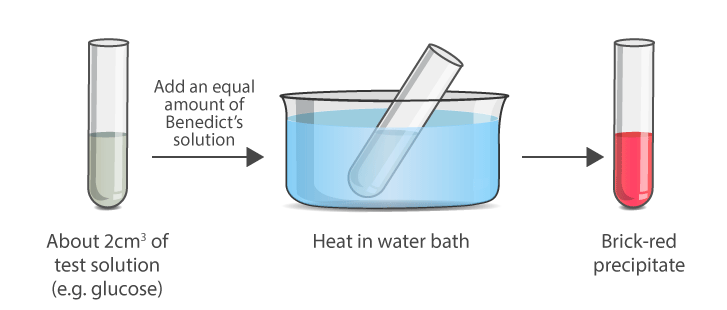
Benedict's solution is used to test for the presence of glucose (a simple sugar) in food.
Example
Testing for Glucose in Food
Method:
- Place the food sample in a test tube
- Add an equal volume of Benedict's solution
- Heat the test tube in a hot water bath (at about to )
- If glucose is present, the Benedict's solution turns from blue to brick-red
- If no glucose is present, the solution remains blue
Important: Always use a control experiment (water and Benedict's solution) to compare with the test sample. This helps confirm your results.
Organisation of life
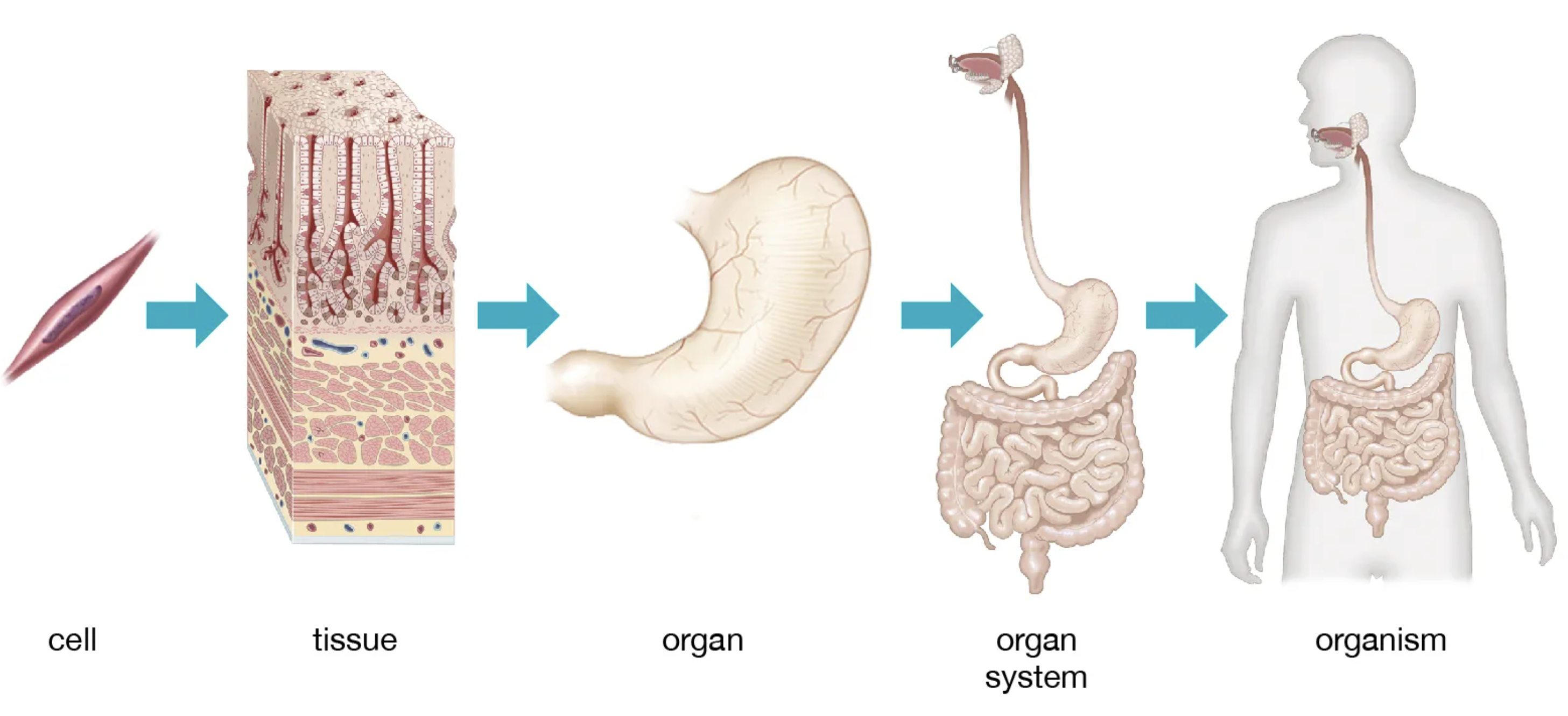
Living things are organised in a hierarchy, from the smallest unit (the cell) to the complete organism.
Note
The organisation of life follows a clear hierarchy:
- A cell is the smallest unit of an organism
- Tissues are made of many cells that work together, for example skin tissue
- Organs are made of a group of tissues that work together, for example the stomach
- Systems are made of a group of organs that work together, for example the digestive system
- An organism is the result of all the systems working together
Understanding this organisation helps us see how different parts of the body work together to carry out digestion.
The digestive system
The digestive system is a group of organs that work together to break down food and absorb nutrients into the bloodstream.
Why do we need a digestive system?
Each cell in our body needs food or fuel to release energy. However, the food we eat is made up of large particles that are too big to pass through the wall of the digestive system and into the blood. The digestive system breaks down these large food particles into smaller, soluble particles that can be absorbed into the bloodstream and delivered to cells.
Structure and functions of the digestive system

The digestive system consists of several organs, each with a specific function:
Mouth - takes in food and chews it
Salivary glands - produce the enzyme amylase
Oesophagus - carries food from the mouth to the stomach
Liver - produces bile to aid digestion of fat
Gall bladder - stores bile until it is needed in the small intestine
Stomach - churns food and adds hydrochloric acid to kill bacteria
Pancreas - makes enzymes to digest food
Small intestine - absorbs food into the blood, absorbs water from food into the blood
Large intestine (colon) - absorbs water from food into the blood
Rectum - stores faeces for egestion
Anus - allows faeces to pass from the body (egestion)
Types of digestion
There are two types of digestion: mechanical and chemical.
| Mechanical digestion | Chemical digestion |
|---|---|
| Physically breaking down food with the teeth | Enzymes break down larger food molecules into smaller soluble molecules |
| Churning by the stomach |
Note
Mechanical digestion involves physical breakdown - your teeth chew food into smaller pieces, and your stomach churns the food to mix it up.
Chemical digestion involves enzymes that break down large food molecules into smaller, soluble molecules that can be absorbed.
Important
An enzyme is a chemical found in cells. It speeds up chemical reactions. Enzymes are essential for digestion because they break down food much faster than would happen naturally.
The five steps of nutrition
The process of getting nutrients from food to cells involves five key steps:
1. Ingestion - taking in food (eating)
2. Digestion - breaking down food into soluble particles. This happens in the stomach and intestines.
3. Absorption - digested food passes into the bloodstream through blood vessels in the wall of the small intestine.
4. Assimilation - food is used by the cells for energy or growth.
5. Egestion - unabsorbed food leaves the body as faeces.
Important
Exam tip: Don't confuse egestion with excretion. Egestion is the removal of undigested food from the digestive system. Excretion is the removal of waste products made by cells (like carbon dioxide and urea).
The teeth and their functions
The teeth, along with the muscles of the digestive system, carry out mechanical digestion. Different teeth have different shapes and functions.
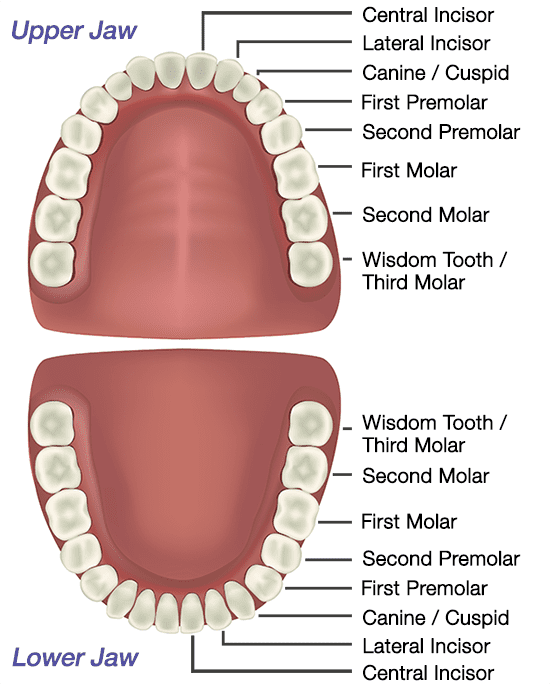
An adult has 32 teeth in total:
- incisors (top and bottom)
- canines (top and bottom)
- premolars (top and bottom)
- molars (top and bottom)
Note
Functions of different teeth:
Incisors - cut and slice food with their sharp, chisel-shaped edges
Canines - grip and tear food with their pointed shape
Premolars - chew and grind food with their broad, flat surfaces
Molars - chew and grind food with their large, flat surfaces
The different shapes of teeth are adapted to their specific functions. Front teeth (incisors and canines) are sharp for cutting and tearing, while back teeth (premolars and molars) are flat for grinding.
Enzymes
Enzymes are biological catalysts that speed up chemical reactions in the body, including the breakdown of food during digestion.
What are enzymes?
An enzyme is a chemical found in cells that speeds up chemical reactions. During digestion, enzymes break down large food molecules into smaller, soluble molecules that can be absorbed into the bloodstream.
The food that an enzyme breaks down is called the substrate.
The substance(s) that the substrate is broken down into is called the product(s).
Example
How Enzymes Work
For example:
- Enzyme: Amylase
- Substrate: Starch
- Product: Maltose
Naming convention: Most enzymes end in "-ase" and many sugars end in "-ose". This makes it easier to identify enzymes and their products.
Investigating the digestion of starch by amylase
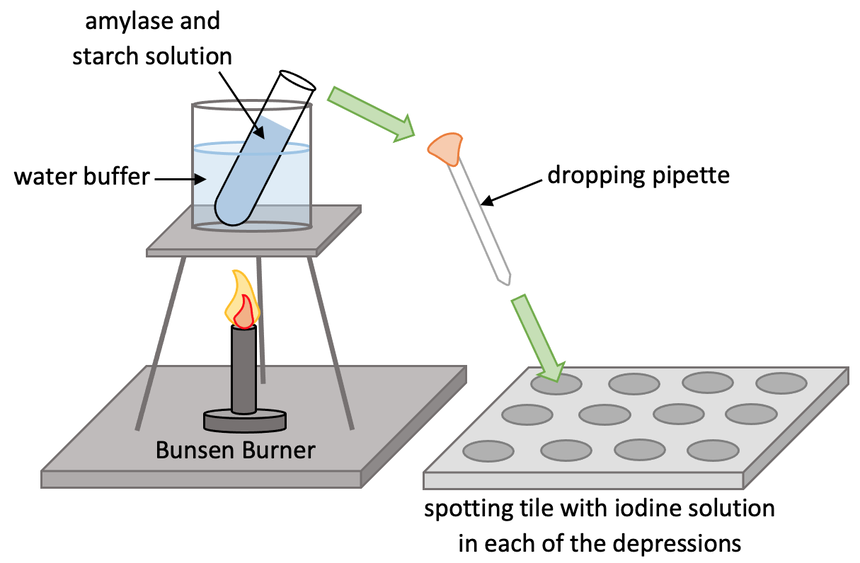
We can investigate how the enzyme amylase breaks down starch using a simple experiment.
Example
Investigating Starch Digestion by Amylase
Procedure:
- Place equal volumes of starch solution in two test tubes (A and B)
- Add amylase to test tube A
- Add water to test tube B (this is the control)
- Place both test tubes in a hot water bath at for minutes
- After minutes, take samples from both tubes
- Test each sample with iodine solution on a spotting plate
Results:
- Test tube B (starch + water): iodine turns blue-black, showing starch is still present
- Test tube A (starch + amylase): iodine remains brown-orange, showing the starch has been digested
Conclusion: The enzyme amylase breaks down starch into maltose. The control experiment (tube B) shows that without the enzyme, starch is not broken down.
Important
Exam tip: The water bath is kept at because this is body temperature - the temperature at which enzymes work best in the human body.
How the organs of the digestive system interact
The organs of the digestive system don't work in isolation - they interact and work together to digest food efficiently.
Mouth and salivary glands
The salivary glands produce the enzyme amylase, which is passed into the saliva through tiny tubes into the mouth. When amylase begins the digestion of starch in the mouth, it starts breaking down starch into smaller sugar molecules even before the food reaches the stomach.
Liver and gall bladder
Note
The liver produces bile, which helps in fat digestion. Bile is not an enzyme, but it breaks down large fat droplets into smaller ones, making it easier for enzymes to digest them.
The bile passes to the gall bladder to be stored until it is needed in the small intestine. When fatty food enters the small intestine, the gall bladder sends bile to help digest the fat.
Pancreas and small intestine
The pancreas produces a number of enzymes that are passed to the small intestine, where they are needed for digestion. These enzymes help break down proteins, carbohydrates and fats into smaller molecules that can be absorbed through the wall of the small intestine into the bloodstream.
The small intestine is where most absorption takes place - this is where digested food molecules pass into the blood vessels and are carried around the body to cells.
Remember!
Summary
Key Points to Remember:
- We need food for four main reasons: energy, growth, repair and preventing disease
- The six main types of nutrients are: protein, carbohydrates, fats, vitamins, minerals and water
- Iodine solution turns blue-black when starch is present
- Benedict's solution turns brick-red when heated with glucose
- The five steps of nutrition are: ingestion, digestion, absorption, assimilation and egestion
- There are two types of digestion: mechanical (physical breakdown) and chemical (breakdown by enzymes)
- Enzymes are biological catalysts that speed up the breakdown of food. For example, amylase breaks down starch into maltose
- Different organs work together: salivary glands produce amylase, the liver produces bile stored in the gall bladder, and the pancreas produces enzymes for the small intestine