Connected Particles (Leaving Cert Applied Maths): Revision Notes
📚Revision Notes
Connected Particles
What are connected particles?
Connected particles refer to a system where two or more masses are joined together by inelastic strings, typically involving pulleys. In these systems, the masses are physically connected, meaning they share the same acceleration magnitude (though possibly in different directions) and the tension in the string remains constant throughout.
Note
The key assumptions in connected particle systems are that the string is both light (massless) and inelastic (doesn't stretch). These assumptions allow us to treat the tension as constant throughout the system and ensure both masses have the same acceleration magnitude.
Key concepts to understand
When dealing with connected particles, there are several important principles to remember:
Tension force: The tension (T) in the string is the same throughout the entire system. This is because we assume the string is light (massless) and inelastic (doesn't stretch).
Shared acceleration: Both masses will have the same magnitude of acceleration, though they may move in opposite directions. If one mass accelerates upwards, the other accelerates downwards with the same acceleration value.
Direction matters: The direction each mass moves determines how we set up our force equations. This is crucial for getting the signs correct in our calculations.
Important
Pay special attention to the direction of motion when setting up your equations. A common mistake is getting the signs wrong, which leads to incorrect results. Always establish your sign convention clearly at the beginning.
Setting up the problem
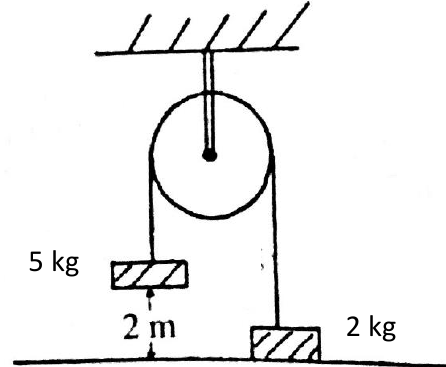
When approaching a connected particles problem, start by identifying:
- The masses involved and their positions
- Which direction each mass will move when released
- The forces acting on each mass (weight and tension)
Note
Take time to draw a clear diagram showing the system, label all forces, and indicate the expected direction of motion for each mass. This visual representation will help prevent sign errors in your equations.
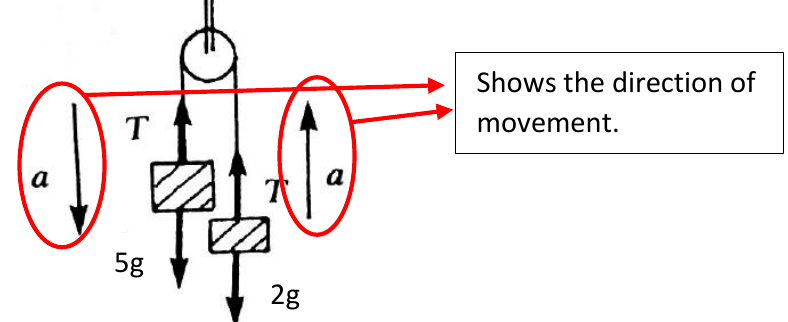
Force analysis method
The key to solving connected particles problems is to analyse each mass separately using Newton's second law (). For each mass, we consider:
Forces acting:
- Weight () acting downwards
- Tension () acting through the string
Net force equation: The net force equals mass times acceleration ()
For the heavier mass (moving downwards)
When a mass moves downwards, its weight is greater than the tension:
- Net downward force = Weight - Tension
- Equation:
For the lighter mass (moving upwards)
When a mass moves upwards, the tension is greater than its weight:
- Net upward force = Tension - Weight
- Equation:
Step-by-step solution approach
Follow these systematic steps to solve any connected particles problem:
Step 1: Set up equations for each mass Apply Newton's second law to each mass separately, paying careful attention to the direction of movement and the resulting signs.
Step 2: Create simultaneous equations Rearrange both equations to express them in terms of and , creating two equations with two unknowns.
Step 3: Solve for acceleration Add or subtract the equations to eliminate one variable (usually ) and solve for the acceleration.
Step 4: Find other quantities Use the acceleration value to find tension, velocities, distances, or any other required quantities using appropriate kinematic equations.
Important
Remember that the acceleration you calculate applies to both masses - they move with the same acceleration magnitude, just in opposite directions through the pulley system.
Worked example breakdown
Example
Worked Example: Pulley System Analysis
Consider a pulley system with a 5kg mass and a 2kg mass connected by a string. The 5kg mass starts 2m above the floor.
Setting up the equations:
- 5kg mass (moving upwards): ... (Equation 1)
- 2kg mass (moving downwards): ... (Equation 2)
Solving simultaneously: Setting the expressions for equal: Rearranging: Therefore:
Finding velocity: Using with , , :
Key problem-solving tips
Successful problem solving in connected particles requires attention to several key areas:
Important
Sign convention: Establish a clear sign convention at the start. Typically, upward forces and accelerations are positive, downward are negative. Stick to this convention throughout your solution.
Important
Logic check: The heavier mass should accelerate downwards, and the lighter mass upwards. If your answer suggests otherwise, check your equation setup - you may have made a sign error.
Use kinematic equations: Once you have the acceleration, you can find velocities, distances, and times using the standard equations of motion.
Consider what happens next: In some problems, the system changes (like when one mass hits the ground), requiring additional analysis using projectile motion or other concepts.
Remember!
Summary
Key Points to Remember:
- Connected particles share the same acceleration magnitude - they're physically linked by the string
- Tension is constant throughout the string - this is a key assumption for inelastic strings
- Analyse each mass separately using Newton's second law, then combine the equations
- Direction matters - upward movement means tension > weight, downward means weight > tension
- Always check your answers make physical sense - the heavier mass should accelerate the system downwards