Movable Pulleys (Leaving Cert Applied Maths): Revision Notes
📚Revision Notes
Movable Pulleys
What are movable pulleys?
A movable pulley is a type of simple machine where the pulley itself can move up and down along with the load. Unlike fixed pulleys that remain stationary, movable pulleys are attached to the object being lifted. This arrangement provides a mechanical advantage by effectively distributing the load across multiple sections of rope or string.
The key characteristic of a movable pulley system is that two sections of string support the movable pulley, while typically only one section extends down to support any hanging mass. This creates specific acceleration and tension relationships that we must consider when solving problems.
Note
The fundamental difference between fixed and movable pulleys lies in their motion: fixed pulleys remain stationary and only change the direction of force, while movable pulleys move with the load and provide actual mechanical advantage by reducing the force needed.
Key principles of movable pulley systems
When analysing movable pulley systems, several important principles apply:
Note
Essential Principles of Movable Pulleys:
- String constraint: Since the string is inextensible (doesn't stretch), the total length remains constant
- Acceleration relationship: If a hanging mass accelerates downward at rate a, the movable pulley typically accelerates upward at rate a/2
- Tension distribution: The tension in the string is the same throughout (assuming the string is massless and passes over smooth pulleys)
- Force analysis: We must apply Newton's second law () to each component separately
Problem-solving approach
When tackling movable pulley problems, follow this systematic approach:
Important
Step-by-Step Problem-Solving Method:
- Identify the system motion - Determine which way each component will move when released
- Draw force diagrams - Show all forces acting on each mass and the pulley
- Establish acceleration relationships - Use string constraints to relate accelerations
- Apply Newton's second law - Write equations for each component
- Solve simultaneously - Combine equations to find unknown values
Remember: Always draw force diagrams first - this is the most critical step that prevents errors!
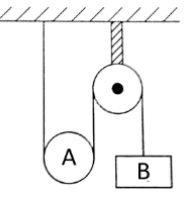
Example 1: Basic movable pulley system
Let's examine a fundamental movable pulley problem to understand the core concepts.
Problem setup: A light inextensible string has one end fastened to a point on the ceiling. It passes under a smooth movable pulley A (mass 10 kg), then over a smooth fixed pulley. A second mass B (10 kg) hangs freely from the other end of the string.
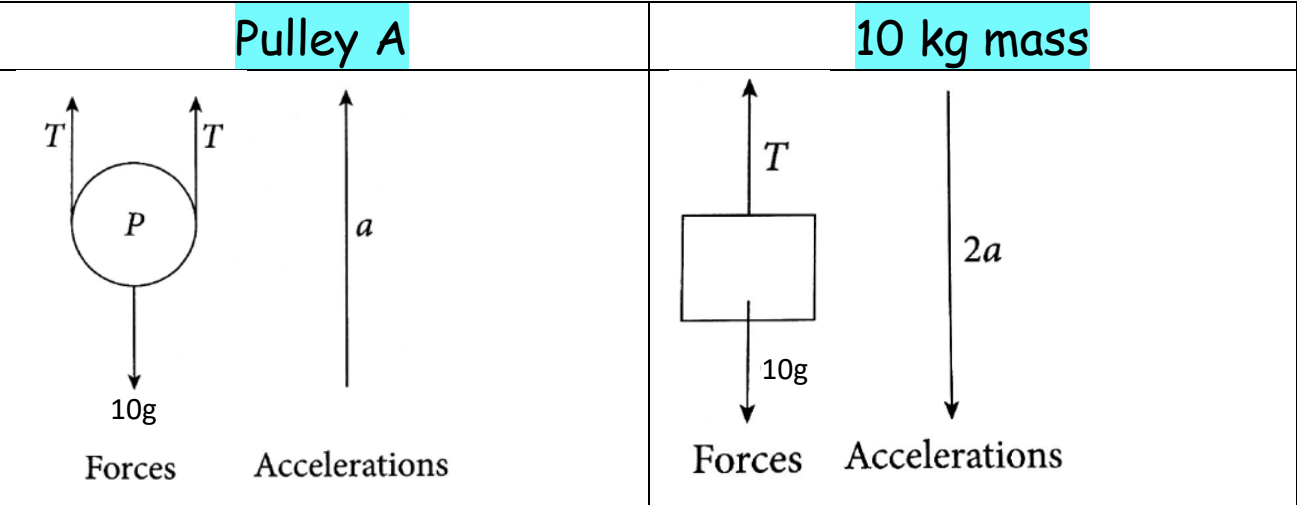
Example
Worked Example: Basic Movable Pulley Analysis
Step 1: Determine system motion First, we determine the system motion by comparing forces:
- Pulley A has two strings pulling it upward
- Mass B has one string pulling it upward
- Since both masses are 10 kg, we compare: versus
- As , mass B will move downward and pulley A will move upward
Step 2: Force analysis
For Pulley A:
- Upward forces: (two string sections)
- Downward force: (weight)
- Using :
For Mass B:
- Upward force: (tension)
- Downward force: (weight)
- Using :
Note that if pulley A accelerates upward at rate a, then mass B accelerates downward at rate 2a due to string constraints.
Step 3: Mathematical solution
From the two equations:
- Equation 1:
- Equation 2:
Solving simultaneously:
- Adding equations:
- Therefore: m/s²
- Substituting back: N
Example 2: Complex system with friction
This more advanced example involves multiple masses connected through a movable pulley system with friction.
Problem setup: A 10 kg mass rests on a horizontal table, connected via string to a 6 kg mass on another horizontal table. The string passes under a movable pulley of mass 20 kg. The coefficient of friction between each mass and its table is 0.5.
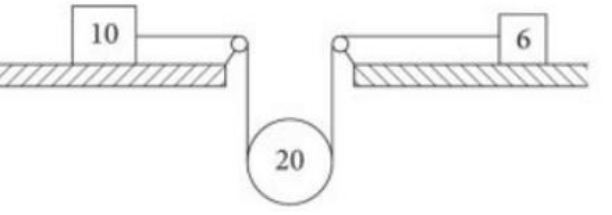
Example
Worked Example: Movable Pulley with Friction
Step 1: Force analysis for each component
6 kg Mass:
- Horizontal: (where )
- Vertical:
- Therefore: ... (Equation I)
10 kg Mass:
- Horizontal: (where )
- Vertical:
- Therefore: ... (Equation II)
20 kg Pulley:
- Using :
- Simplifying: ... (Equation III)
Step 2: Mathematical solution
Substituting Equations I and II into Equation III:
Solving this system of equations:
- N
- m/s²
- m/s²
- Pulley acceleration = m/s²
Key formulas and relationships
Understanding the mathematical relationships in movable pulley systems is crucial for problem-solving success.
Note
Essential Formulas for Movable Pulleys:
- Newton's second law:
- String tension relationship: Same tension throughout (for massless string)
- Acceleration constraint: Related by string length conservation
- Friction force: (where is coefficient of friction, is normal reaction)
Common acceleration relationships:
- If hanging mass accelerates at a, movable pulley often accelerates at a/2
- For complex systems, use string constraint equations to establish relationships
Exam tips
Important
Critical Exam Success Strategies:
- Always draw force diagrams - This prevents errors and clarifies your thinking
- Check your acceleration directions - Ensure they're consistent with string constraints
- Identify friction forces early - Don't forget for surfaces with friction
- Set up equations systematically - Write for each component before solving
- Verify your answer makes physical sense - Check if directions and magnitudes are reasonable
Common mistakes to avoid:
- Forgetting that movable pulleys have TWO string sections supporting them
- Mixing up acceleration relationships between connected masses
- Neglecting friction forces in horizontal motion problems
Summary
Key Points to Remember:
-
Movable pulleys have the pulley itself moving with the load, creating specific force and acceleration relationships
-
Always determine system motion first by comparing the effective forces on each component
-
Use string constraints to establish acceleration relationships between different parts of the system
-
Apply Newton's second law () separately to each component, including the movable pulley itself
-
For friction problems, remember to include in your force analysis for any surfaces in contact