Newton's Laws of Motion (Leaving Cert Applied Maths): Revision Notes
📚Revision Notes
Newton's Laws of Motion
Fundamental concepts in mechanics
Before diving into Newton's famous laws, it's essential to understand the basic building blocks that make these principles work. These concepts form the foundation for understanding how objects move and interact in our physical world.
Understanding force
A force represents any influence that causes an object to change its motion. When we think about forces, we're looking at what makes things speed up, slow down, or change direction.
Important
Key definition: A force is something that causes an object to speed up or slow down, which means it causes acceleration.
Forces have two important characteristics that make them special:
- Magnitude: The strength of the force, measured in newtons (N)
- Direction: Forces point in specific directions, making them vector quantities
Note
This means that forces aren't just about how strong they are, but also about which way they're pushing or pulling.
Mass versus weight
Understanding the difference between mass and weight is crucial for applying Newton's laws correctly.
Important
Mass is the amount of matter in something. This value stays constant regardless of where the object is located in the universe. Mass is measured in kilogrammes or grammes and is a scalar quantity (it has no direction).
Weight is quite different. It's the force experienced by an object due to gravity pulling it towards the centre of the Earth. This means weight can change depending on location - an object weighs less on the Moon than on Earth because the Moon's gravity is weaker.
To calculate weight on Earth, we multiply mass by the acceleration due to gravity (9.81 m/s²), though we often approximate this as 10 m/s² for simpler calculations.
Momentum in motion
Momentum describes how much "oomph" a moving object has. When something rolls down a hill, it "gathers momentum" - this everyday phrase actually reflects a precise physical concept.
Formula:
Momentum is measured in kg m/s and depends on both how massive an object is and how fast it's moving. A small object moving very quickly can have the same momentum as a large object moving slowly.
Tension forces
Note
Tension represents the force transmitted through strings, ropes, cables, and similar materials. When a light hangs from the ceiling by a cable, the weight of the light pulls downward while tension in the cable provides an upward force to balance it.
Newton's three laws of motion
Sir Isaac Newton established three fundamental laws in the 17th century that govern how objects move. These laws form the backbone of classical mechanics and help us understand everything from walking to rocket launches.
Newton's first law (Law of inertia)
Important
The law: A body will continue in a state of rest, or of uniform motion, in a straight line, unless it is impelled to change that state by an external force applied to it.
This law tells us that objects naturally resist changes to their motion. A book sitting on a table will stay there forever unless someone picks it up. A hockey puck sliding on ice will keep moving in a straight line at constant speed unless friction or a collision stops it.
This resistance to change is called inertia, and it's why passengers lurch forwards when a car brakes suddenly - their bodies want to keep moving at the car's original speed.
Newton's second law (The acceleration law)
Important
The law: The change in momentum per unit time is proportional to the applied force, and takes place along the straight line in which the force acts.
This law gives us one of the most important equations in physics:
Where:
- = net force (in newtons)
- = mass (in kilogrammes)
- = acceleration (in m/s²)
This equation tells us that the acceleration of an object depends on two things: the net force acting on it and its mass. More force means more acceleration, but more mass means less acceleration for the same force.
Newton's third law (Action-reaction law)
Important
The law: To every action there is an equal and opposite reaction.
This law means that forces always come in pairs. When you push against a wall, the wall pushes back against you with exactly the same force. When you walk, you push backwards against the ground, and the ground pushes forwards against you - that's what moves you forwards.
Note
These paired forces act on different objects, which is why they don't cancel each other out.
Applying Newton's laws with force diagrams
Understanding Newton's laws becomes much clearer when we use force diagrams to visualise what's happening. These diagrams help us identify all forces acting on an object and calculate the net effect.
Force analysis example
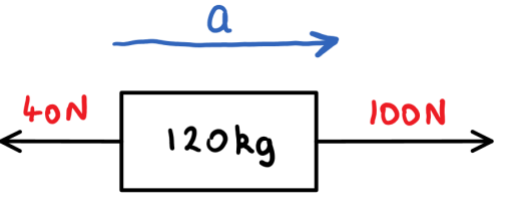
Let's examine how to solve problems using Newton's second law. Consider a boat being pulled by a rope while experiencing water resistance.
Example
Worked Example: Calculating Boat Acceleration
Given information:
- A 120 kg boat
- A 40 N resistance force pointing left
- A 100 N pulling force pointing right
- The boat accelerates to the right
Step 1: Calculate the net force Net force = 100 N - 40 N = 60 N (to the right)
Step 2: Apply 60 = 120 × = 60/120 = 0.5 m/s²
Result: The boat accelerates at 0.5 m/s² in the direction of the net force.
Changing mass scenarios
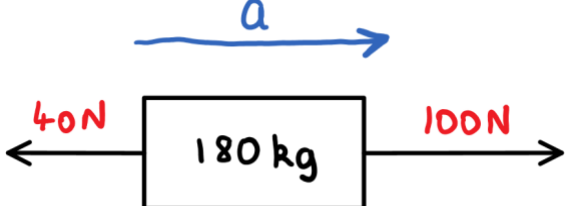
What happens when the mass changes but the forces stay the same? Let's see what occurs when additional mass is added to our boat.
Example
Worked Example: Effect of Increased Mass
Now we have:
- A 180 kg boat (increased mass)
- Same forces: 40 N left, 100 N right
- Net force remains: 60 N to the right
Step 1: Apply with new mass 60 = 180 × = 60/180 = 0.33 m/s²
Conclusion: With greater mass, the same net force produces less acceleration. This demonstrates the inverse relationship between mass and acceleration in Newton's second law.
Complex motion analysis
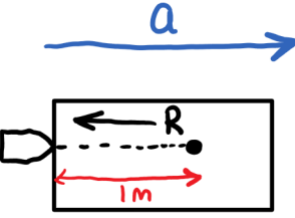
More challenging problems involve objects that experience significant resistance forces. Let's examine what happens when a bullet enters wood.
Note
This type of problem requires us to:
- Calculate the initial acceleration as the object enters the material
- Use kinematic equations to find unknown quantities
- Apply Newton's second law to determine resistance forces
The process involves combining Newton's laws with motion equations to solve multi-step problems.
Contact forces in mechanics
Beyond the fundamental forces we've discussed, objects in contact experience additional types of forces that are crucial for understanding real-world motion.
Reaction forces
A reaction force is transmitted from one object to another through direct contact. The most common example is the normal reaction force.
When you stand on the ground, your weight pushes down into the ground. The ground responds by pushing back up against you with a normal reaction force. This upward force balances your downward weight, keeping you in equilibrium.
Note
If the ground is too soft to provide sufficient reaction force (like quicksand or deep mud), it can't support your weight, and you'll sink.
Friction forces
Friction occurs when objects slide or attempt to slide against each other. This force always opposes the direction of motion or intended motion.
Consider a block being pulled across a surface. The forces acting on it include:
- T: Tension force pulling the block forwards
- Mg: Weight of the block pulling downward
- R: Normal reaction force pushing upward
- Friction: Force opposing the motion
Note
The friction force depends on the nature of the surfaces in contact and the normal force pressing them together. Smooth surfaces produce less friction than rough ones.
Force equilibrium
When multiple forces act on an object, we must consider their combined effect. If all forces balance out (the net force equals zero), the object remains at rest or continues moving at constant velocity, as predicted by Newton's first law.
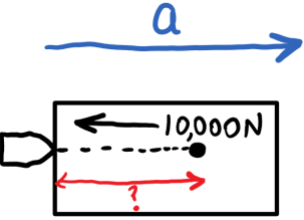
In this diagram, we see a situation where forces must be balanced. The 10,000 N force pointing left must be balanced by an equal force pointing right for the object to remain in equilibrium.
Practical problem-solving strategies
When tackling Newton's laws problems, follow these systematic steps:
Summary
Problem-Solving Strategy:
- Draw a clear force diagram showing all forces acting on the object
- Identify the direction of acceleration (if any)
- Calculate the net force by adding forces in the direction of acceleration and subtracting opposing forces
- Apply to find unknown quantities
- Check your answer by ensuring the units are correct and the result makes physical sense
Remember that forces are vectors, so direction matters just as much as magnitude. Always be clear about which direction you're calling positive and stick to that convention throughout your solution.
Summary
Key Points to Remember:
- Force causes acceleration - any unbalanced force will change an object's motion
- is your key equation - memorise it and understand how to use it in different situations
- Forces always come in pairs - Newton's third law means every push has an equal and opposite push back
- Mass and weight are different - mass stays constant but weight depends on gravity
- Draw force diagrams first - visualising all forces makes problems much easier to solve