Normal Reaction & Friction (Leaving Cert Applied Maths): Revision Notes
📚Revision Notes
Normal Reaction & Friction
What is a reaction force?
A reaction force is a force that gets transmitted from one object to another through direct contact. Think of it as objects "pushing back" against each other when they touch.
Note
Definition: A reaction force is a force transmitted from one object to another by direct contact.
The most common example is when you're standing on the ground. Your weight pushes down into the ground, and the ground supports you by providing an upward normal reaction force (R). This upward force prevents you from sinking into the ground.
However, if the ground is too soft, the reaction force isn't strong enough to support your weight completely, and you'll sink in. This shows us that reaction forces depend on the ability of surfaces to resist deformation.
Understanding friction forces
When objects slide against each other, a new force comes into play called friction. You might remember this definition from your Junior Science course:
Note
Definition: Friction is a force that opposes motion between two bodies in sliding contact with each other.
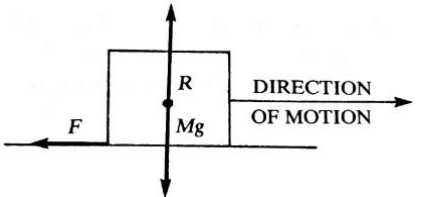
The key phrase here is "opposes motion" - friction always acts in the opposite direction to the direction of movement.
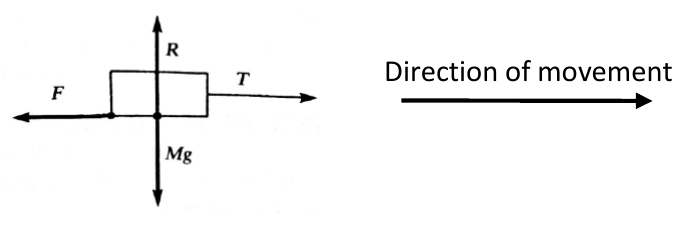
If a block is being pulled to the right along a rough surface, the friction force will act to the left, opposing this motion.
The coefficient of friction
The strength of friction between two surfaces is measured using something called the coefficient of friction, represented by the Greek letter μ (pronounced "mew").
The relationship between friction force (F), normal reaction (R), and coefficient of friction is:
Important
This coefficient depends on what the surfaces are made of and how rough they are, but it's not affected by the size or shape of the objects involved.
Calculating friction problems
Let's work through a practical example to understand how these forces work together.
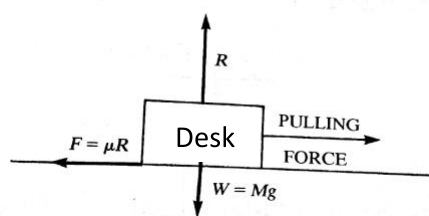
When analysing friction problems, we always start by drawing a force diagram showing all the forces at play:
- Normal reaction (R): Acting upward
- Weight (W = Mg): Acting downward
- Applied force: The force trying to move the object
- Friction force (F = μR): Acting opposite to the direction of motion
Important
Key steps for solving friction problems:
- Find the normal reaction: Since there's no vertical movement, the upward and downward forces must balance:
- Calculate the limiting friction: This is the maximum friction force possible:
- Compare forces: If the applied force is greater than limiting friction, the object will move. If not, it remains stationary.
- Find acceleration: Use Newton's second law () with the net force.
Important concepts to remember
Limiting friction is the maximum amount of friction that can act between two surfaces. Once you apply a force greater than this limiting value, the object will start to move.
Interestingly, if you apply a force smaller than the limiting friction, the actual friction force will only be as large as needed to prevent motion. For example, if limiting friction is 294N but you only apply 100N, the friction force will only be 100N.
Example
Worked Example: Calculating Acceleration with Friction
A 50kg desk is pushed across a floor with a horizontal force of 300N. The coefficient of friction between the desk and floor is 0.6. What's the acceleration?
Solution:
Step 1: Find the normal reaction
Step 2: Calculate limiting friction
Step 3: Find net force Net force = Applied force - Friction force = (in direction of motion)
Step 4: Calculate acceleration
Summary
Key Points to Remember:
- Reaction forces are transmitted through direct contact between objects
- Friction always opposes motion - it acts in the opposite direction to movement
- The coefficient of friction (μ) depends on surface materials, not object size
- Normal reaction (R) equals weight (Mg) when there's no vertical acceleration
- Limiting friction is the maximum friction force possible:
- Always draw force diagrams to visualise all forces before calculating