Overview (Leaving Cert Applied Maths): Revision Notes
📚Revision Notes
Overview
Newton's laws form the foundation of classical mechanics and are essential for understanding how forces affect the motion of objects. This overview covers the key formulae, problem-solving techniques, and applications you'll need to master for your Leaving Cert Applied Maths exam.
Note
Understanding Newton's laws requires both theoretical knowledge and practical problem-solving skills. Focus on mastering the fundamental relationships between force, mass, and acceleration, then practice applying these concepts to real-world scenarios.
Essential formulae for Newton's laws
Understanding the fundamental equations is crucial for solving mechanics problems effectively. These formulae represent the mathematical relationships between forces, motion, and energy that govern how objects behave in the physical world.
Newton's second law provides the cornerstone relationship in mechanics. The equation tells us that the net force acting on an object equals its mass multiplied by its acceleration. This means that heavier objects require more force to achieve the same acceleration as lighter ones, and that doubling the force will double the acceleration if the mass remains constant.
Friction plays a vital role in many real-world problems. The friction force equals , where (mu) represents the coefficient of friction - a measure of how 'grippy' the surfaces are - and represents the normal reaction force pressing the surfaces together. Understanding this relationship helps you calculate how much force is needed to overcome friction or how much friction helps prevent sliding.
Work and power concepts connect forces to energy considerations. Work equals force multiplied by displacement (), but crucially, this only applies when the force acts in the direction of movement. Power can be calculated in two ways: as work divided by time (), or as force multiplied by velocity (). The second formula is particularly useful when dealing with constant forces and steady motion.
Note
Understanding the Units:
- Force is measured in Newtons (N)
- Mass in kilogrammes (kg)
- Acceleration in metres per second squared (m/s²)
- Work in Joules (J)
- Power in Watts (W)
Always check your units to ensure your calculations make physical sense.
Problem-solving rules and techniques
Successful problem-solving in mechanics requires a systematic approach. These rules help you organise your thinking and avoid common mistakes that can derail your calculations.
Important
Always draw force diagrams for each object separately. This visual representation helps you identify all the forces acting and ensures you don't miss any interactions. When objects are connected, each needs its own diagram showing the forces specific to that object.
Equilibrium conditions are fundamental to many problems. When there's no acceleration in a particular direction, the forces in that direction must balance perfectly. This means forces up equal forces down, and forces left equal forces right. Recognising equilibrium situations allows you to set up equations where the net force equals zero.
Force resolution becomes necessary when forces act at angles. You must break angled forces into components parallel and perpendicular to the direction of motion. This technique allows you to apply Newton's laws along specific directions, making complex problems much more manageable.
Important
Common Mistake Alert: Don't assume all objects in a connected system have the same acceleration unless the constraints of the problem specifically require it. Each object may accelerate differently depending on the forces acting on it and the geometry of the system.
Pulley systems and connected particles
Pulley systems demonstrate Newton's laws in action whilst providing mechanical advantage. Understanding these systems helps you tackle more complex problems involving multiple objects and constraints.
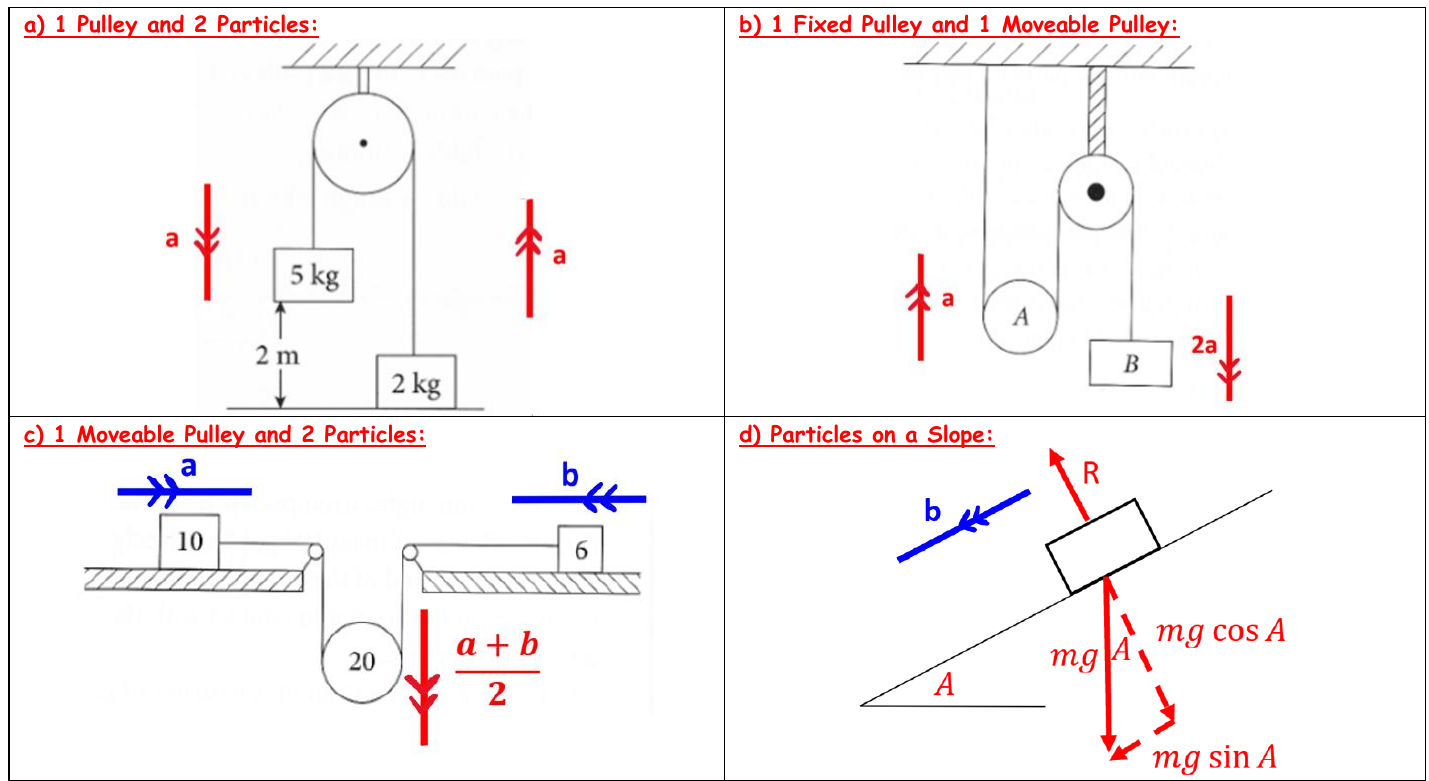
Simple pulley systems with one pulley and two masses show how forces transmit through connecting strings. The key insight is that tension remains constant throughout a massless, inextensible string, but the accelerations of connected objects must be related by the constraint that the string length stays constant.
Compound pulley systems involving both fixed and moveable pulleys create different acceleration relationships. A moveable pulley effectively halves the force needed but doubles the distance through which you must pull. This demonstrates the principle that mechanical advantage comes at the cost of increased displacement.
Inclined plane analysis requires careful force resolution. Weight () must be split into components parallel to the slope () and perpendicular to the slope (). The parallel component drives motion along the slope, whilst the perpendicular component determines the normal force and hence the friction force.
Note
String Constraint Relationships: For objects connected by strings over pulleys, if one object moves a distance in one direction, the other object must move the same distance in the opposite direction (assuming the string is inextensible). This constraint determines the relationship between their accelerations.
Exam strategy and practical tips
Developing a consistent approach to mechanics problems will improve both your accuracy and confidence during examinations.
Start every problem by drawing separate force diagrams for each object involved. This step prevents confusion and helps you identify all the forces correctly. Show the acceleration clearly on one side of your diagram to indicate the direction of net force.
Write down for each object as a separate equation. Don't assume all accelerations are the same - connected objects may have different but related accelerations depending on the constraints of the system.
Important
Be cautious with signs and directions. A negative acceleration doesn't necessarily mean the object is slowing down - it could mean the acceleration is in the opposite direction to your chosen positive direction. Consider the physical meaning of your mathematical results.
Don't assume friction is always present. Only include friction forces when the problem specifically mentions friction or when surfaces are obviously rough. Similarly, don't assume all accelerations are equal unless the geometry of the problem demands it.
Summary
Key Points to Remember:
-
Newton's second law () is your primary tool - apply it separately to each object in the system
-
Always draw clear force diagrams before attempting calculations - this prevents missing forces or making sign errors
-
Friction equals , where the normal force depends on the geometry and other forces present
-
Connected particles have related accelerations due to string constraints - work out these relationships carefully
-
Force resolution into parallel and perpendicular components is essential for problems involving angles or slopes