Stock Control Problems (Leaving Cert Applied Maths): Revision Notes
📚Revision Notes
Stock Control Problems
Stock control problems are a key application of dynamic programming that help businesses determine the most cost-effective way to manage their inventory and production over time. These problems involve balancing production costs, storage expenses, and demand requirements to minimise total costs.
Note
Stock control problems are fundamental to operations research and are frequently tested in business mathematics and optimisation courses. They demonstrate how mathematical techniques can solve real-world business challenges.
What is a stock control problem?
A stock control problem involves deciding when and how much to produce each month to meet customer demand while minimising total costs. The challenge is finding the optimal balance between:
- Production costs - including overheads and labour
- Storage costs - for keeping items in stock
- Capacity constraints - maximum production and storage limits
- Demand requirements - orders that must be fulfilled on time
Important
The key insight is that these decisions are interconnected - producing more today affects storage costs tomorrow, while producing less may require expensive rush production later.
Key components and costs
Stock control problems typically involve several types of costs that must be considered when developing the optimal production strategy.
Storage costs
These are charged for each item held in stock each month. In our example, storage costs €40 per scooter per month, with a maximum storage capacity of 3 scooters.
Note
Storage costs create a direct incentive to minimise inventory levels, but this must be balanced against the need to meet future demand and avoid production constraints.
Overhead costs
Fixed costs that occur whenever production takes place, regardless of quantity produced. These might include heating, electricity, and lighting costs - typically €200 per month when production occurs.
Hired labour costs
Additional costs incurred when production exceeds normal capacity. If production goes above 3 units per month, an assistant must be hired at an additional cost of €350.
Other variable costs
Additional costs that may vary depending on the specific situation, such as overtime or deviation costs (OVD).
The cost formula
The total cost for any production decision follows this fundamental structure:
This formula is applied to each possible production scenario to find the optimal solution.
Important
Every cost component must be included in your calculations. Missing even one element will lead to incorrect optimisation results and suboptimal business decisions.
Dynamic programming approach
Stock control problems use backwards induction - starting from the final time period and working backwards to the beginning. This approach ensures we make optimal decisions at each stage by considering all future consequences.
The backwards induction method is essential because each production decision affects not only immediate costs but also future storage requirements and production flexibility.

The decision table structure
Each stage of the dynamic programming solution uses a decision table with these columns:
- Stage (Demand): The time period and quantity required
- State: Number of units currently in stock
- Action: Number of units to produce
- Destination: Number of units remaining in stock after meeting demand
- Value: Total cost calculation for this decision path
Note
The decision table systematically explores all possible combinations of starting inventory and production levels, ensuring that no potentially optimal solution is overlooked.

Working backwards methodology
The backwards induction process follows a systematic three-step approach that guarantees optimal results.
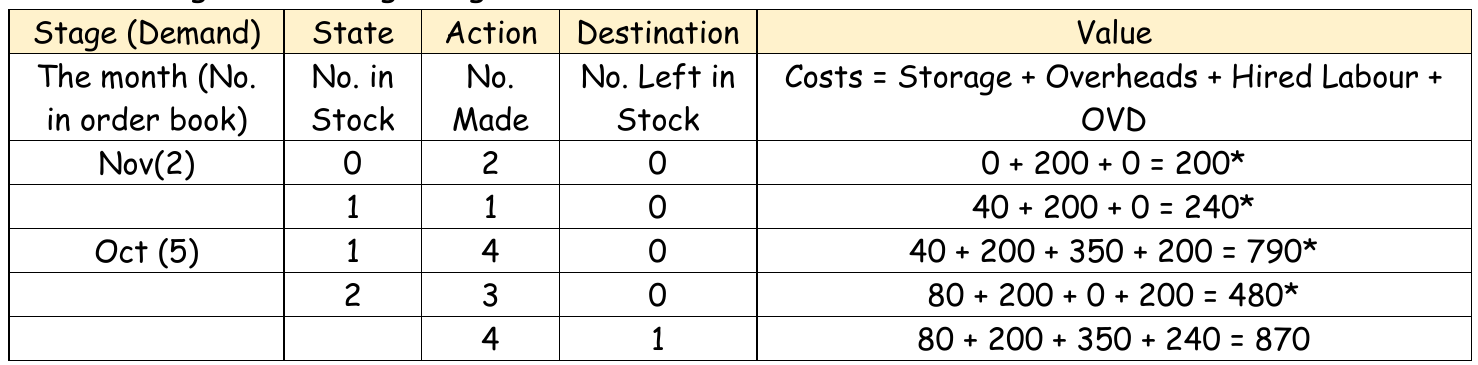
Step 1: Start with the final month
Begin with the last month in your planning period. Calculate costs for all possible starting stock levels and production decisions.
Note
Starting with the final month is crucial because it provides the foundation for all previous decisions. In the last month, there are no future consequences to consider, making it the simplest stage to solve.
Step 2: Work backwards through each month
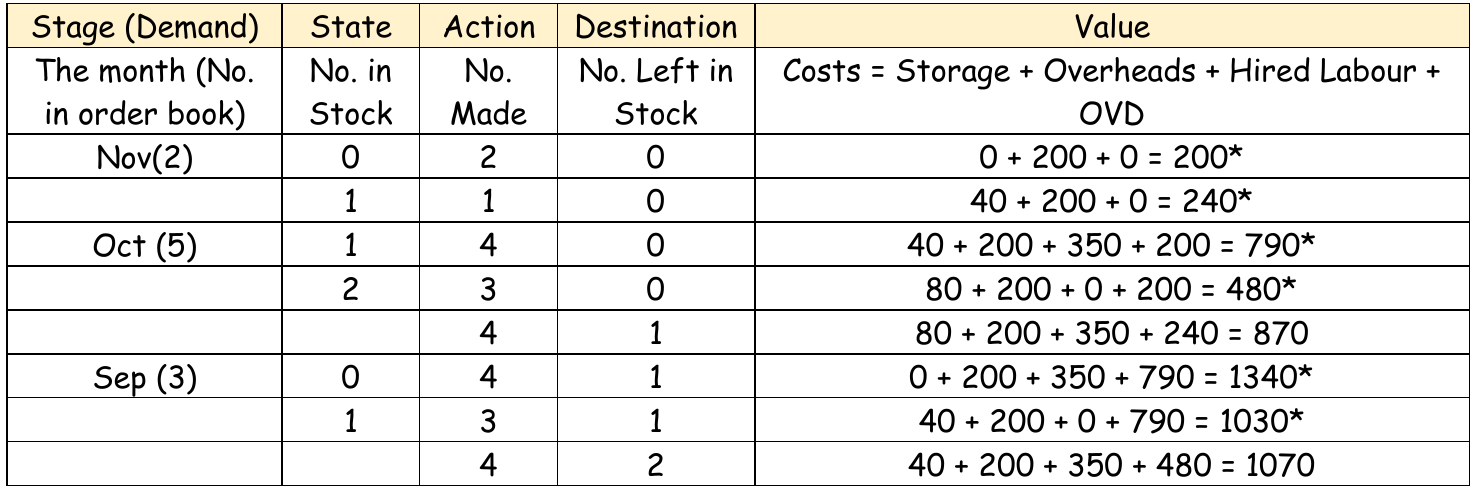
For each previous month, consider all possible stock levels and production options. The key insight is that the cost for any decision equals the immediate cost plus the optimal future cost.
Step 3: Build the complete solution
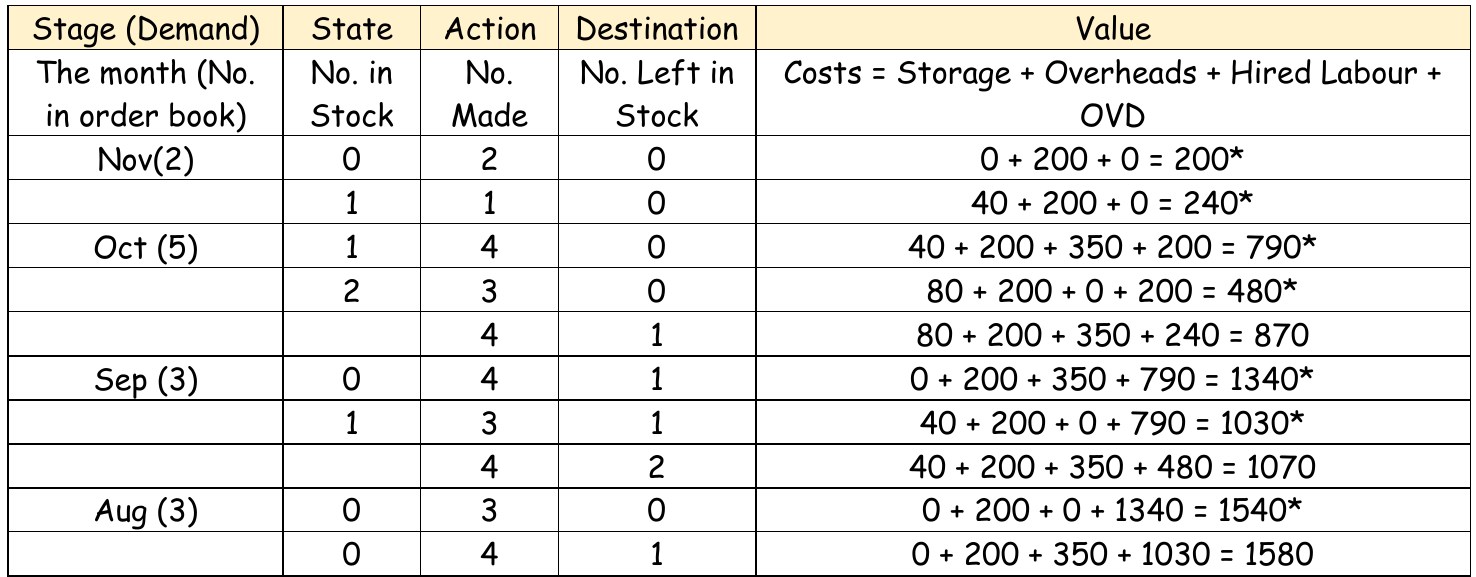
Continue working backwards until you reach the first month. This creates a complete decision tree showing the optimal path.
Finding the optimal solution
The optimal solution is identified through a systematic evaluation process that ensures all constraints are satisfied while minimising costs.
The process involves:
- Marking feasible options: Solutions that don't violate constraints (marked with asterisks)
- Comparing costs: Choosing the lowest-cost option at each stage
- Tracing the path: Following the optimal decisions from first month to last
Example
Worked Example: Optimal Production Schedule
In the example shown, the optimal strategy produces:
- 3 scooters in August
- 4 scooters in September
- 4 scooters in October
- 2 scooters in November
Total minimum cost: €1540
Calculating profitability
Once you have the optimal production plan and minimum costs, you can calculate overall profitability using this comprehensive formula:
Where:
Note
Profitability analysis is the final step that transforms your optimisation results into actionable business insights. This calculation helps management understand whether the proposed production plan will generate adequate returns.
Exam tips
When solving stock control problems in examinations, following these strategic approaches will help ensure accuracy and completeness:
- Always work backwards from the final month
- Check that your solutions respect all constraints (production capacity, storage limits)
- Mark optimal solutions clearly in your tables
- Show all cost calculations step by step
- Don't forget to include all cost components in your formula
- Verify your final answer by checking the complete production plan
Summary
Key Points to Remember:
- Dynamic programming works backwards - start from the end and work to the beginning
- The cost formula includes four components: Storage + Overheads + Hired Labour + OVD
- Optimal solutions minimise total cost while meeting all demand and capacity constraints
- Decision tables track: State → Action → Destination → Value for each stage
- Mark feasible solutions and choose the lowest cost option at each stage