Work, Power & Drag Forces (Leaving Cert Applied Maths): Revision Notes
📚Revision Notes
Work, Power & Drag Forces
Understanding work
Work is a fundamental concept in physics that describes what happens when a force causes an object to move. When we apply a force to an object and that object moves in the direction of the force, we say that work has been done.
Work is defined as the energy transferred when a force acts on an object to cause displacement. The amount of work done depends on two key factors:
- The magnitude of the force applied
- The distance the object moves in the direction of that force
Note
The formula for calculating work is:
Work = Force × Distance
Work is measured in Joules (J) or kilojoules (kJ). One Joule represents the work done when a force of 1 Newton moves an object through a distance of 1 metre.
Understanding power
Power tells us how quickly work is being done. If you can complete the same amount of work in less time, you are demonstrating greater power output.
Power is defined as the rate at which work is done, or work done per unit time. This relationship helps us understand efficiency and performance in mechanical systems.
Note
Power is measured in Watts (W) or kilowatts (kW). One Watt equals one Joule per second, meaning it represents the power when one Joule of work is done in one second.
Power output for moving objects
When an object moves at constant velocity while being acted upon by a driving force, there is a very useful relationship between power, force, and velocity.
Important
Power Output = Force × Velocity
This formula is particularly important for understanding vehicles and machinery. When a car travels at constant speed, the engine provides a tractive force that overcomes resistance forces like friction and air resistance.
Practical problem solving
Let's examine how these concepts apply to real situations through worked examples.
Example 1: Toboggan problem

Consider a toboggan being pulled across snowy ground. The problem involves multiple forces acting on the object:
- Weight (acting downward)
- Normal reaction from the ground (acting upward)
- Friction force (opposing motion)
- Tension force (causing motion)
Example
Worked Example: Resolving Forces on a Toboggan
When solving such problems, we often need to resolve forces into components using trigonometry. The tension force can be split into horizontal and vertical components.
Step 1: Identify force components
- Horizontal component: (does the work)
- Vertical component: (affects normal reaction)
Step 2: Apply equilibrium conditions
- For constant velocity: Horizontal forces balance
- Driving force = Resistance forces
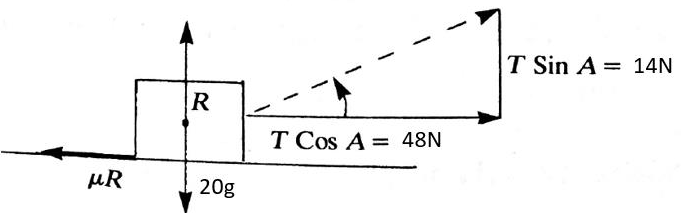
The horizontal component of tension does the work of moving the toboggan, while the vertical component affects the normal reaction and thus the friction force. By applying equilibrium conditions and using the work formula, we can determine the work done and power output.
Example 2: Car engine analysis
Example
Worked Example: Car Climbing a Hill
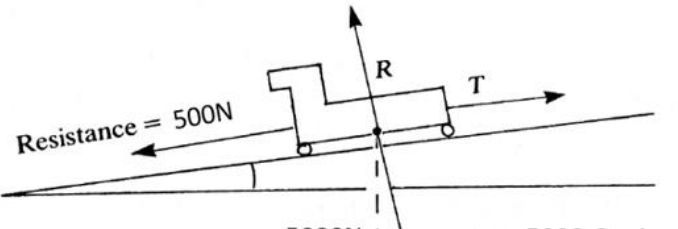
For a car climbing a hill at steady speed, the engine must provide enough tractive force to overcome both the resistance forces and the component of weight acting down the slope.
Step 1: Identify all forces
- Weight component down slope:
- Resistance forces: friction + air resistance
- Driving force: engine tractive force
Step 2: Apply equilibrium (constant velocity) Driving force = Weight component + Resistance forces
Step 3: Calculate power output Power = Driving force × Velocity
Drag forces and resistance
When objects move through any medium (air, water, etc.), they experience drag forces or resistance forces that oppose their motion. These forces are crucial to understanding real-world motion.
Note
Key Characteristics of Drag Forces:
- They always oppose the direction of motion
- They increase as the speed of the object increases
- They can often be modelled using the relationship , where k is a constant and n is typically between 1 and 2
- For many situations involving air resistance, n = 2, giving us
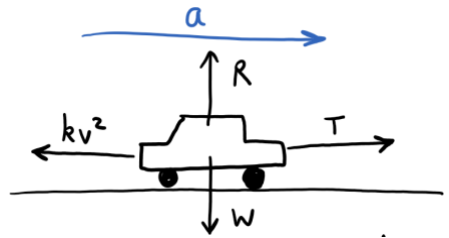
This diagram shows all the forces acting on a moving car:
- Weight (W) acting downward
- Normal reaction (R) from the road acting upward
- Driving force (T) from the engine acting forwards
- Drag force () from air resistance acting backwards
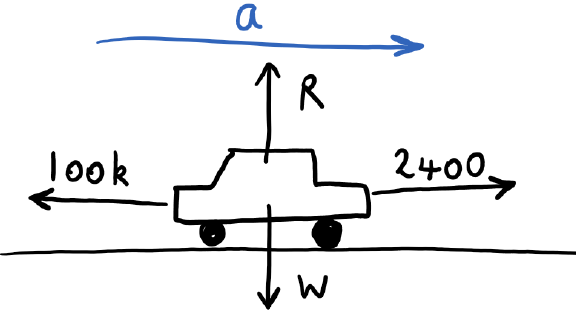
For a car travelling at constant velocity, the driving force must equal the total resistance forces. This equilibrium condition allows us to calculate unknown quantities like the drag coefficient or maximum speed.
Maximum speed considerations
Important
At Maximum Speed: When a vehicle reaches its maximum speed, it can no longer accelerate. This occurs when the driving force equals the total resistance forces. At this point, all the engine's power output is being used to overcome resistance rather than increase speed.
Energy relationships
Understanding the connection between work, power, and energy helps complete the picture of motion and forces.
Note
Kinetic Energy represents the energy an object possesses due to its motion. The formula is:
When work is done on an object, it can change the object's kinetic energy. This relationship is fundamental to understanding how forces affect motion and why power calculations are so important in engineering applications.
Key problem-solving strategies
When tackling work and power problems, follow these systematic approaches:
Note
Strategic Problem-Solving Steps:
- Draw force diagrams showing all forces acting on the object
- Resolve forces into components when dealing with angled forces
- Apply equilibrium conditions for objects moving at constant velocity
- Use appropriate formulas depending on whether you need work, power, or force
- Check units to ensure your answer makes physical sense
- Consider energy conservation when applicable
Summary
Key Points to Remember:
- Work = Force × Distance - work is done when a force causes displacement
- Power = Work/Time - power measures how quickly work is done
- Power Output = Fv - for objects moving at constant velocity
- Drag forces increase with speed - typically following relationships
- At maximum speed, driving force equals total resistance - no net force means no acceleration