Vincent van Gogh (Leaving Cert Art): Revision Notes
📚Revision Notes
Vincent van Gogh

Introduction
Vincent van Gogh stands as one of history's most celebrated artists, despite remaining largely unknown during his lifetime. This Dutch Post-Impressionist painter created over 2,100 works in just ten years, developing a distinctive style characterised by bold colours, dramatic brushstrokes, and emotional intensity.
Born in 1853 in the Netherlands, Van Gogh's journey to becoming an artist was far from straightforward. His life was marked by personal struggles, failed relationships, and mental health issues, yet these challenges fuelled some of the world's most recognisable and valuable artworks.
Note
Van Gogh's entire artistic career spanned only about 10 years, yet in that short time he produced an extraordinary body of work that includes 860 oil paintings and over 1,300 watercolours and drawings. This incredible productivity makes his artistic output even more remarkable.
Early life and family background
Van Gogh was born on 30th March 1853 in Groot-Zundert, Netherlands. His family background significantly influenced his later artistic development. His father, Theodorus van Gogh, worked as an austere country minister, whilst his mother, Anna Cornelia Carbentus, was a moody artist who loved nature, drawing, and watercolours - artistic interests she passed on to her son.
Important
In a tragic twist of fate, Vincent was born exactly one year after his parents' first son, also named Vincent, was stillborn. Growing up with his name and birthdate already carved on his dead brother's headstone created a melancholic atmosphere that would shadow Van Gogh throughout his life.
The importance of Theo van Gogh
Van Gogh's younger brother Theo played a crucial role in his artistic career. As the eldest of six living children, Vincent had two younger brothers (Theo and Cor) and three younger sisters. Theo worked as an art dealer and became Vincent's most important supporter, providing both financial assistance and emotional encouragement throughout his artistic journey.
Career development
Early working life
At age 15, financial struggles forced Van Gogh's family to remove him from school. He began working at his Uncle Cornelis' art dealership, Goupil & Cie, in The Hague. By this time, Van Gogh was fluent in French, German, and English, as well as his native Dutch.
In June 1873, Van Gogh transferred to the Goupil Gallery in London, where he fell in love with English culture. He visited art galleries during his spare time and became fascinated with the writings of Charles Dickens and George Eliot. However, his personal life took a difficult turn when his landlady's daughter, Eugenie Loyer, rejected his marriage proposal, causing Van Gogh to suffer a breakdown.
Religious calling
Following his romantic disappointment, Van Gogh threw away all his books except the Bible and devoted his life to God. He became angry with people at work, telling customers not to buy "worthless art," and was eventually fired.
Note
Van Gogh's religious period was intense and deeply felt. He taught in a Methodist boys' school and preached to congregations. Although raised in a religious family, this period marked when he seriously began considering devoting his life to the church.
He prepared for the entrance exam to the School of Theology in Amsterdam but refused to take the Latin exams, calling Latin a "dead language" of poor people, and was subsequently denied entrance.
Later, Van Gogh volunteered to move to an impoverished coal mine in southern Belgium, where preachers were usually sent as punishment. He preached and ministered to the sick, and also drew pictures of the miners and their families, who called him "Christ of the Coal Mines". However, evangelical committees disagreed with his lifestyle and refused to renew his contract.
Finding solace in art
In the autumn of 1880, Van Gogh decided to move to Brussels and become an artist. Despite having no formal art training, his brother Theo offered to support him financially. He began taking lessons independently, studying books like Travaux des champs by Jean-François Millet and Cours de dessin by Charles Bargue.
Important
Van Gogh discovered that art helped him stay emotionally balanced. This realisation marked a turning point in his life - art became not just his profession, but his therapy and means of emotional expression.
In 1885, he began work on what is considered his first masterpiece, "Potato Eaters". Theo, living in Paris at this time, believed the painting would not be well-received in the French capital, where Impressionism had become the trend.
Paris period and artistic development
Nevertheless, Van Gogh decided to move to Paris and showed up uninvited at Theo's house in March 1886. In Paris, Van Gogh first encountered Impressionist art, and he was inspired by the colour and light techniques. He began studying with Henri de Toulouse-Lautrec, Camille Pissarro, and others.
To save money, Van Gogh and his friends posed for each other instead of hiring models. Van Gogh was passionate about art and often argued with other painters about their works, sometimes alienating those who became tired of his intense discussions.
Artistic techniques and style
Post-impressionist characteristics
Van Gogh's work is characterised by several distinctive features:
- Impasto technique: Thick application of paint that creates visible texture
- Dynamic brushstrokes: Swirling, energetic marks that convey movement and emotion
- Complementary colours: Bold use of contrasting colours like oranges and blues, greens and yellows
- Expressive style: Emotional intensity conveyed through colour and brushwork rather than realistic representation
Example
Technique Demonstration: Van Gogh's Impasto Method
The impasto technique involved applying paint so thickly that the brushstrokes or palette knife marks were visible in the finished work. Van Gogh would sometimes squeeze paint directly from the tube onto the canvas, then use his brush to create swirling, textured patterns that seemed to move and breathe with life.
This technique can be clearly seen in "Starry Night," where the paint builds up in thick ridges that catch the light differently, creating a three-dimensional quality that makes the sky appear to actually swirl and move.
The artist's technique demonstrates the Post-Impressionist movement's departure from Impressionism's focus on light and atmosphere towards more personal, symbolic, and emotional expression.
Major works and artistic periods
Arles period
Van Gogh became influenced by Japanese art and began studying Eastern philosophy to enhance his art and life. In February 1888, he boarded a train to the south of France and moved into a now-famous "yellow house", spending his money on paint rather than food.
During this prolific period, Van Gogh created some of his most famous works:
"Starry Night"
Example
Masterpiece Analysis: "The Starry Night" (1889)
Van Gogh painted "The Starry Night" whilst staying in an asylum in Saint-Rémy, France, in 1889, the year before his death. He wrote to his brother Theo: "This morning I saw the countryside from my window a long time before sunrise, with nothing but the morning star, which looked very big."
Key Elements:
- Combines imagination, memory, emotion, and observation
- Features an expressive swirling night sky and a sleeping village
- Large flame-like cypress thought to represent the bridge between life and death
- Currently housed at the Museum of Modern Art in New York

"Sunflowers"
Example
Series Study: The Sunflowers Collection
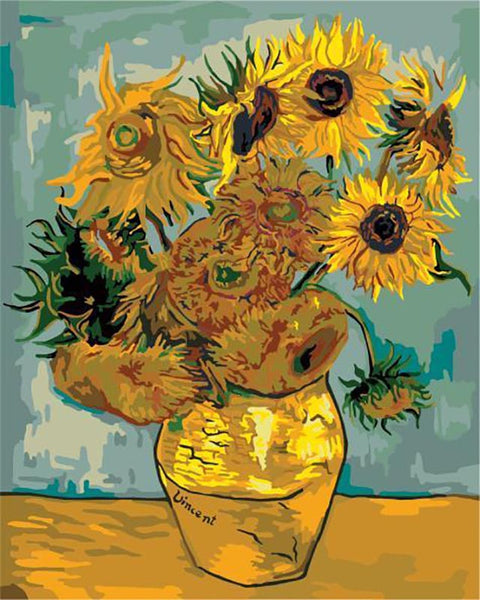
Van Gogh painted two series of sunflowers in Arles, France: four between August and September 1888 and one in January 1889. These oil paintings on canvas depict wilting yellow sunflowers in a vase and demonstrate his mastery of complementary colour schemes - the vibrant yellows against blues and purples.
Current locations: Museums in London, Amsterdam, Tokyo, Munich, and Philadelphia
"Irises"
In 1889, after entering an asylum in Saint-Rémy, France, Van Gogh began painting Irises, working from the plants and flowers he found in the asylum's garden. Critics believe the painting was influenced by Japanese woodblock prints. The work sold for a record £53.9 million, making it one of the most expensive paintings in the world.

Self-portraits
Over ten years, Van Gogh created more than 43 self-portraits as both paintings and drawings. He wrote to his sister: "I am looking for a deeper likeness than that obtained by a photographer."
Note
Van Gogh explained his approach to self-portraiture: "People say, and I am willing to believe it, that it is hard to know yourself. But it is not easy to paint yourself, either. The portraits painted by Rembrandt are more than a view of nature, they are more like a revelation."
These self-portraits are now displayed in museums around the world, including Washington D.C., Paris, New York, and Amsterdam.

Personal struggles and mental health
The ear incident
In December 1888, Van Gogh was living on coffee, bread, and absinthe in Arles, France, and found himself feeling sick and strange. His psychological health was declining, and he is known to have sipped on turpentine and eaten paint.
His brother Theo was worried and offered Paul Gauguin money to watch over Vincent in Arles. Within a month, Van Gogh and Gauguin were arguing constantly. One night, Gauguin walked out, and Van Gogh followed him. When Gauguin turned around, he saw Van Gogh holding a razor in his hand.
Important
Hours later, Van Gogh went to the local brothel and paid for a prostitute named Rachel. With blood pouring from his hand, he offered her his ear, asking her to "keep this object carefully." This incident has become one of the most famous episodes in art history, symbolising the tortured artist stereotype.
Hospitalisation and asylum
The police found Van Gogh in his room the next morning and admitted him to the Hôtel-Dieu hospital. The doctors assured Theo that his brother would live and would be taken good care of. On 7th January 1889, Van Gogh was released from the hospital.
However, he remained alone and depressed. Unable to find peace, he was hospitalised again. Van Gogh decided to move to the Saint-Paul-de-Mausole asylum in Saint-Rémy-de-Provence after the people of Arles signed a petition saying he was dangerous.
Note
On 8th May 1889, he began painting in the hospital gardens. Remarkably, some of his most celebrated works, including "Starry Night" and "Irises," were created during his time in the asylum. In November 1889, he was invited to exhibit his paintings in Brussels, sending six paintings including "Irises" and "Starry Night."
Death and immediate aftermath
Van Gogh's mental state continued to deteriorate. On 27th July 1890, he went out to paint in the morning carrying a loaded pistol and shot himself in the chest, but the bullet did not kill him. He was found bleeding in his room.
Important
Van Gogh was distraught about his future because, in May of that year, his brother Theo had visited and spoken about needing to be stricter with finances. Van Gogh interpreted this to mean Theo was no longer interested in selling his art - a misunderstanding that may have contributed to his final desperate act.
Van Gogh was taken to a nearby hospital, and doctors sent for Theo, who arrived to find his brother sitting up in bed, smoking a pipe. They spent the next couple of days talking together, and then Van Gogh asked Theo to take him home.
On 29th July 1890, Vincent van Gogh died in the arms of his brother Theo. He was only 37 years old.
Legacy and recognition
Posthumous fame
Theo, who was suffering from syphilis and weakened by his brother's death, died six months later in a Dutch asylum. He was buried in Utrecht, but in 1914, Theo's wife, Johanna, who was a dedicated supporter of Van Gogh's works, had Theo's body reburied in the Auvers cemetery next to Vincent.
Note
Johanna then collected as many of Van Gogh's paintings as she could but discovered that many had been destroyed or lost, as Van Gogh's own mother had thrown away crates full of his art. This loss represents countless masterpieces that the world will never see.
On 17th March 1901, 71 of Van Gogh's paintings were displayed at a show in Paris, and his fame grew enormously. His mother lived long enough to see her son hailed as an artistic genius. Today, Vincent van Gogh is considered one of the greatest artists in human history.
Van Gogh Museum
In 1973, the Van Gogh Museum opened in Amsterdam to make Van Gogh's works accessible to the public. The museum houses more than 200 Van Gogh paintings, 500 drawings, and 750 written documents, including letters to Vincent's brother Theo. It features self-portraits, "The Potato Eaters," "The Bedroom," and "Sunflowers."
In September 2013, the museum discovered and unveiled a Van Gogh painting of a landscape entitled "Sunset at Montmajour". The painting is believed to have been created by Van Gogh in 1888 — around the same time his artwork "Sunflowers" was made — just two years before his death.
Remember!
Summary
Key Points to Remember:
-
Vincent van Gogh (1853-1890) was a Dutch Post-Impressionist painter who created over 2,100 works in just ten years
-
His distinctive style featured thick brushstrokes (impasto), swirling patterns, and bold complementary colours that conveyed intense emotion
-
Major works include "Starry Night", "Sunflowers", "Irises", and numerous self-portraits that are now among the world's most valuable paintings
-
Despite struggling with mental illness and remaining virtually unknown during his lifetime, he was supported throughout by his brother Theo van Gogh
-
His legacy lives on through the Van Gogh Museum in Amsterdam and his enormous influence on modern art, proving that true artistic genius is often only recognised after death