Water (Leaving Cert Biology): Revision Notes
📚Revision Notes
Water
Water is the most abundant chemical compound found in living organisms. It makes up approximately 60% of the human body mass and an impressive 80-90% of plant mass. This essential biomolecule originated in water environments, and all living things remain dependent on water for their survival.
Note
Water's abundance in living organisms isn't coincidental - life as we know it evolved in aquatic environments, and this dependency on water remains fundamental to all biological processes today.
The main roles of water in living organisms
Main component of cytoplasm and body fluids
Water serves as the primary component of cells and body fluids. Inside cells, water in the cytoplasm helps maintain cell shape, similar to how water fills a balloon and gives it structure.
Note
The Balloon Analogy
Think of a cell like a water balloon - just as the balloon maintains its shape because of the water inside, cells maintain their structure through the water content in their cytoplasm.
In the human body, about 33% of our water exists outside cells. This water forms tissue fluid, which plays a crucial role in allowing materials to move in and out of cells. The remaining water outside cells is found in blood plasma, the liquid portion of blood that transports various substances throughout the body.
Good solvent
Water possesses excellent solvent properties, meaning it can dissolve a wide variety of molecules effectively. This characteristic enables several important processes:
- Many chemical reactions occur when substances dissolve in the water within cytoplasm and cell organelles
- Molecules are transported efficiently throughout organisms by dissolving in water found in animals' blood and plants' xylem and phloem systems
Neutral pH maintenance
Living organisms maintain their water at a pH close to 7, which is neutral. This neutral environment is essential because most enzymes function optimally at this pH level.
Important
When pH levels deviate significantly from neutral, enzyme activity decreases dramatically, potentially disrupting vital cellular processes. This is why maintaining proper pH is critical for life.
Participates in chemical reactions
Water plays an active role in many biological reactions, including:
- Photosynthesis: Water molecules are split to provide hydrogen ions and electrons for the process
- Respiration: Water is produced as an end product of cellular respiration
- Digestion: Water helps break down complex food molecules into simpler, absorbable forms
Example
Worked Example: Water in Photosynthesis
In the light-dependent reactions of photosynthesis:
Step 1: Water molecules (H₂O) are split by light energy
Step 2: This produces hydrogen ions (H⁺), electrons (e⁻), and oxygen (O₂)
Step 3: The equation can be written as: 2H₂O → 4H⁺ + 4e⁻ + O₂
The hydrogen ions and electrons are then used to produce ATP and NADPH for the Calvin cycle.
Moves easily through membranes
Water can move freely through cell membranes, a property that has significant effects on cellular function:
-
When cells gain sufficient water, they become swollen, allowing them to maintain proper shape and structure
-
When cells lose water, they lose shape and function. This effect is clearly visible when plant cells lose water, causing the entire plant to wilt and lose strength
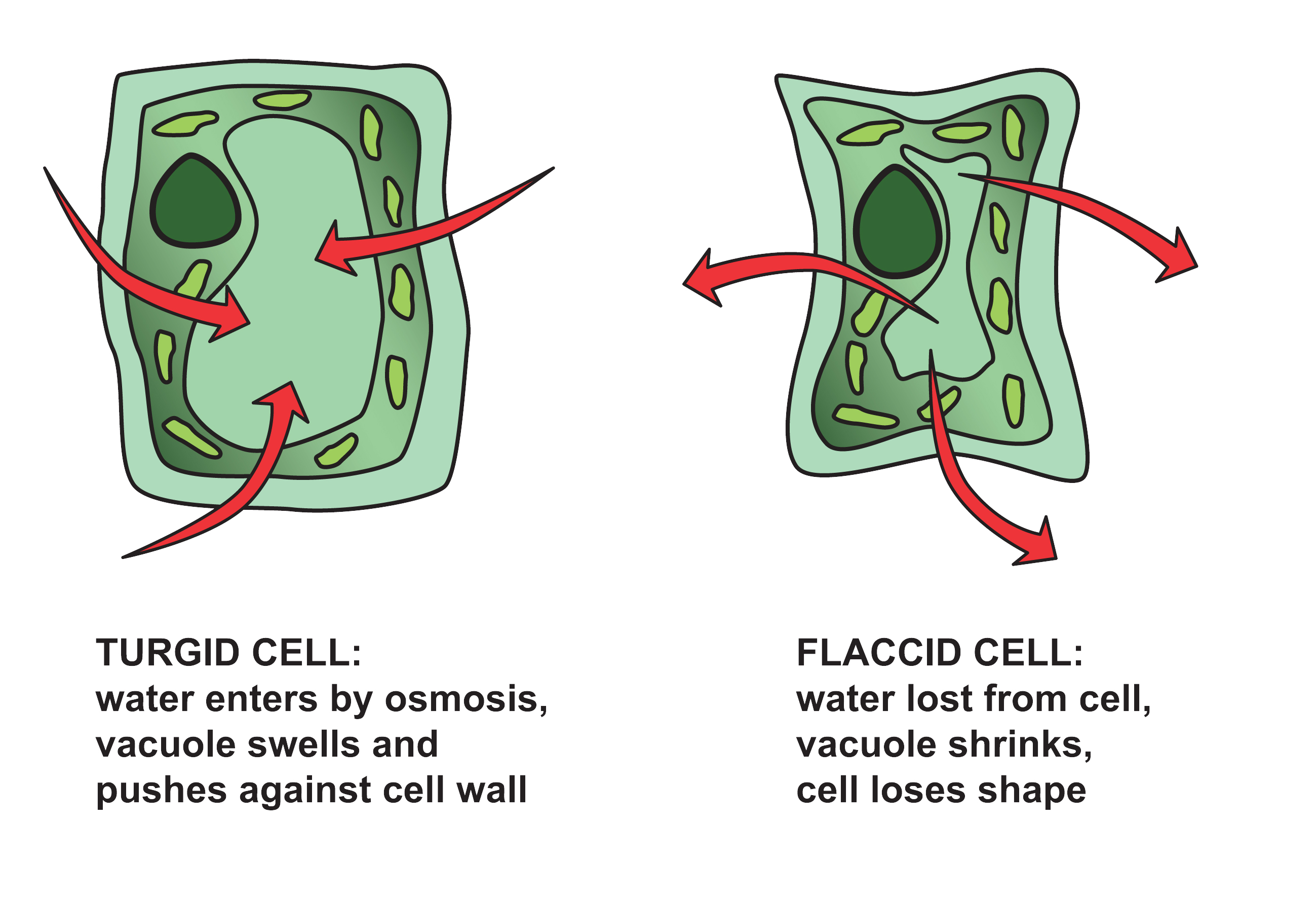
Note
The image above demonstrates the dramatic difference between well-hydrated plant cells (turgid) and dehydrated plant cells (flaccid), showing how water content directly affects structural integrity.
Helps to regulate temperature
Water serves as an excellent temperature regulator due to its ability to absorb heat energy effectively. This means water heats up slowly when energy is added and cools down gradually when energy is removed.
Living organisms benefit from this property because they live in water or have bodies composed mainly of water. Enzyme-controlled reactions function best within narrow temperature ranges. Water's temperature-regulating properties help maintain stable internal temperatures, preventing dangerous overheating during fever or excessive cooling in cold conditions.
Note
Water's High Specific Heat Capacity
Water can absorb large amounts of heat energy with only small increases in temperature. This property, called high specific heat capacity, makes water an ideal biological thermostat.
Effects of water on cellular function
The amount of water in cells directly impacts their ability to function properly:
Important
Critical Water Balance Effects:
- Water gain: Cells that absorb adequate water maintain their correct shape and can carry out normal functions effectively
- Water loss: When cells lose water, they shrivel and lose their normal structure. In red blood cells, this results in reduced oxygen-carrying capacity. In plant cells, water loss leads to wilting and loss of structural strength
Summary
Key Points to Remember:
- Water makes up about 60% of human body mass and 80-90% of plant mass
- Water serves six main roles: body fluid component, solvent, pH regulation, chemical reactions, membrane transport, and temperature regulation
- Water's neutral pH (around 7) is crucial for optimal enzyme function in living organisms
- Water loss causes cells to shrivel and lose function, while adequate water maintains proper cell shape and structure
- Water's heat-absorbing properties help regulate body temperature and maintain stable conditions for enzyme activity