Bioprocessing with Immobilised Enzymes (Leaving Cert Biology): Revision Notes
📚Revision Notes
Bioprocessing with Immobilised Enzymes
Bioprocessing
Note
Bioprocessing: the use of enzyme-controlled reactions to make a product.
-
Bioprocessing: the use of enzyme-controlled reactions to make a product.
-
A bioreactor is a vessel in which bioprocessing occurs.
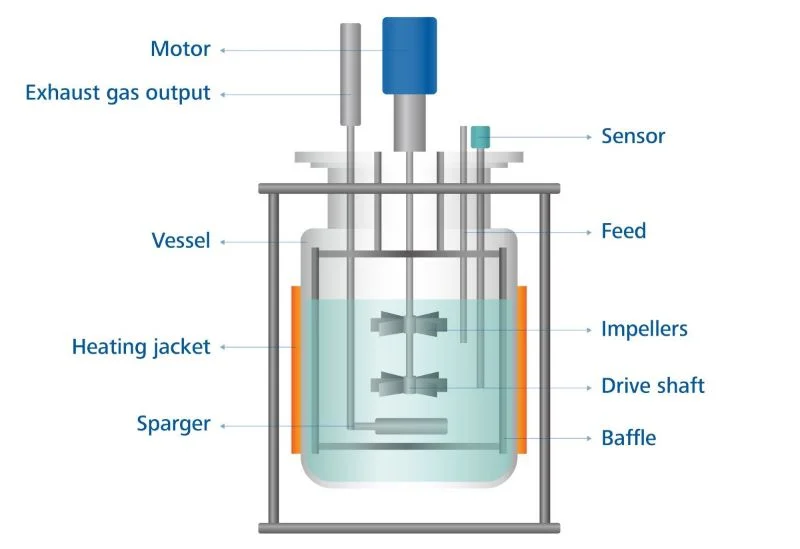
-
Bioprocessing is used by pharmaceutical and food companies to produce high-quality products quickly and at a low cost.
-
Examples:
- Cheese Making: Rennin coagulates milk.
- Washing Powders: Proteases break down protein-based stains on clothes.
- Alcohol Production: Yeast ferments sugar to produce alcohol.
Immobilised Enzymes
Note
Immobilised enzymes: enzymes that are attached to an inert (inactive) material.
- Enzyme immobilisation is a process where enzymes are fixed in place so they can be reused multiple times.
- This is useful in industrial processes because it saves money and resources.
There are three main ways to immobilise enzymes:
- Attaching enzymes to each other: Join enzymes to one another.
- Binding enzymes to an inactive substance: Enzymes are stuck onto materials like beads or other supports.
- Trapping enzymes in a gel or membrane: Enzymes are placed inside a gel or covered with a thin film to hold them in place.
How it works:
- The substrate (the material the enzyme works on) is passed over the immobilised enzymes.
- A reaction occurs, and the product (the final result) is collected.
- The enzymes stay fixed in place and can be used again for another round of reactions.
Benefits of Immobilised Enzymes
- Reusable
- More stable: the enzymes are protected in a gel or membrane, making them less likely to break down.
- No enzymes in the product: this saves time and money, as there is no need for a separation process.
Note
Immobilised enzymes are NOT cheaper than regular enzymes! The savings come from not needing to separate enzymes from the product, which is an additional step.
This is a common exam pitfall, so be careful!
Uses of Immobilised Enzymes
- Cheese production: immobilised rennin is used to coagulate milk
- Sweetening soft drinks: soft drinks are often sweetened with the sugar fructose. Fructose is sweeter than glucose but more expensive. An immobilised enzyme called glucose isomerase is used to convert glucose to fructose.
Experiments
There is one experiment related to this section. Check out our experiment notes:
- To prepare an enzyme immobilisation and examine its application
Note
Step-by-Step Breakdown: Enzyme Immobilisation in Action
Let's use a real-life example of immobilising lactase to break down lactose in milk. Lactase is an enzyme that breaks lactose (milk sugar) into glucose and galactose. This is useful for people who are lactose intolerant.
- Immobilising the Enzyme (Lactase):
- Imagine we trap the enzyme lactase in a gel (like jelly).
- This keeps the enzyme in one place so it doesn't mix into the milk.
- Set-Up for the Reaction:
- The immobilised lactase is placed inside a tube or container.
- Milk (the substrate) is poured over the gel that holds the enzyme.
- The Reaction Happens:
- As the milk flows over the lactase, the enzyme breaks down the lactose into glucose and galactose.
- The reaction happens without the lactase dissolving into the milk.
- Collect the Product:
- The milk, now free of lactose, comes out the other end. This is the product.
- It's safe for lactose-intolerant people to drink.
- Reusing the Enzyme:
- The gel with lactase stays in place and can be used again for the next batch of milk.
- No need to add more lactase – it's already immobilised!
Why This is Useful:
- The enzyme doesn't get wasted.
- The process is faster because you don't need to add and separate the enzyme each time.