Composition of Blood (Leaving Cert Biology): Revision Notes
📚Revision Notes
Composition of Blood
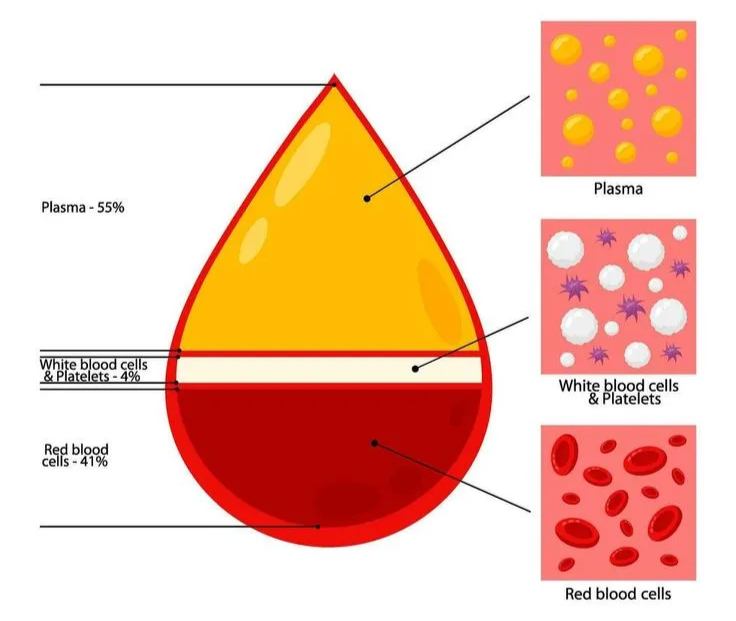
Blood is composed of:
- Plasma
- Red blood cells
- White blood cells
- Platelets
Plasma
- Plasma is the liquid part of the blood.
- It is approximately:
- 90% water
- 7% proteins
- 3% dissolved substances.
- Proteins include antibodies and clotting proteins.
- The function of plasma is transport.
- It transports dissolved materials like glucose, vitamins, minerals, and hormones.
- It transports wastes including urea, salts and CO₂.
- Plasma also transports heat. It is involved in homeostasis.
Note
Homeostasis: the maintenance of a constant internal environment.
Red Blood Cells (Erythrocytes)
- Red blood cells transport oxygen.
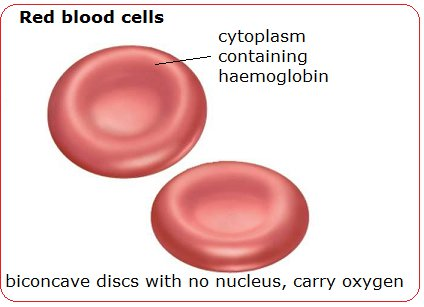
- They contain haemoglobin.
- Haemoglobin is a globular protein pigment made from iron, which carries oxygen.
- Red blood cells are biconcave in shape. This increases their surface area for oxygen transport.
- They are made in the bone marrow of long bones.
Note
Haemoglobin + Oxygen ↔ Oxyhaemoglobin (Gives oxygenated blood its red colour)
Note
The femur in the thigh is the longest bone in the body.
- When first created, red blood cells have a nucleus. When they mature, the nucleus dies.
- As a result, red blood cells are unable to repair themselves and live for only four months (approx.).
- They contain no mitochondria and do not respire.
- Red blood cells are broken down in the liver and spleen.
- When broken down:
- Haemoglobin is converted into the pigments bilirubin and biliverdin, which are sent to the gall bladder and secreted into bile.
White Blood Cells (Leucocytes)
- White blood cells fight infection.
- They are large, flattened discs.
- They have a nucleus and mitochondria.
- They are made in the bone marrow and some mature in the lymph system.
- There are two main types of white blood cells:
- Lymphocytes
- Monocytes
Lymphocytes:
- Produce antibodies to fight disease.
- Made in the bone marrow.
- Stored in the spleen and lymphatic system.
- Have a large, rounded nucleus that almost fills the entire cell.
Monocytes:
- Engulf foreign bodies (phagocytosis).
- Live for less time than lymphocytes.
- Have a kidney-shaped nucleus.
Platelets (Thrombocytes)
- Platelets allow blood to clot.
- Made in the bone marrow.
- Do not have a nucleus.
- Blood clotting prevents the entry of foreign cells and pathogens into the body.
- Clotting forms scabs on wounds, which reduces the risk of infection.
Key:
Note
Plasma
- Plasma is the liquid part of blood (90% water).
- Transports nutrients, wastes, hormones, and heat.
Note
Red Blood Cells
- Transport oxygen using haemoglobin (iron-based protein).
- Biconcave shape and no nucleus when mature.
- Made in bone marrow, broken down in liver and spleen.
Note
White Blood Cells
- Fight infection.
- Have a nucleus and mitochondria.
- Made in the bone marrow; some mature in the lymph system.
- Two types:
- Lymphocytes produce antibodies to fight disease.
- Monocytes engulf foreign bodies (phagocytosis).
Note
Platelets
- Allow blood to clot.
- Made in the bone marrow.
- No nucleus.