Mitosis (Leaving Cert Biology): Revision Notes
📚Revision Notes
Mitosis
Note
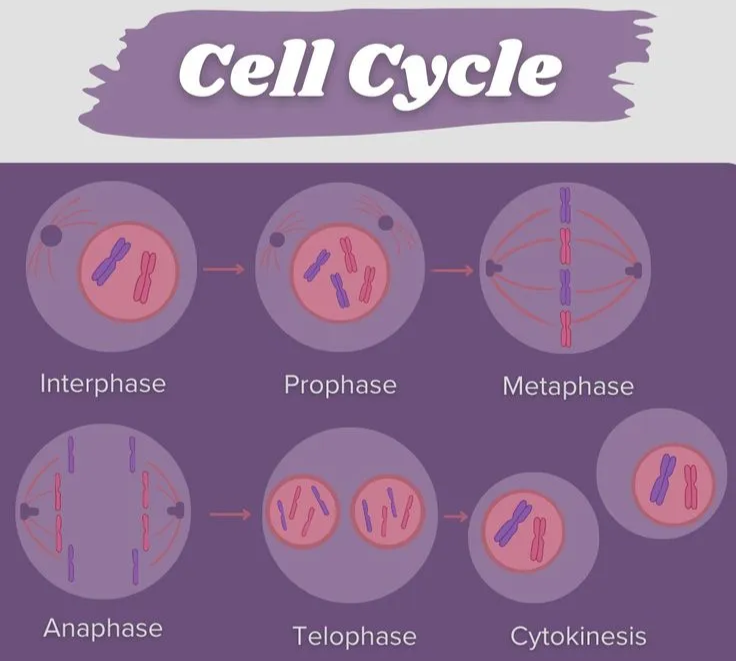
Mitosis is a form of nuclear division in which one nucleus divides to form 2 nuclei, each with the same number of chromosomes as the parent nuclei.
- Mitosis is the phase when the cell actually divides, making up about 10% of the cell cycle.
- It can be broken into four stages:
- Prophase
- Metaphase
- Anaphase
- Telophase
Note
An easy way to remember these stages is: Party on Mondays And Tuesdays – for Prophase, Metaphase, Anaphase, and Telophase.
1. Prophase
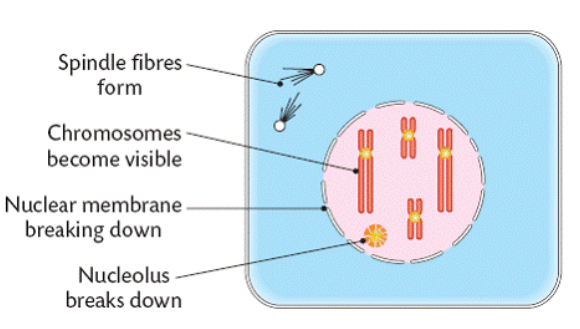
- The chromosomes become visible as short, thick, double-stranded structures.
- Each strand is held together at a point called the centromere.
- The two strands are identical copies of each other.
- At the poles of the cell (either end of the cell), the centriole starts to form spindle fibres.
- The nuclear membrane starts to break down.
2. Metaphase
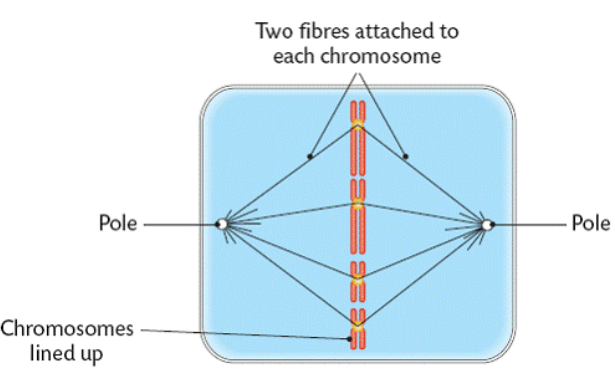
- The nuclear membrane completely breaks down.
- The chromosomes line up along the equator of the cell.
- The spindle fibres attach to the centromeres.
3. Anaphase
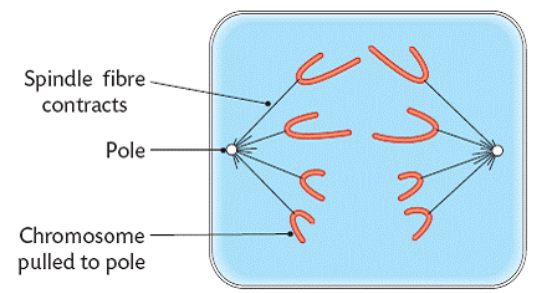
- The spindle fibres contract.
- The centromeres split.
- The chromosomes are pulled to opposite poles (ends) of the cell.
4. Telophase
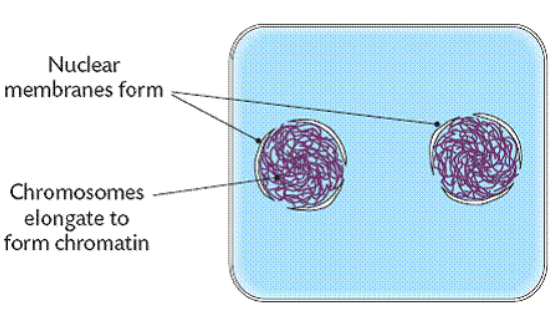
- A nuclear membrane forms around each group of chromosomes.
- Chromosomes elongate to become chromatin.
- The spindle fibres break down.