Cell Cycle, Interphase, and Stages of Mitosis (Leaving Cert Biology): Revision Notes
📚Revision Notes
Cell Cycle, Interphase, and Stages of Mitosis
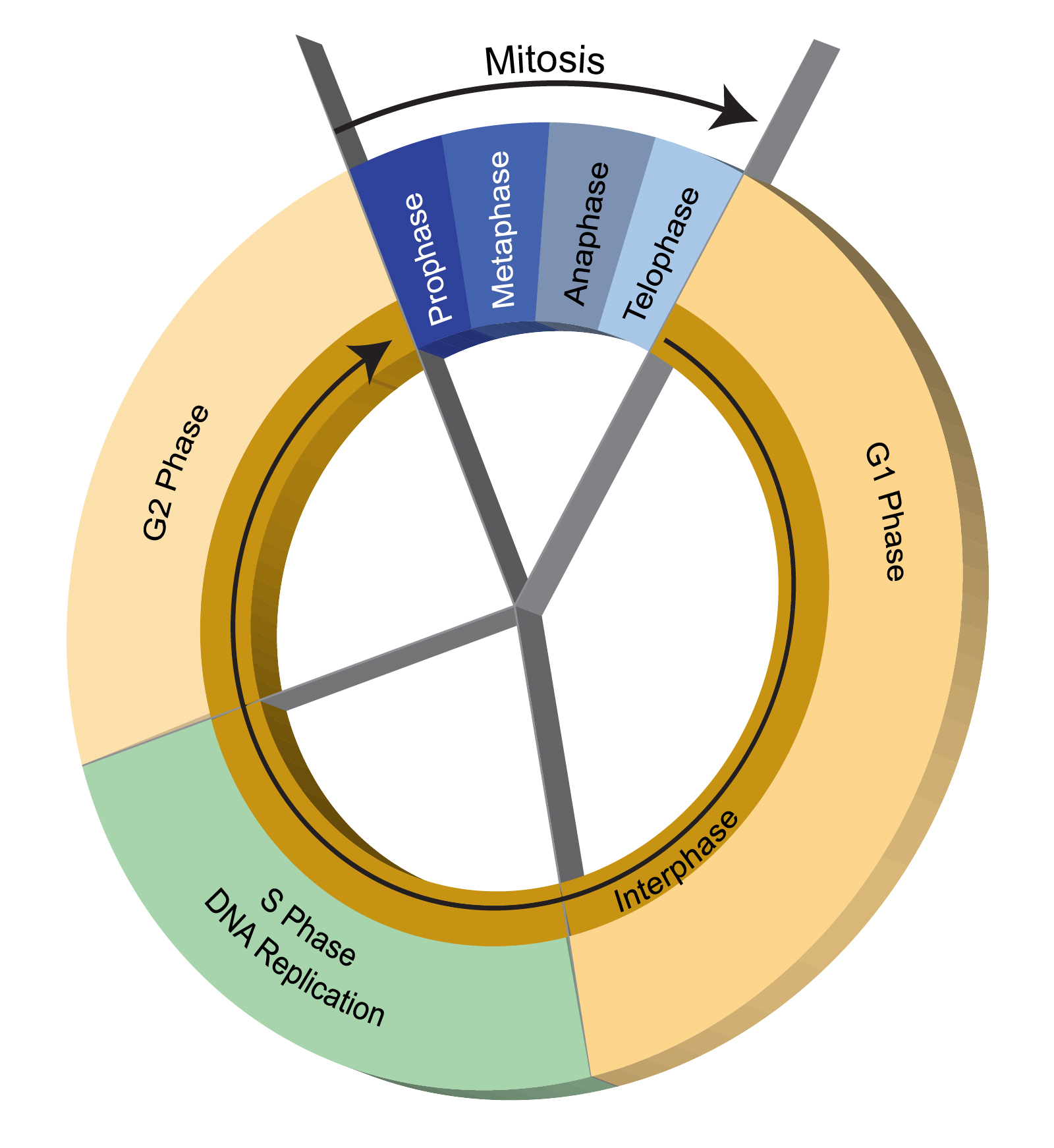
Overview of the cell cycle
The cell cycle represents a series of events that occur in a cell between one division and the next. This process describes the complete life cycle of a cell and consists of two main parts:
- Interphase - the period when the cell is not actively dividing
- A phase of nuclear division - either mitosis or meiosis
- Cytokinesis - the division of the cell's cytoplasm
Think of the cell cycle as a continuous loop where cells grow, prepare for division, divide, and then begin the cycle again.
Note
The cell cycle is not just about division - it's a complete life cycle that includes growth, preparation, and reproduction phases. Understanding this cycle is essential for understanding how all living organisms grow and reproduce at the cellular level.
Interphase: the growth and preparation phase
Interphase is the longest phase of the cell cycle, typically accounting for over 90% of the total cycle time. During this crucial period, the cell is very active, even though it's not dividing.
Important
Many students think cells are "resting" during interphase because they're not dividing. This is incorrect! Cells are actually extremely active during interphase, carrying out essential growth and preparation activities.
What happens during interphase?
Early interphase activities:
- The cell grows rapidly in size
- New organelles are produced, including mitochondria and chloroplasts
- The cell manufactures many essential chemicals needed for growth
- Enzymes and proteins are synthesised
DNA replication:
- Chromosomes create identical copies of themselves
- This duplication process ensures each new cell will receive a complete set of genetic material
- After replication, each chromosome consists of two identical strands joined at the centromere
Key cellular processes:
- Respiration continues to provide energy
- Photosynthesis occurs in plant cells
- Protein synthesis takes place continuously
Although cells appear inactive during interphase because they're not dividing, they're actually working hard to prepare for the next division.
Mitosis: nuclear division
Mitosis is the process of nuclear division that produces two identical daughter cells. While mitosis is actually a continuous process, we describe it as having four distinct stages to make it easier to understand.
Prophase: preparation for division
During prophase, the cell begins to prepare for division:
- Chromosome condensation: Chromosomes contract and become visible under a microscope as short, thickened strands
- Double-stranded structure: Each chromosome now appears as two identical chromatids joined at the centromere
- Spindle fibre formation: Protein fibres called spindle fibres begin to form in the cell's cytoplasm
- Nuclear membrane breakdown: The nuclear membrane starts to break down and disappear
Metaphase: chromosomes line up
Metaphase is characterised by chromosome alignment:
- Nuclear membrane disappears: The nuclear membrane is now completely broken down
- Chromosome alignment: Chromosomes move to line up across the middle (equator) of the cell
- Spindle attachment: Two spindle fibres from each pole of the cell attach to each chromosome at the centromere
- Perfect positioning: This alignment ensures each daughter cell will receive exactly the same genetic material
Anaphase: chromosomes separate
During anaphase, the actual separation occurs:
- Spindle fibre contraction: The spindle fibres contract and shorten
- Chromatid separation: The two chromatids of each chromosome are pulled apart to opposite ends of the cell
- Chromosome movement: Each separated chromatid (now called a chromosome) moves towards opposite poles
- Genetic distribution: This ensures each end of the cell has an identical set of chromosomes
Telophase: two new nuclei form
Telophase marks the final stage of mitosis:
- Nuclear membrane reformation: A new nuclear membrane forms around each set of chromosomes at opposite ends of the cell
- Chromosome elongation: The chromosomes begin to elongate and become harder to distinguish
- Spindle fibre breakdown: The spindle fibres start to disappear
- Two nuclei formed: The cell now contains two separate nuclei, each with identical genetic material
Memory aids for mitosis
Example
Worked Example: Remembering Mitosis Stages
Remember the sequence: Prophase → Metaphase → Anaphase → Telophase
Useful mnemonics:
- "Please Make A Tea"
- "Party Monday And Tuesday"
Key movement patterns:
- Prophase: chromosomes condense
- Metaphase: chromosomes meet in the middle
- Anaphase: chromatids move apart
- Telophase: two nuclei form
Exam tips
The following strategies will help you succeed in questions about cell division:
Note
- Draw simple diagrams to show chromosome behaviour in each stage
- Remember that mitosis produces two identical daughter cells
- Understand that interphase is the longest phase, not mitosis
- Know that DNA replication happens during interphase, before mitosis begins
- Be able to identify each stage from diagrams showing chromosome position and nuclear membrane presence
Summary
Key Points to Remember:
- The cell cycle consists of interphase (growth and preparation) and mitosis (nuclear division)
- Interphase is the longest phase where DNA replication and cell growth occur
- Mitosis has four stages that can be remembered as PMAT (Prophase, Metaphase, Anaphase, Telophase)
- Prophase involves chromosome condensation and nuclear membrane breakdown
- Metaphase sees chromosomes align at the cell's equator with spindle fibres attached
- Anaphase is when chromatids separate and move to opposite poles of the cell
- Telophase results in the formation of two new nuclei as the cell prepares to divide completely