Catabolic and Anabolic Enzymes (Leaving Cert Biology): Revision Notes
📚Revision Notes
Catabolic and Anabolic Enzymes
Note
Enzymes are biological catalysts that alter the rate of a chemical reaction without being used up in the reaction.
- Enzymes are the driving force for metabolism.
- They catalyse metabolic reactions such as respiration.
- They are biological catalysts made from proteins.
- Proteins are made of long chains of amino acids that fold to form a 3D shape.
- All enzymes are globular proteins.
Note
Metabolism: the sum of all the chemical reactions in an organism.
Note
Catabolic Reaction: the breakdown of larger molecules into smaller molecules e.g. digestion.
Anabolic Reaction: the use of smaller molecules to form larger molecules e.g. photosynthesis, protein synthesis.
Catabolic Enzymes
- Catabolic enzymes are involved in catabolic reactions.
- They break large molecules into smaller ones.
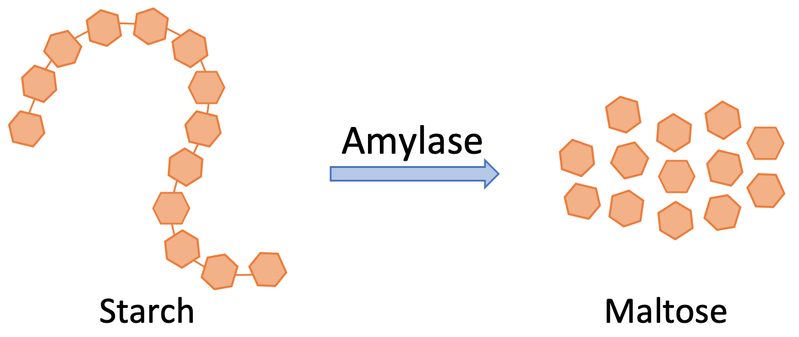
- Example: Amylase
- Catalyses the breakdown of starch into maltose.
- Found in saliva and pancreatic juices.
Note
Catabolic reactions break down larger molecules: Catabolic = Catastrophe
Anabolic Enzymes
- Anabolic enzymes are involved in anabolic reactions.
- They help combine smaller molecules to form larger ones.
- Example: DNA polymerase
- Catalyses DNA formation.
- Found in all living cells.