Control of Thyroxine Levels - Negative Feedback (Leaving Cert Biology): Revision Notes
📚Revision Notes
Control of Thyroxine Levels - Negative Feedback
Note
Revision:
The thyroid gland;
-
Is found in the neck, in front of the larynx.
-
Produces thyroxine. Thyroxine controls metabolism. The pituitary gland
-
Often called the 'master gland' because its hormones cause other glands to release their hormones.
-
Found at the base of the brain, just below the hypothalamus, and is connected to the hypothalamus by a portal system.
Hormones Released by the Pituitary Gland:
| Hormone | Function |
|---|---|
| Thyroid Stimulating Hormone (TSH) | Stimulates the thyroid gland to release thyroxine. |
| Follicle Stimulating Hormone (FSH) | Controls the formation of eggs in ovaries and sperm in testes. |
| Luteinising Hormone (LH) | Controls ovulation in females and testosterone production in males. |
| Growth Hormone (GH) | Causes cells to increase in size. |
| Anti-diuretic Hormone (ADH) | Regulates water balance (osmoregulation) in the kidneys. |
| Prolactin | Causes milk formation. |
| Oxytocin | Causes the uterus to contract during labour. |
Control of Thyroxine Levels
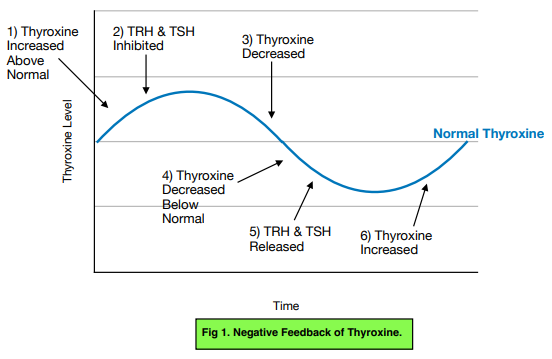
The concentration of thyroxine, like all hormones, is regulated by a mechanism called negative feedback.
- The pituitary gland produces TSH (Thyroid Stimulating Hormone), which prompts the thyroid gland to produce thyroxine.
- When thyroxine levels in the bloodstream are normal, no TSH is produced, so no more thyroxine is made. This is the negative feedback mechanism at work.
- If thyroxine levels drop below normal, the pituitary gland produces TSH, which then causes more thyroxine to be produced.
- Once thyroxine levels return to normal, TSH production is inhibited, stopping further production of thyroxine.