The Main Endocrine Glands (Leaving Cert Biology): Revision Notes
📚Revision Notes
The Main Endocrine Glands
- The hypothalamus
- The pituitary gland
- The pineal gland
- The pancreas
- The adrenal gland
- The testes
- The ovaries
- The thyroid gland
- The parathyroid glands
- The thymus
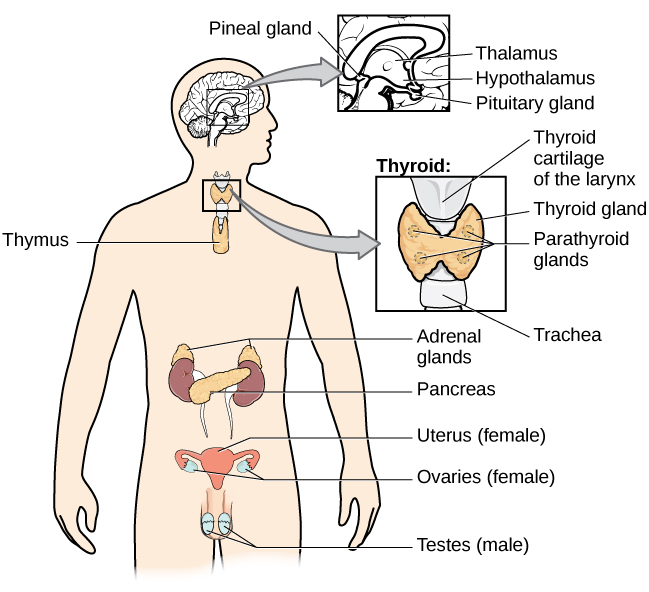
1. Hypothalamus
The hypothalamus**;**
- Found in the brain.
- Secretes hormones that control the pituitary gland.
- Controls hunger, thirst, and body temperature.
- Releases Growth Hormone Releasing Hormone (GHRH), which stimulates the pituitary gland to release growth hormone.
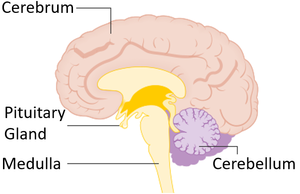
2. The Pituitary Gland
- The pituitary gland is often called the 'master gland' because its hormones cause other glands to release their hormones.
- It is located at the base of the brain, just below the hypothalamus, and is connected to the hypothalamus by a portal system.
Note
Portal system: a blood pathway that begins and ends in capillaries.
Note
Why is the pituitary gland often called the 'master gland'? The pituitary gland is often called the 'master gland' because its hormones cause other glands to release their hormones.
Hormones Released by the Pituitary Gland:
| Hormone | Function |
|---|---|
| Thyroid Stimulating Hormone (TSH) | Stimulates the thyroid gland to release thyroxine. |
| Follicle Stimulating Hormone (FSH) | Controls the formation of eggs in ovaries and sperm in testes. |
| Luteinising Hormone (LH) | Controls ovulation in females and testosterone production in males. |
| Growth Hormone (GH) | Causes cells to increase in size. |
| Anti-diuretic Hormone (ADH) | Regulates water balance (osmoregulation) in the kidneys. |
| Prolactin | Causes milk formation. |
| Oxytocin | Causes the uterus to contract during labour. |
Excess Growth Hormone
- Excessive growth hormone release is usually caused by a tumour on the pituitary gland.
- Results in gigantism, causing a person to grow very tall.
- This can put pressure on the joints and the heart, making the circulatory system work harder.
- Treatment may involve surgery to remove the tumour.
Deficiency of Growth Hormone
- If too little growth hormone is released, it can cause dwarfism, leading to stunted growth.
- Today, new-born babies are tested for growth hormone levels. If they are too low, growth hormones can be given during childhood to prevent dwarfism.
3. The Pineal gland
The pineal gland;
- Found in the centre of the brain.
- Secretes melatonin, which regulates sleep patterns.
- Sensitive to changes in day length, as it is connected to the retina.
4. The Pancreas
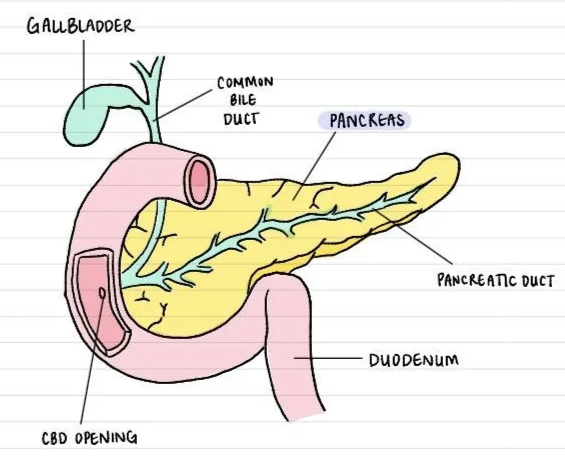
The pancreas acts as both an exocrine and an endocrine gland.
Endocrine Function:
- The Islets of Langerhans are special cells that produce insulin.
- Insulin regulates blood glucose levels by causing glucose to be absorbed from the bloodstream into cells, where it is converted into glycogen for storage.
Exocrine Function:
- Most pancreatic cells produce digestive enzymes, such as:
- Pancreatic amylase (breaks down starch).
- Pancreatic lipase (breaks down fats).
- These enzymes pass into the pancreatic duct and become active in the duodenum.
5. The Adrenal Gland
The adrenal glands;
- Are found on top of the kidneys.
- Produce the hormone adrenaline.
- Adrenaline is the fight or flight hormone.
- It increases the flow of blood to the brain, lungs, heart and skeletal muscle.
- This helps the body respond quickly in stressful situations by providing more oxygen and energy to these critical areas.
6. The Testes
- The testes produce testosterone.
- Testosterone is responsible for the secondary sexual characteristics in males like;
- widening of the shoulders
- deepening of the voice
- facial and pubic hair formation
Note
Secondary sexual characteristics are features that distinguish males from females, apart from the sex organs.
7. The Ovaries
- The ovaries produce the hormones oestrogen and progesterone.
- These hormones are responsible for the secondary sexual characteristics in females like;
- widening of the hips
- enlarging of the breasts
- pubic hair formation
8. The Thyroid Gland
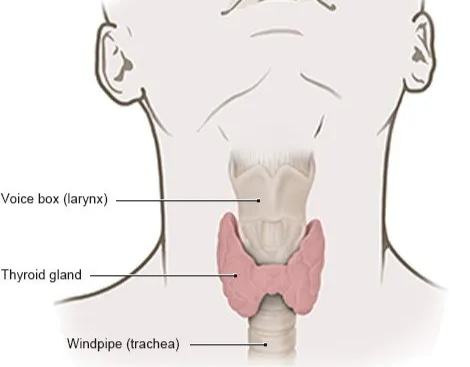
The thyroid gland;
- Is found in the neck, in front of the larynx.
- produces thyroxine. Thyroxine controls metabolism.
Thyroxine Deficiency
- In young children, thyroxine deficiency can lead to reduced mental and physical development.
- In adults, this deficiency lowers metabolism, causing symptoms such as tiredness, reduced mental and physical activity, and weight gain. Additionally, the thyroid gland can swell, leading to a condition called goitre.
Treatment:
- Thyroxine tablets or iodine supplements.
- Surgical removal or treatment with radioactive iodine to reduce thyroid activity.
Excess of Thyroxine
- An overproduction of thyroxine increases metabolic rate, causing symptoms such as:
- Hunger
- Weight loss
- Sweating
- Anxiety
- Bulging eyes (Graves' Disease)
9. The Parathyroid Glands
- There are 4 parathyroid glands found in the 4 corners of the thyroid.
- They secrete parathormone which controls calcium levels in the blood.
10. The Thymus
The thymus gland;
- Located behind the sternum, in front of the heart.
- Produces thymosin, a hormone that causes **T-cells (**involved in the immune system) to mature.