Excretion (LC 2026) (Leaving Cert Biology): Revision Notes
📚Revision Notes
Urine Production - How is Blood Filtered?
Note
We will study:
- The production of urine
- The nephron
- The Bowman's capsule
- How blood is filtered
- Adaptations of the proximal convoluted tubule
- Control of urine volume
- How ADH works
- A summary on how blood is filtered
The Production of Urine
- Urine is made up of urea, salt and water.
- Three main processes occur in the kidneys; filtration, reabsorption and secretion. 9. Filtration takes place in the cortex. 10. Reabsorption takes place in the cortex and the medulla. 11. Secretion is the active transport of substances out of the blood into the kidneys for excretion.
Note
Active transport is the movement of substance from an area of low concentration to an area of high concentration against a concentration gradient.
The Nephron
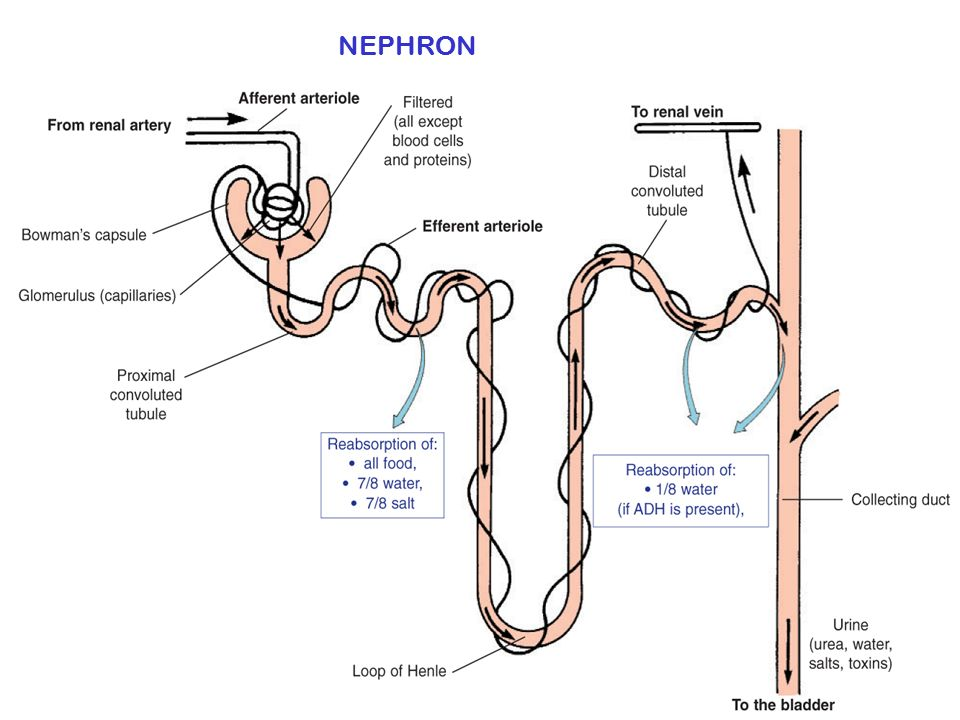
- The nephron is the functional unit of the kidney.
- Each kidney contains about 1 million nephrons.
- A nephron is a tube, about 3 cm long, located in the cortex and the medulla of the kidney.
- Nephrons make urine by filtering the blood. The urine then flows into collecting ducts, which drain into the renal pelvis.
Note
A functional unit is the smallest part of an organ that performs all its main functions. In the kidney, the nephron is the functional unit because it can filter blood and make urine on its own, just like the entire kidney does. Even though the kidney has millions of nephrons, each one can perform these tasks independently.
The Bowman's Capsule
Filtration takes place in the Bowman's Capsule.
How is blood filtered?
- Blood entry
- Afferent arterioles
- Bowman's capsule
- The glomerulus
- Ultrafiltration
- Reabsorption
Note
6 litres of blood are filtered at least 30 times per day!
How is Blood Filtered?
- Blood Entry:
- Blood enters each kidney through the renal artery.
- The renal artery branches into smaller renal arterioles.
- Afferent Arterioles:
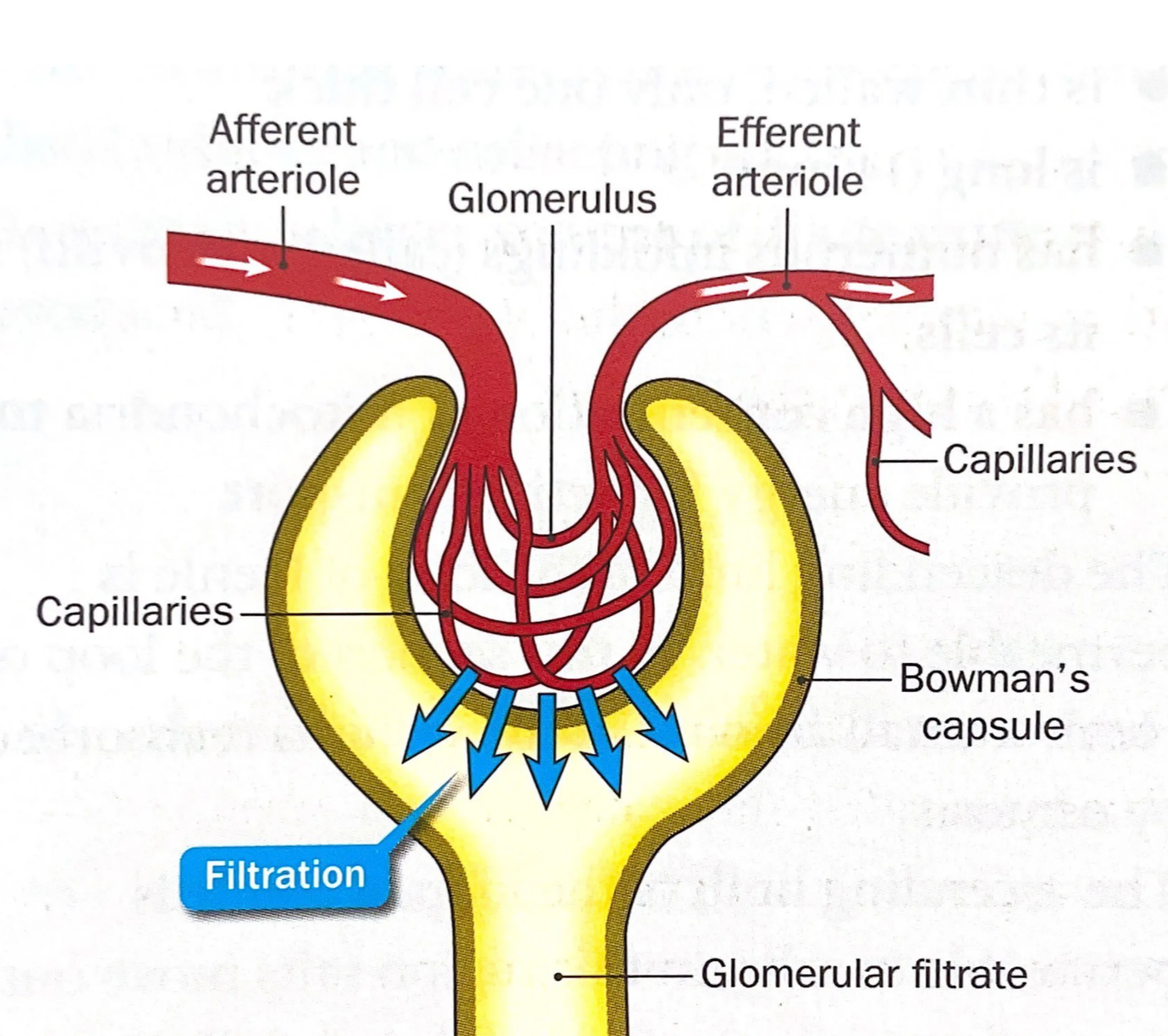
- The renal arterioles split further into afferent (incoming) arterioles.
- Each afferent arteriole leads to a Bowman's Capsule.
- Bowman's Capsule:
- The Bowman's Capsule is a cup-shaped structure that is one cell thick.
- Inside the Bowman's Capsule, the afferent arteriole forms a cluster of capillaries called the glomerulus.
- The Glomerulus:
- Blood leaves the glomerulus through the efferent arteriole.
- The blood pressure in the glomerulus is much higher than normal because:
- Blood in an arteriole is under high pressure.
- The afferent arteriole is wider than the efferent arteriole.
- Ultrafiltration:
- The high pressure causes ultrafiltration.
- Small molecules like glucose, amino acids, vitamins, minerals, salts, urea, and water are forced into the Bowman's Capsule, forming the glomerular filtrate.
- Large molecules (proteins, some hormones, antibodies, red and white blood cells) are too big to pass into the glomerular filtrate.
- Reabsorption:
- Many substances in the glomerular filtrate are essential and must be reabsorbed into the blood.
- In the proximal convoluted tubule:
- About 80% of water is reabsorbed by osmosis.
- Glucose, vitamins, minerals, and amino acids are reabsorbed by diffusion or active transport.
- Descending Loop of Henle:
- 5% of water is reabsorbed by osmosis.
- Calcium and magnesium are also reabsorbed.
- Ascending Loop of Henle:
- Some salts are reabsorbed by active transport.
- Distal Convoluted Tubule:
- Up to 10% of water is reabsorbed.
- Some salts are also reabsorbed into the blood.
- Secretion in the Convoluted Tubules:
- Secretion occurs by active transport.
- Potassium ions, hydrogen ions, and urea are actively secreted into the distal convoluted tubule, moving against their concentration gradient.
- Secretion of H⁺ ions helps to control blood pH.
- Collecting Duct:
- The collecting duct is permeable to water.
- Up to 4.9% of water is reabsorbed by osmosis.
- The liquid that remains leaves the collecting ducts as urine.
Adaptations of the Proximal Convoluted Tubule
- Long (large surface area).
- Thin-walled (1 cell thick).
- Has many infoldings called microvilli to increase the surface area for reabsorption.
- Has a large number of mitochondria to provide energy for active transport.
Note
Diffusion: The movement of substances from an area of high concentration to an area of low concentration.
Note
Osmosis: The movement of water molecules from an area of high water concentration to an area of low water concentration across a semipermeable membrane.
Control of Urine Volume
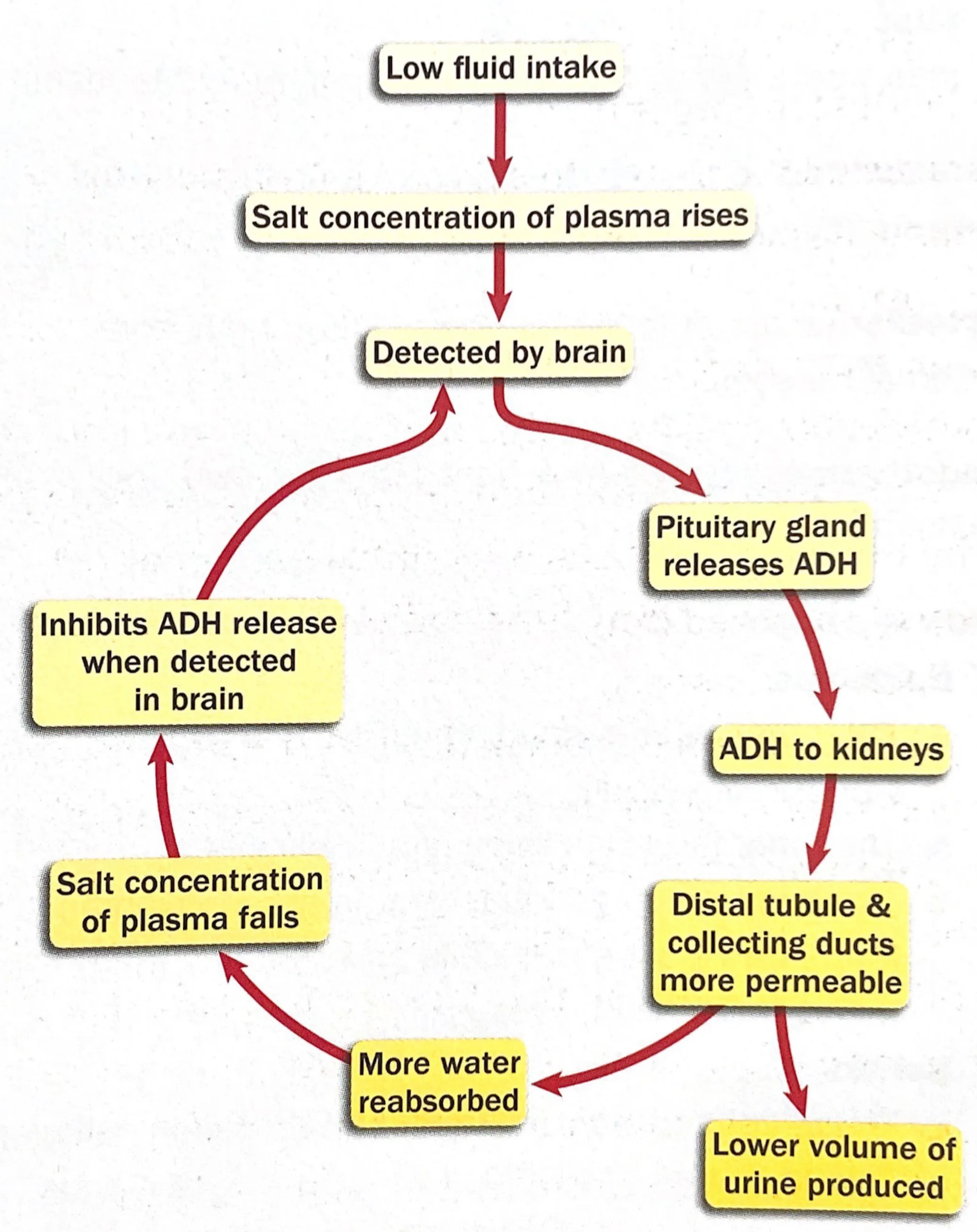
- The volume of urine produced is controlled by the hormone ADH (antidiuretic hormone).
- It controls how much water is reabsorbed in the distal convoluted tubule and the collecting ducts.
- ADH is produced by the pituitary gland.
Note
Exam Tip: Questions on ADH often focus on its role in regulating water balance. Remember that ADH increases water reabsorption in the kidneys, reducing urine output.
How ADH Works
High Salt Concentration in the Body (e.g., on a hot day or with low water consumption):
- The water level in blood plasma is low.
- ADH is released, making the collecting ducts more permeable to water.
- More water is reabsorbed into the blood.
- Urine produced is low in volume and very concentrated.
Low Salt Concentration in the Body (e.g., with high water consumption):
- The water level in blood plasma is normal or high.
- ADH is not released.
- The collecting ducts remain impermeable to water.
- Less water is reabsorbed into the blood.
- Urine produced is high in volume and very dilute.
| Condition | Effect on blood | ADH | Distal tubule and collecting duct | Urine |
|---|---|---|---|---|
| • Thirsty
• Salty diet
• Hot day
• Lots of exercise | Low water concentration & high salt concentration | Produced | More permeable to water | • Low volume of water
• High salt concentration | | • High water intake
• Very low salt diet | High water concentration & low salt concentration | Not produced | Less permeable to water | • High volume of water
• Low salt concentration | | High protein diet | Normal water concentration and increased urea concentration | No effect | No effect | • Same volume of water
• Increased urea concentration |
Note
Exam Tip: When discussing the role of the kidneys in excretion, focus on the three main processes: filtration, reabsorption, and secretion. Be sure to mention the function of the nephron in detail, as it's often a key point in exam questions.
Note
Summary: How is Blood Filtered?
- Blood enters the kidneys through the renal artery, which branches into smaller arterioles.
- These arterioles lead to Bowman's Capsules, where blood pressure is high due to the wider afferent arteriole.
- High pressure causes ultrafiltration, forcing small molecules like glucose, amino acids, salts, urea, and water into the Bowman's Capsule, forming the glomerular filtrate.
- Large molecules like proteins and blood cells are too big to pass through.
- Essential substances are reabsorbed in the proximal convoluted tubule, where 80% of water is reabsorbed by osmosis.
- In the descending loop of Henle, 5% of water, calcium, and magnesium are reabsorbed.
- The ascending loop reabsorbs some salts.
- In the distal convoluted tubule, up to 10% of water and some salts are reabsorbed.
- Secretion (by active transport) in the convoluted tubules removes potassium, hydrogen ions, and urea, helping to control blood pH.
- Finally, the collecting duct, which is permeable to water, reabsorbs up to 4.9% of water before the remaining liquid is excreted as urine.