Sight - The Eye (Leaving Cert Biology): Revision Notes
📚Revision Notes
Sight - The Eye
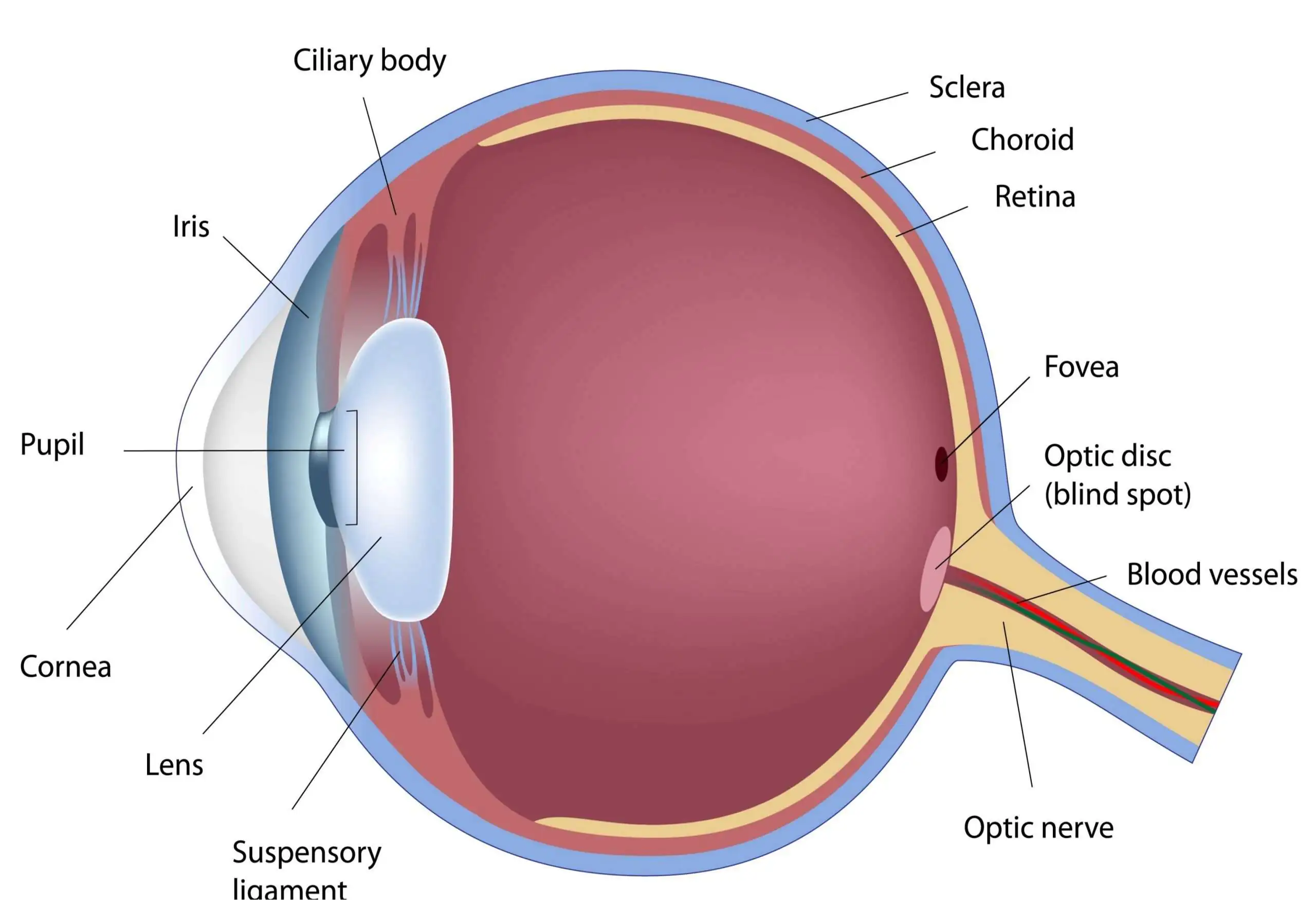
| Part | Function |
|---|---|
| Conjunctiva | Thin membrane protecting the sclera. Inflammation leads to conjunctivitis. |
| Sclera | Tough, white, outer coat that holds the eye in shape. |
| Cornea | Transparent section of the eye that allows light to enter the eye. |
| Choroid | Dark-brown or black layer containing blood vessels that nourish the eye. Absorbs light to prevent reflexion. |
| Retina | Light-sensitive layer containing rods and cones. Rods detect black and white, while cones detect colour. |
| Fovea | Central part of the retina with only cones, providing the sharpest vision and focus. |
| Blind spot | Area with no rods or cones, so no images are detected. |
| Optic nerve | Carries impulses from the eye to the brain. |
| Lens | Elastic, transparent structure that changes shape to focus light on the retina. |
| Ciliary muscle | Surrounds the lens and adjusts its shape to focus on objects at varying distances. |
| Iris | Coloured part of the eye. Controls the amount of light entering the eye. |
| Pupil | Opening in the iris that appears black because no light emerges from the inside of the eye. |
| Aqueous humour | Liquid that maintains the shape of the front part of the eye. |
| Vitreous humour | More viscous fluid that maintains the shape of the eyeball by exerting outward pressure. |
Pupil Reflex
- Bright light: the pupil contracts to reduce the amount of light entering the eye.
- Dim light: Pupil dilates (enlarges) to allow more light to enter the eye.
- When we observe an object that we admire, our pupils also enlarge.
Vision Problems
Long Sight (Hyperopia)
- A person can see distant objects clearly but cannot see near objects clearly.
- Caused by the eyeball being too short or the ciliary body being too weak.
- Corrected by placing a convex lens in front of the eyes.
Short Sight (Myopia)
- A person can see near objects clearly but cannot see distant objects clearly.
- Caused by the eyeball being too long or the ciliary body being too strong, resulting in the image being focused in front of the retina.
- Corrected by placing a concave lens in front of the eyes.
The Eye Focuses Light
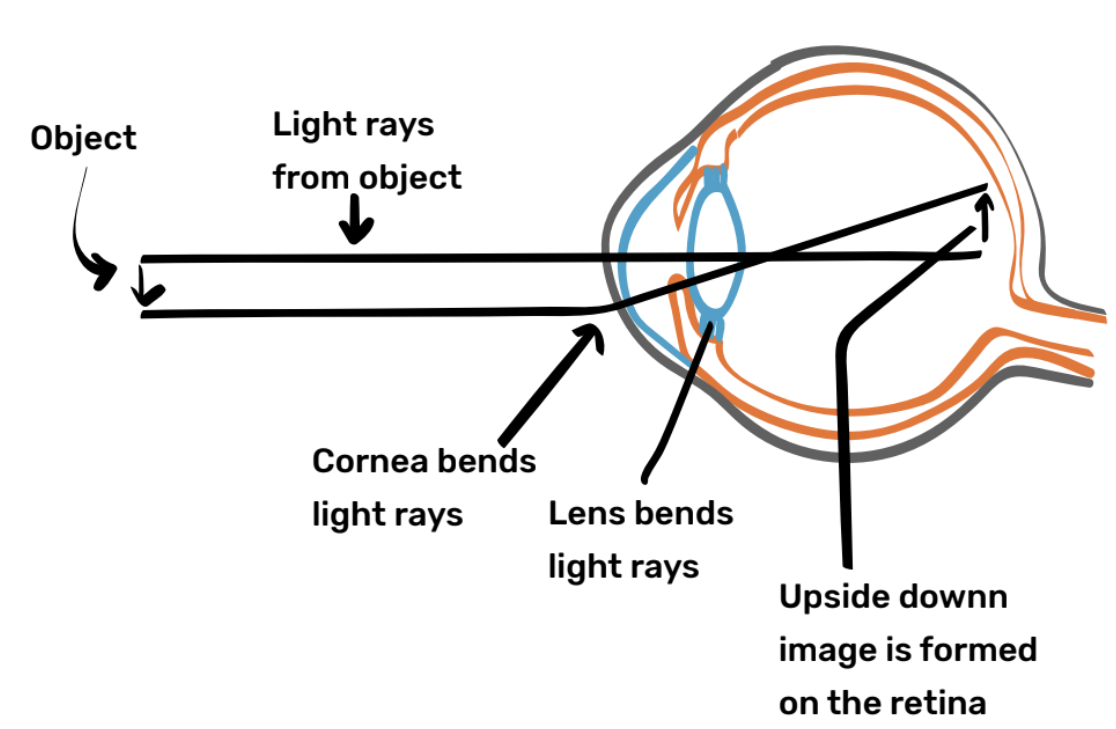
- Light waves travel in straight lines. These waves must be bent or refracted so that they focus exactly onto the retina.
- Light waves are bent by the cornea and lens to focus the light onto the retina.
- The shape of the lens can be changed to allow nearby or distant objects to be viewed. The process of changing the focus of the eye is called accommodation.
- The light receptor cells (cones and rods) in the retina use light to generate impulses in sensory neurons.
- These impulses are transmitted to the brain via neurons in the optic nerve.
- The image on the retina is upside down. The brain interprets this so that we see the right way up.