Selfing and Linkage (Leaving Cert Biology): Revision Notes
📚Revision Notes
Selfing and Linkage
What is selfing?
Selfing is a breeding process where you cross a genotype with the same genotype. This means taking an organism and breeding it with another organism that has identical genetic makeup, or in some cases, an organism breeding with itself.
When selfing occurs, it typically produces what we call the F₂ generation - this is the second filial generation that results from crossing two F₁ individuals.
Note
The F₂ generation is particularly important in genetics because it reveals the underlying genetic ratios that were hidden in the F₁ generation. While F₁ offspring often look identical due to dominant traits, the F₂ generation shows the full range of possible genetic combinations.
Understanding the F₂ generation
The F₂ generation becomes particularly interesting when we perform a dihybrid cross. This involves looking at two different traits at the same time, such as flower colour and stem length.
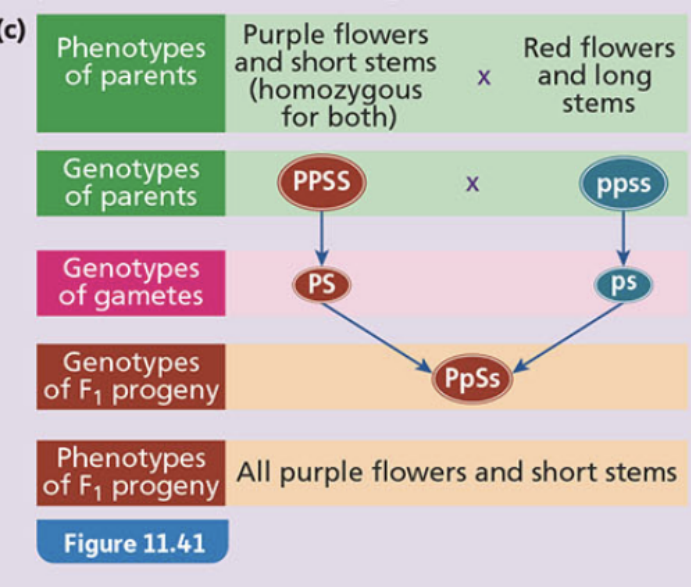
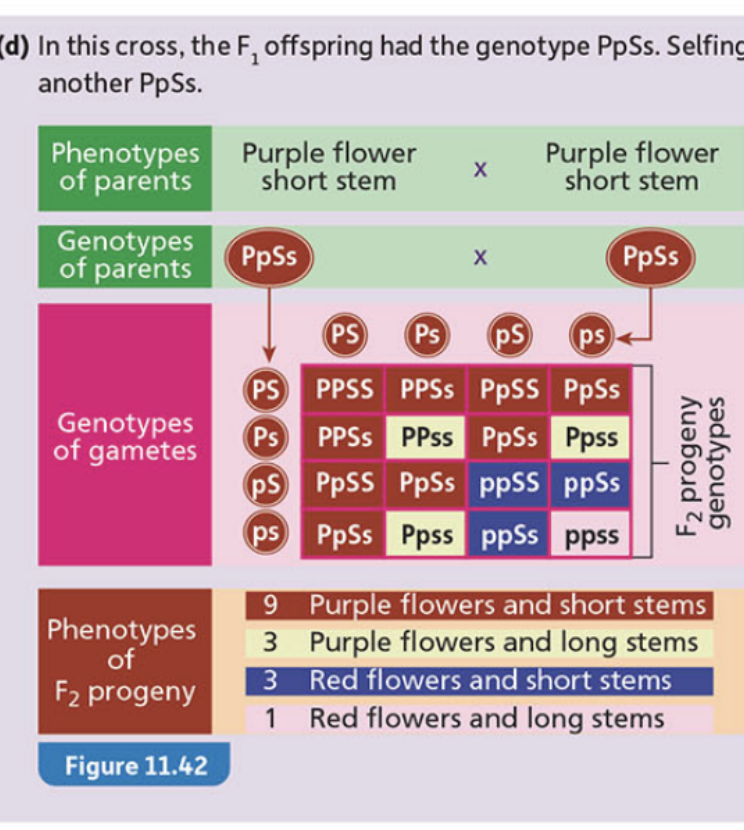
When we cross two F₁ plants (both with genotype PpSs), we can predict the outcomes using a Punnett square. The F₁ plants can produce four different types of gametes: PS, Ps, pS, and ps.
Example
Worked Example: Dihybrid Cross Ratios
This dihybrid cross produces the famous phenotypic ratio:
- 9 purple flowers with short stems
- 3 purple flowers with long stems
- 3 red flowers with short stems
- 1 red flower with long stems
This ratio occurs when genes assort independently according to Mendel's second law.
What is genetic linkage?
Linkage refers to genes or alleles that are located on the same chromosome. Because these genes are physically close together on the same chromosome, they tend to be passed on together to the next generation.
Important
The key concept here is that linked genes don't follow Mendel's law of independent assortment. Instead of separating randomly during gamete formation, they tend to stay together because they're on the same piece of DNA.
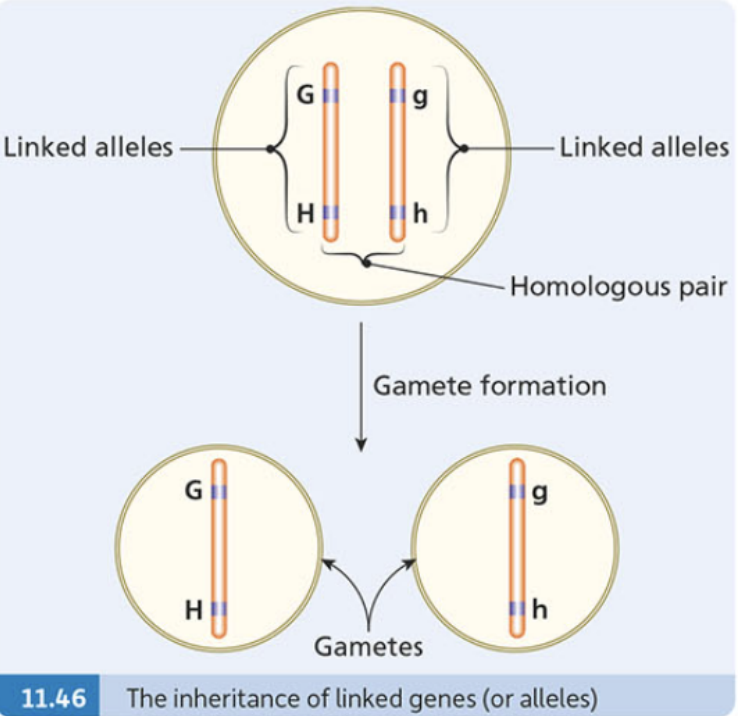
In this diagram, you can see how linked alleles (G with H, and g with h) are inherited together during gamete formation. The homologous pair of chromosomes carries these linked genes, and they move together into the gametes.
How linkage affects independent assortment
Linkage contradicts Mendel's second law of independent assortment. Here's why this happens:
When genes are unlinked (independent assortment):
- Four different types of gametes are produced in equal numbers
- This gives a ratio (25% each)
- The genes can combine freely with any other gene
When genes are linked:
- Only two types of gametes are formed
- This gives a ratio (50% each)
- The genes cannot separate easily and stay together
Important
Critical Difference: Unlinked genes produce four different gamete types in equal proportions, while linked genes produce only two types of gametes. This fundamental difference completely changes the expected ratios in genetic crosses.
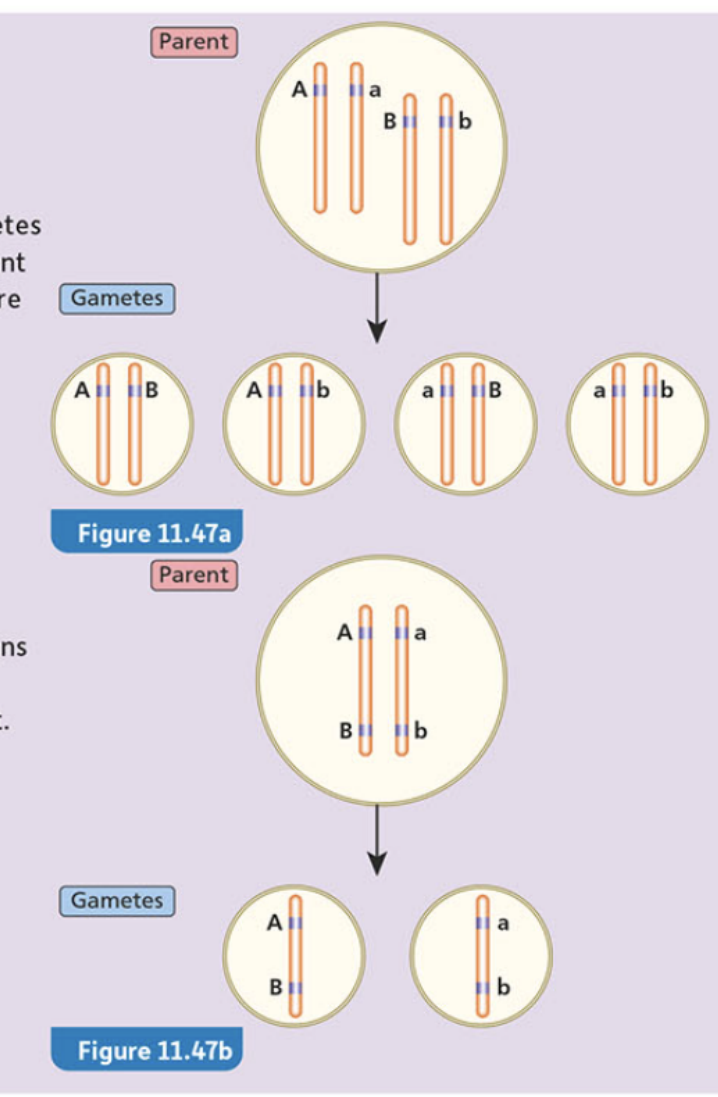
This diagram shows the difference clearly. In part (a), unlinked genes produce four different gamete types, while in part (b), linked genes produce only two types.
Expected ratios in genetic crosses
Understanding the expected ratios helps us identify whether genes are linked or unlinked. Different patterns emerge depending on the genetic relationship between the traits being studied.
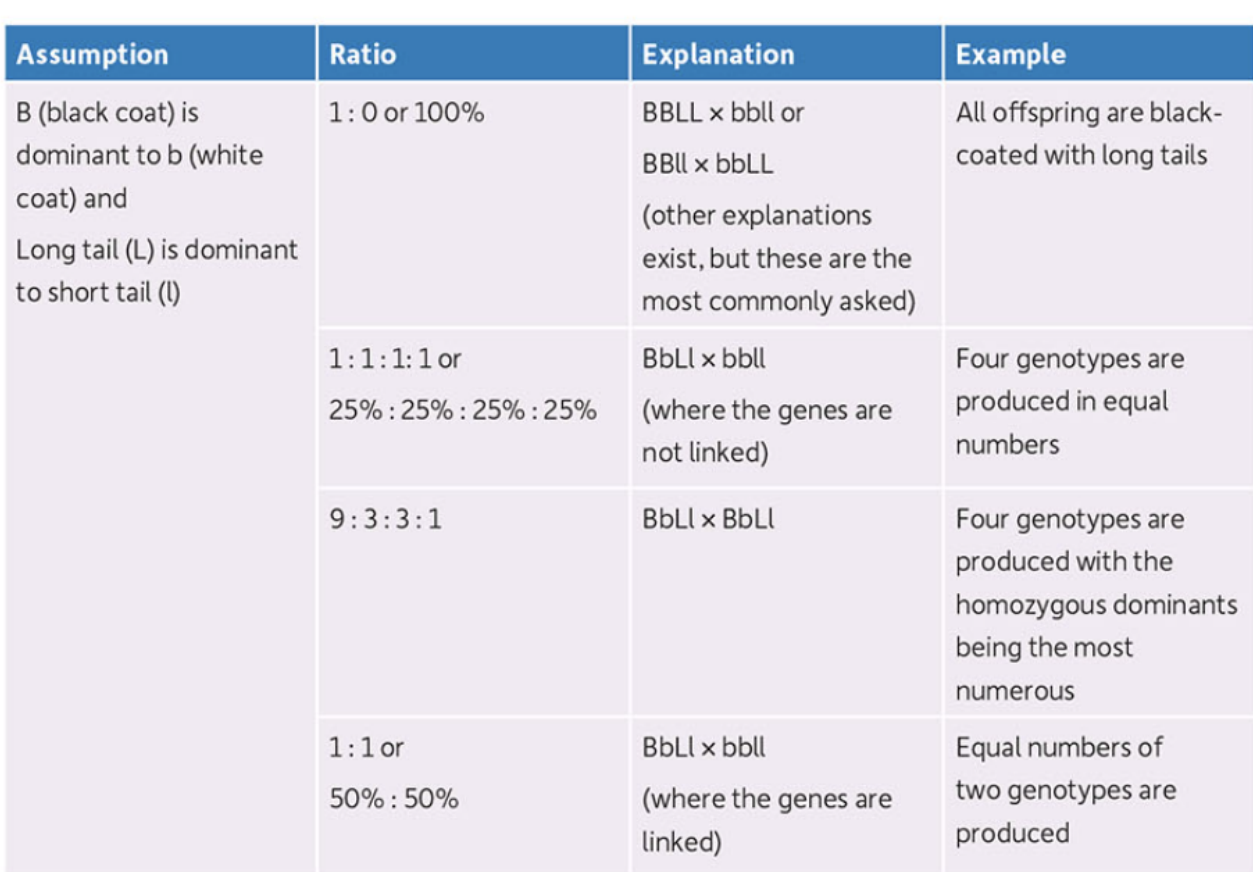
The table shows different scenarios:
Example
Ratio Patterns in Genetic Crosses
Complete dominance ( or 100%):
- All offspring show the dominant trait
- Example: All black-coated, long-tailed offspring
Independent assortment ():
- Four genotypes produced in equal numbers (25% each)
- Occurs when genes are on different chromosomes
Classic Mendelian cross ():
- Typical dihybrid cross pattern
- Homozygous dominants are most numerous
Genetic linkage ():
- Equal numbers of two genotypes (50% each)
- Occurs when genes are on the same chromosome
Key differences between linked and unlinked genes
Understanding the fundamental differences between these two scenarios is essential for predicting inheritance patterns and interpreting genetic data.
Unlinked genes:
- Located on different chromosomes
- Follow independent assortment
- Produce gamete ratio
- Give phenotypic ratio in F₂
Linked genes:
- Located on the same chromosome
- Do not assort independently
- Produce gamete ratio
- Give different ratios in F₂ (not )
Note
Exam tip: If you see a ratio in offspring, the genes are likely unlinked. If you see a ratio, the genes are probably linked. This is one of the most reliable ways to distinguish between these two scenarios in genetic problems.
Practical applications
Understanding linkage has significant real-world applications beyond theoretical genetics. This knowledge is actively used in various fields where genetic inheritance matters.
Note
Real-World Applications of Linkage
Understanding linkage is important for:
- Plant and animal breeding programmes
- Predicting inheritance patterns
- Genetic counselling
- Medical genetics research
When breeders want certain traits to stay together (like disease resistance with high yield), they look for linked genes. When they want traits to separate, they prefer unlinked genes.
Summary
Summary
Key Points to Remember:
- Selfing means crossing organisms with identical genotypes to produce the F₂ generation
- Linked genes are located on the same chromosome and tend to be inherited together
- Independent assortment gives a ratio, while linkage gives a ratio
- Linkage breaks Mendel's second law because genes don't assort independently when they're on the same chromosome
- The ratio only appears when genes are unlinked and follow independent assortment
- Recognizing ratios is the key to identifying whether genes are linked or unlinked in genetic crosses