The General Defence System (Leaving Cert Biology): Revision Notes
📚Revision Notes
The General Defence System
- The body's defence system protects us against disease-causing organisms called pathogens.
- Humans have 2 methods of defence against pathogens:
- The general defence system
- The specific defence system
Note
Pathogens are disease causing organisms.
The General Defence System
- The general defence system is the body's first line of defence.
- It is non-specific- it does not recognise the individual pathogen.
Barrier System
- Skin: Acts as a physical barrier to stop pathogens entering the body.
- Sebaceous Glands: Produce sebum, which prevents the skin from cracking, blocking pathogen entry.
- Mucus Membranes: Line the breathing, reproductive, and digestive tracts, trapping pathogens with sticky mucus.
- Stomach Acid: Hydrochloric acid in the stomach kills many pathogens.
- Cilia: The respiratory system is lined with tiny hairs called cilia. These beat and create a current, which moves mucus back up the respiratory system so that it can be swallowed into the stomach. Coughing assists this process by clearing mucus from the larynx, helping to keep our airways clear.
- Ear Wax: Traps pathogens and small particles.
- Tears: Wash away pathogens and debris.
Non-Specific Cellular Response:
If pathogens pass the barrier system, the body initiates non-specific responses, including:
- Defence Proteins
- Interferons
- Phagocytic White Blood Cells (Phagocytes/Monocytes)
- Inflammation
- Fever
- Lysozyme
1. Defence Proteins
- Complement: A group of about 30 proteins in blood plasma, produced by the liver.
- These proteins support the specific defence system and become active when an infection occurs.
- Complement proteins trigger a chain reaction that leads to the bursting of viruses and other pathogens.
- They are non-specific, meaning they produce the same response against all pathogens.
2. Interferons
- Produced by body cells that have been infected with a virus.
- Once released, interferons spread to nearby cells and stimulate them to prevent viral multiplication.
- Interferons are non-specific, meaning they are released in response to all infections and do not change or adapt.
3. Phagocytic White Blood Cells (Phagocytes/Monocytes)
- Phagocytes ingest and engulf pathogens in a process called phagocytosis.
- This removes pathogens from the body.
4. Inflammation
- When cells are infected, they release a chemical called histamine.
- This causes:
- Blood vessels to dilate, leading to redness, heat, and swelling.
- Attraction of more white blood cells to the infected area to fight the infection.
- Antihistamines are chemicals that block the effects of histamine, reducing inflammation (e.g., during hay fever or stings).
Note
Remember! Histamine causes blood vessels to dilate, leading to redness and swelling. Think of it as a signal flare that attracts immune cells to the battle site!
5. Fever
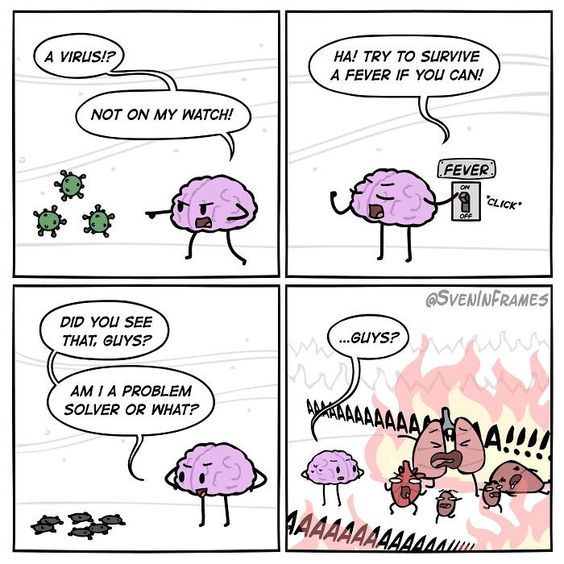
- Fever increases body temperature, which denatures the enzymes in bacteria and viruses, stopping their activity.
6. Lysozyme
- Lysozyme is an enzyme found in tears and saliva that kills bacteria by breaking down their cell walls.
- It is non-specific, acting against most bacteria.
Note
Denatured: The active site of an enzyme has been destroyed. The enzyme can no longer act on the substrate.