Viruses (Leaving Cert Biology): Revision Notes
📚Revision Notes
Viruses
What are viruses?
Viruses are incredibly tiny structures that are fundamentally different from all other forms of life. These microscopic entities are non-cellular, meaning they are not made up of cells like bacteria, plants, or animals. Due to their extremely small size, viruses cannot be seen with ordinary light microscopes - scientists need to use powerful electron microscopes to observe them.

To put their size into perspective, viruses are approximately 50 times smaller than bacteria. This means that about 50,000 viruses could fit across the width of a full stop at the end of this sentence!
Note
The development of electron microscopy in the 1930s was crucial for virus research. Before this technology, scientists could only infer the existence of viruses by studying their effects on host organisms, as they were completely invisible under conventional light microscopes.
Structure of viruses
Viruses have a remarkably simple structure consisting of just two main components. This basic design reflects their parasitic nature - they don't need complex internal machinery because they rely entirely on their host cells for survival and reproduction.

The two essential parts of every virus are:
- Protein coat (capsid) - This is the outer protective layer that surrounds and protects the genetic material. The capsid is made of proteins and gives the virus its shape.
- Nucleic acid core - This contains the virus's genetic material, which can be either DNA or RNA (but never both). This genetic material contains all the instructions needed to make new viruses.
Note
Unlike living cells, viruses do not contain any cellular organelles such as mitochondria, ribosomes, or a nucleus. This simple structure makes them completely dependent on host cells for all life processes.
Functions of viruses
The primary function of a virus is to replicate itself by hijacking the cellular machinery of a host cell. Here's how this process works:
Example
Viral Replication Process:
Step 1: Attachment and entry - The virus attaches to a suitable host cell and enters it
Step 2: Hijacking - Once inside, the virus takes over the host cell's normal functions
Step 3: Replication - The virus uses the host cell's resources to produce many copies of itself
Step 4: Release - New virus particles are released from the host cell to infect other cells
This process often damages or destroys the host cell, which explains why viral infections can make organisms sick. Importantly, viruses can only replicate inside living host cells - they cannot reproduce on their own.
Are viruses living or dead?
One of the most fascinating debates in biology concerns whether viruses should be classified as living or non-living. Viruses exist on the border between life and non-life, showing characteristics of both categories.
Important
The question of whether viruses are alive is not just academic - it has important implications for how we understand life itself and how we approach treating viral infections. Most scientists consider viruses to be "on the edge of life" rather than truly living organisms.
Living characteristics of viruses:
- Contain genetic material (DNA or RNA)
- Have a protein coat structure
- Can replicate (but only inside host cells)
- Show heredity - they pass traits to offspring
Non-living characteristics of viruses:
- Are not made of cells (non-cellular structure)
- Cannot reproduce by themselves
- Do not have cell organelles
- Do not display metabolism
- Do not respire or carry out other life processes independently
Shapes of viruses
Viruses can be arranged into three main groups based on their shape and structure:
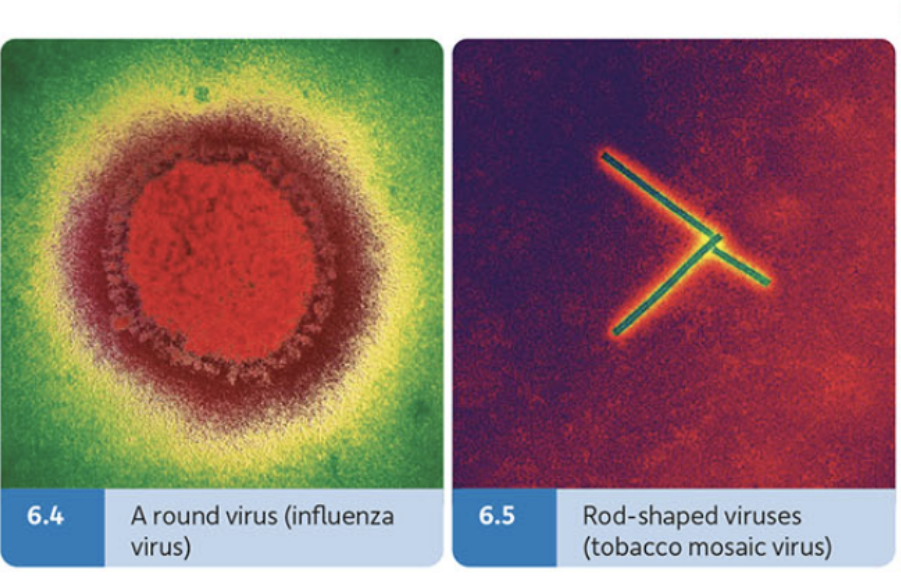
Round (spherical) viruses
These viruses have a roughly spherical shape. The influenza virus is a good example of this type, appearing as circular structures when viewed under a microscope.
Rod (helical) viruses
These viruses have an elongated, cylindrical shape. The tobacco mosaic virus is a classic example of this type, appearing as long, thin rods.
Complex viruses
These viruses have more complicated, irregular shapes. Bacteriophages (viruses that infect bacteria) often fall into this category, sometimes having structures that look like tiny spacecraft with "landing legs."
Economic and medical importance of viruses
Viruses have enormous impact on human society, both negative and positive. Understanding these impacts is crucial for appreciating why virus research is so important.
Disadvantages of viruses
Human diseases Viruses cause a wide range of human diseases that affect millions of people worldwide. Common viral infections include:
- Colds and influenza (flu)
- Measles and mumps
- Chickenpox and cold sores
- Hepatitis and AIDS
- More recent threats like Ebola, Zika virus, and COVID-19
These diseases create enormous economic costs through lost work time, medical treatments, and prevention programmes.
Plant diseases Viruses also attack plants, causing significant agricultural losses. Examples include:
- Tobacco mosaic disease - causes spotted, mosaic patterns on leaves
- Potato mosaic disease
- Tomato mosaic disease
These plant viruses reduce crop yields and quality, affecting food security and farmer incomes.
Animal diseases Common viral diseases in animals include foot and mouth disease, rabies, swine fever, bird flu, and myxomatosis in rabbits. These diseases cause huge economic losses in agriculture and can sometimes spread to humans.
Advantages of viruses
Despite their reputation as harmful agents, viruses also have important beneficial applications:
Gene transfer Scientists use modified viruses as vectors to transfer genes from one organism to another in genetic engineering and gene therapy. This technique has potential for treating genetic diseases.
Control of infections Bacteriophages (viruses that specifically attack bacteria) can be used to control harmful bacterial infections. This is particularly valuable as an alternative to antibiotics, especially against antibiotic-resistant bacteria.
Biological control Viruses can be used to control pest populations naturally. For example, myxoma virus was introduced to Australia in 1950 to control the rabbit population, which had become a serious agricultural pest.
Example
Successful Biological Control:
In Australia, the rabbit population had exploded to over 600 million by 1950, causing massive agricultural damage. The introduction of myxoma virus reduced the rabbit population by over 99% within just a few years, saving millions of dollars in crop damage annually.
Remember!
Summary
Key Points to Remember:
-
Viruses are non-cellular structures that require electron microscopes to be seen - they're about 50 times smaller than bacteria
-
Simple structure consisting of just a protein coat (capsid) surrounding genetic material (DNA or RNA)
-
Cannot reproduce independently - they must hijack host cells to replicate, making them parasitic
-
Living vs non-living debate - viruses show some characteristics of life but lack others, particularly the ability to carry out metabolism independently
-
Three main shapes - round (like influenza), rod (like tobacco mosaic virus), and complex (like bacteriophages) help scientists classify different virus types