The Central Nervous System - The Brain (Leaving Cert Biology): Revision Notes
📚Revision Notes
The Central Nervous System - The Brain
The Brain
- The brain is responsible for interpreting incoming impulses and deciding on a response.
- Grey matter: composed of cell bodies and dendrites.
- White matter: composed of axons.
- The skull protects the brain.
- The brain is surrounded by three layers of membranes called the meninges.
- Cerebrospinal fluid (CSF) is found between these membranes, protecting the brain.
- Meningitis is an infection of the meninges, caused by either a viral or bacterial infection.
Structure of the Brain
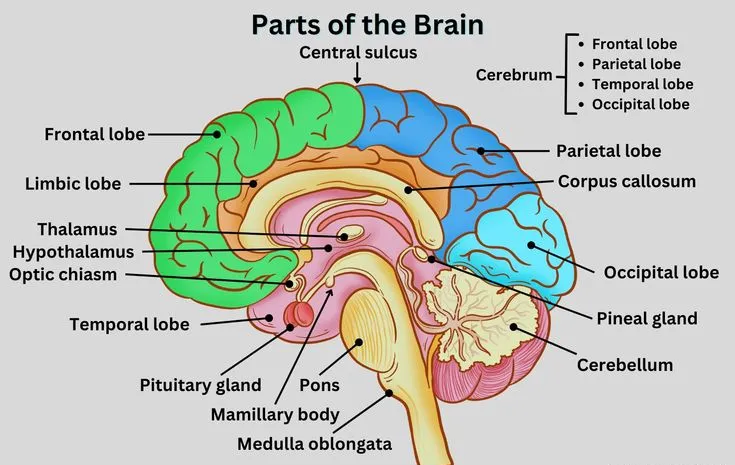
- The brain is composed of outer grey matter and inner white matter.
- It is divided into three main parts:
- Forebrain: Includes the cerebrum, hypothalamus, thalamus, pituitary gland, and pineal gland.
- Midbrain: A small part of the brain containing optic lobes, which control eye movements. It connects the forebrain with the hindbrain.
- Hindbrain: Includes the cerebellum and medulla oblongata.
Note
Exam Focus: What is the function of the pineal body?
The pineal gland secretes melatonin, which helps regulate sleep and wake cycles.
Parts of the Brain
| Part | Function |
|---|---|
| Cerebrum | • Made of two hemispheres, connected by the corpus callosum (bundle of nerves). • Controls thought, logic, will, intelligence, memory, and activities connected with sense organs (e.g., speech, vision, hearing), plus motor control. • The right hemisphere controls the left side of the body and vice versa. |
| Thalamus | • Receives sensory messages and directs them to the correct area in the cerebrum. • Controls emotional states such as pain and pleasure. |
| Hypothalamus | • Regulates the internal environment (homeostasis) by monitoring osmoregulation, appetite, thirst, body temperature, heart rate, blood pressure, breathing etc. • Assists the pituitary gland in hormone regulation. |
| Cerebellum | • Located at the back of the head. • Controls balance and muscular coordination. • Affected by alcohol. |
| Medulla oblongata | • Located where the spinal cord enters the brain. • Controls involuntary muscles involved in breathing (diaphragm), heart rate, swallowing (peristalsis), coughing and sneezing. • Detects carbon dioxide levels in the blood. |
| Pituitary | • Known as the master hormone gland. • Controlled by the hypothalamus. |
| Pineal body | • Controls sleep/wake cycles by secreting melatonin. |
| Olfactory lobes | • Responsible for the sense of smell. |
Note
Homeostasis: the maintenance of a constant internal environment.
Note
Brain Functions Simplified: 4. Cerebrum: controls thought, memory,sensory activities and motor control. 5. Thalamus: directs sensory messages to the cerebrum. 6. Hypothalamus: regulates homeostasis, including body temperature and appetite. 7. Cerebellum: controls balance and coordination. 8. Medulla oblongata: controls involuntary functions like breathing and heart rate. 9. Pituitary: acts as the master hormone gland. Releases hormones that regulate various physiological processes, including growth. 10. Pineal gland: controls sleep/wake cycles (secretes melatonin). 11. Olfactory lobes: concerned with the sense of smell.
The Spinal Cord
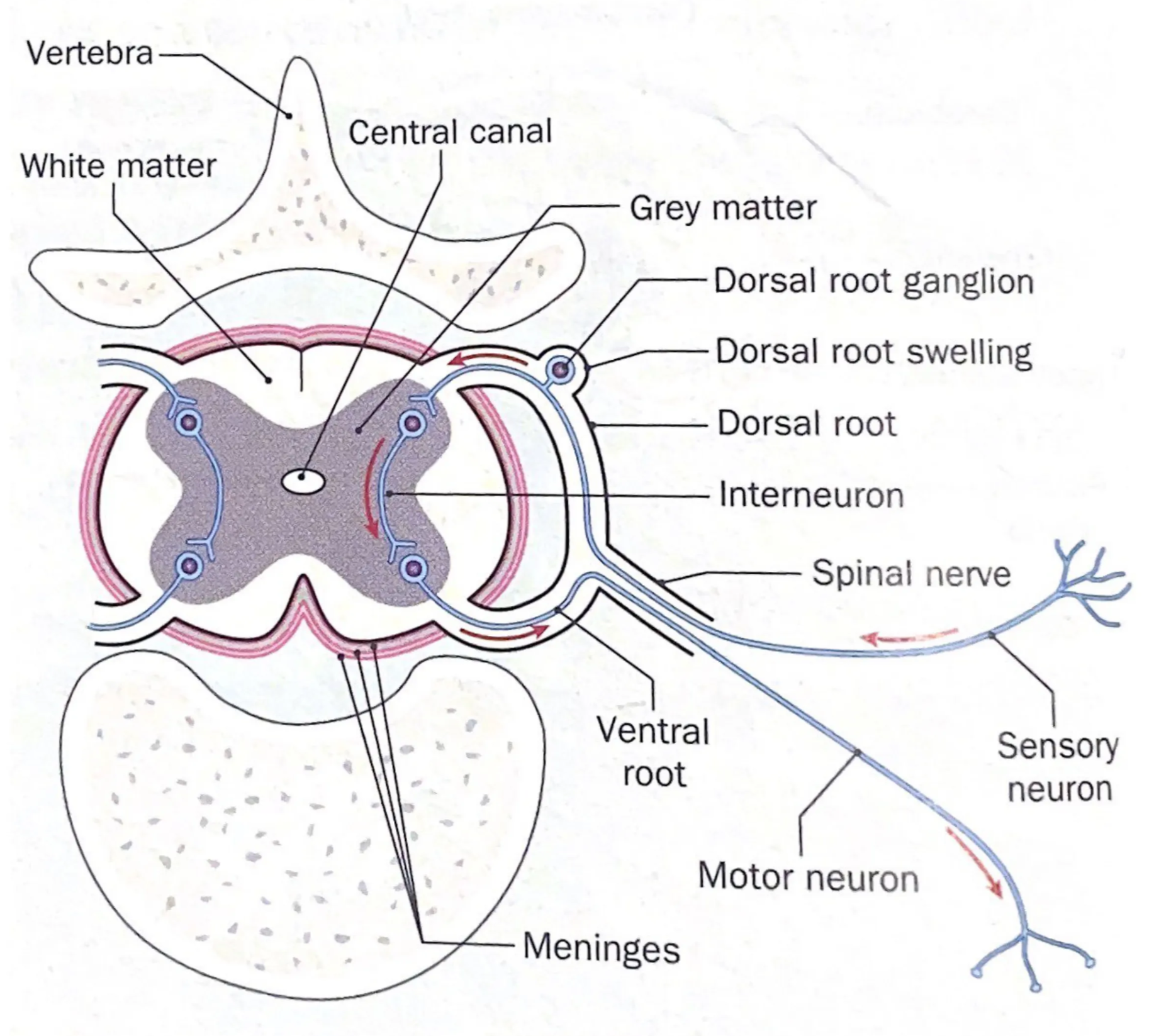
- The spinal cord carries messages to and from the brain.
- The spinal cord has 31 pairs of spinal nerves, which carry messages to and from different areas of the body.
- Before entering the spinal cord, each spinal nerve divides into a dorsal root and a ventral root.
- Dorsal roots carry sensory neurons into the spinal cord.
- Ventral roots carry the axons of motor neurons away from the spinal cord.
- The dorsal root is at the back of the spinal cord, and the ventral root is at the front of the spinal cord.
- Every dorsal root has a dorsal root ganglion, which holds the cell bodies of sensory neurons.
Sections of the Spinal Cord
- Outer section (White Matter):
- Contains axons covered in a myelin sheath, which allows for faster impulse transmission.
- Inner section (Grey Matter):
- Contains cell bodies, dendrites, and interneurons.
- Includes the central canal, filled with cerebrospinal fluid. This helps cushion and protect the spinal cord.