Structure of the Flower (Leaving Cert Biology): Revision Notes
📚Revision Notes
Structure of the Flower
- Asexual reproduction: involves one parent.
- Sexual reproduction: the fusion of two gametes. Two parents are involved in this process.
- Gametes: haploid cells that are able to fuse together.
- Flowers are the reproductive organs of flowering plants.
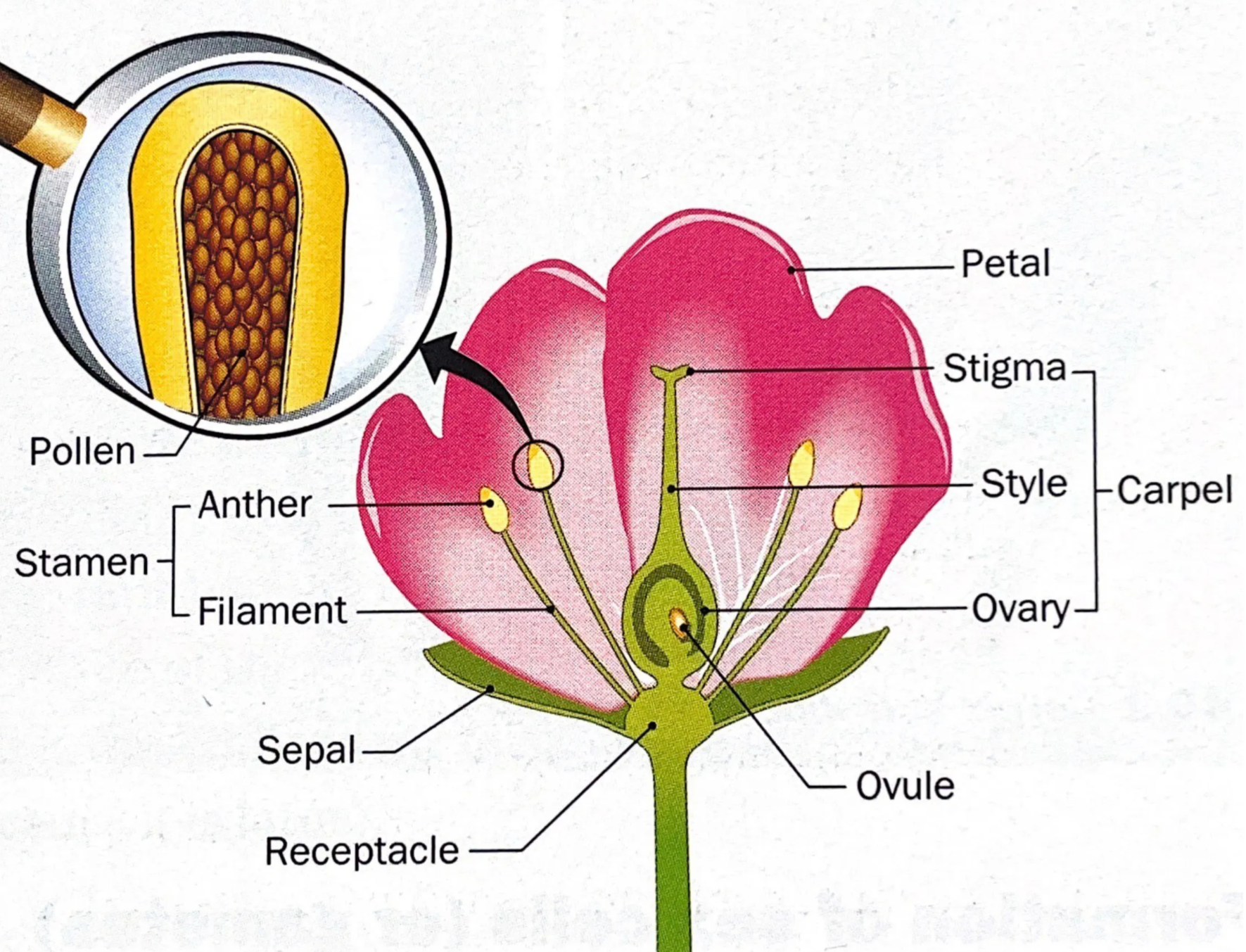
| Sepals | Protects the flower when it is a bud. |
|---|---|
| Petals | Attracts animals to the flower for pollination• large, brightly coloured and scented to attract insects in animal-pollinated plants. Small, green or absent in wind-pollinated plants. |
| Stamen (male) | The male part of the flower consisting of the anther and filament. |
| Anther | Produces pollen grains. |
| Filament | Supports the anther. |
| Carpel (female) | The female part of the flower, consisting of the stigma, the style and the ovary. |
| Stigma | Where pollen lands. |
| Style | A tube through which the pollen tube grows. |
| Receptacle | Supports the flower and forms its base. |
| Ovary | Contains one or more ovules. |
| Nectary | Produces sugary substance called nectar. Attracts insects for pollination. |
Introduction to Sexual Reproduction in Flowering Plants
- Definition:
- Sexual reproduction involves the fusion of a male gamete and a female gamete to form a zygote, which develops into a seed.
- Purpose of Sexual Reproduction:
- Promotes genetic variation, which is beneficial for survival and adaptation to environmental changes.
- Structure of the Flower:
- Flowers are the reproductive organs of flowering plants.
- Male and female structures are required for reproduction:
- Stamen: Male part of the flower, which produces pollen grains (male gametes).
- Carpel: Female part of the flower, which produces ovules (female gametes).
- Pollination:
- The process of transferring pollen from the anther (male part) to the stigma (female part) of the same or a different flower.