Summary of Key Points (Leaving Cert Biology): Revision Notes
📚Revision Notes
Summary
Note
We understand that this topic may seem complicated, but don't worry! Let's run through the key points together.
When in doubt, focus on learning your definitions, understanding the concepts in ordinary, everyday language, mastering the keywords, and then piecing it all together.
You've got this, and we're here to help every step of the way!

Male Gamete Formation
-
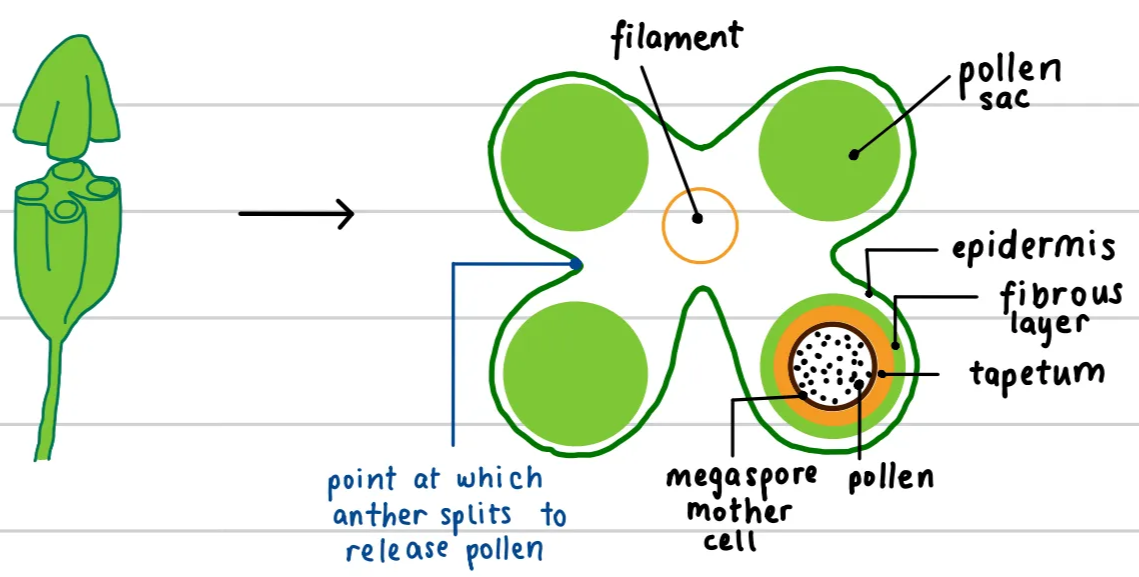
Anther consists of four pollen sacs which contain diploid microspore mother cells.
-
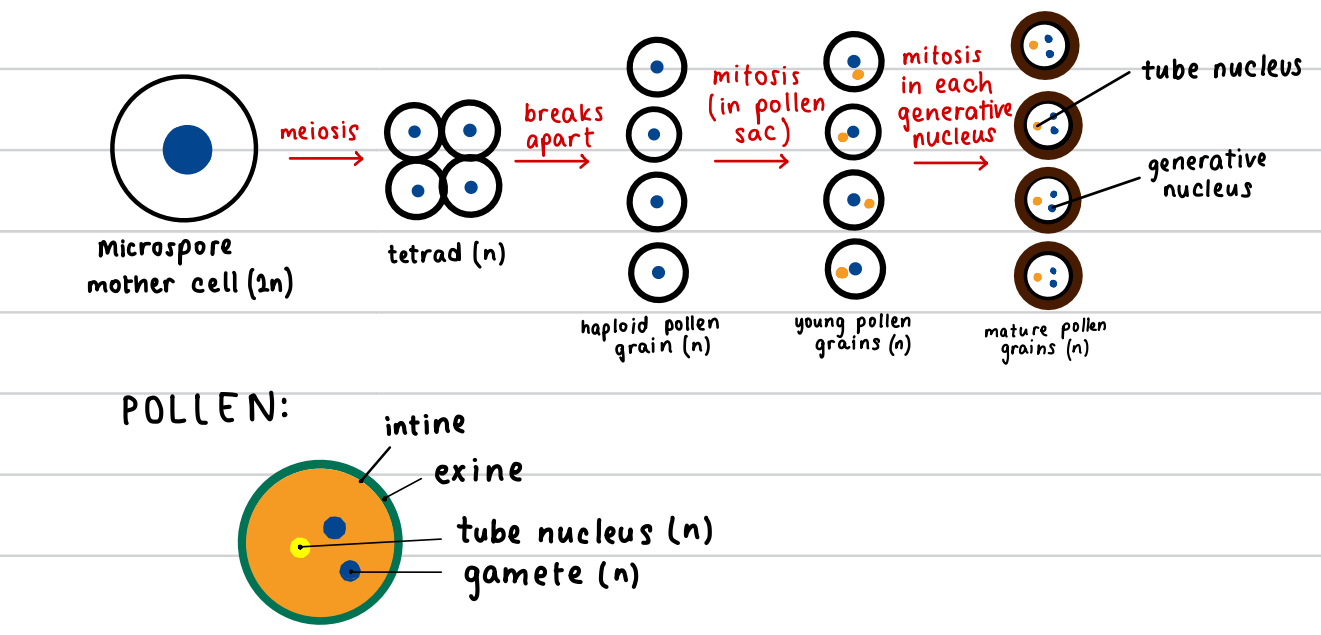
Microspore mother cell (2n) divides by meiosis in the cells lining the anther to produce four haploid pollen grans - tetrad.
-
The tetrad separates into 4 individual pollen grains -microspores.
-
The nucleus in each pollen grain divides by mitosis to produce two haploid nuclei:
-
Generative nucleus
-
Tube nucleus
Female Gamete Formation
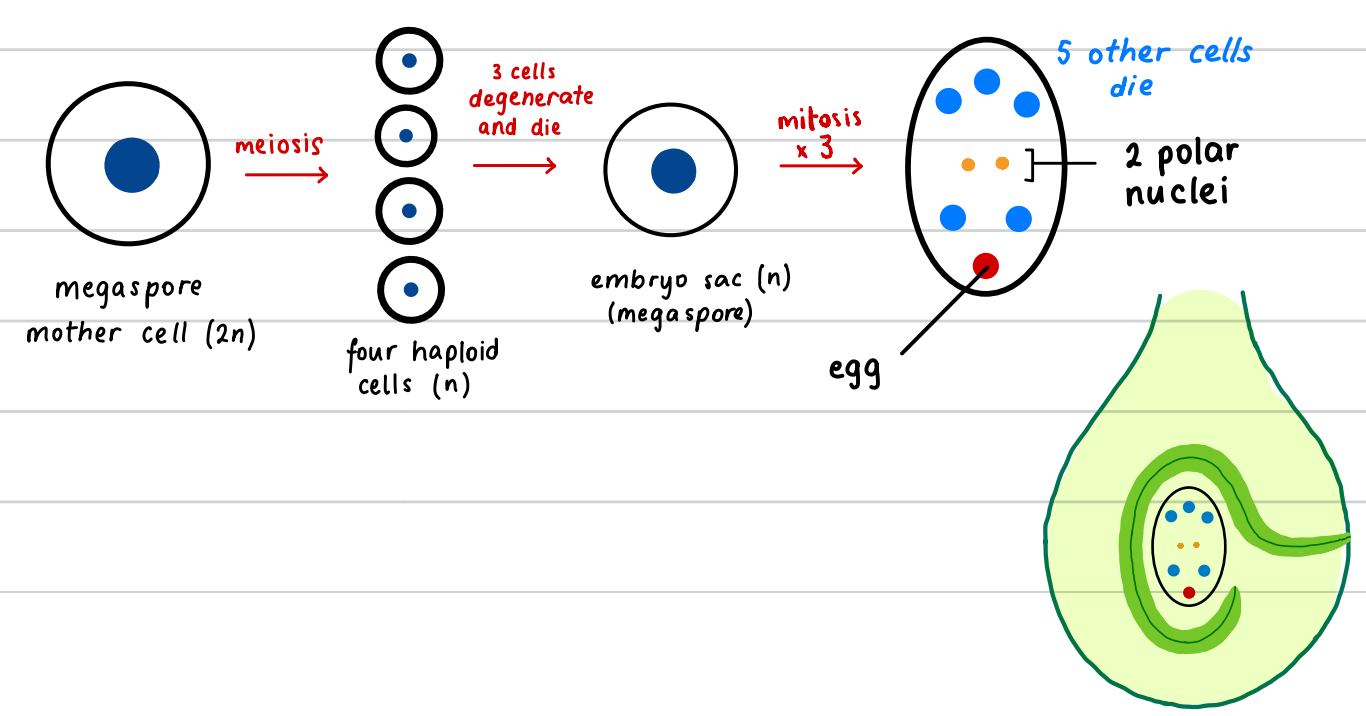
- Megaspore mother cell (2n) in the ovule divides by meiosis to produce 4 haploid cells.
- Three die (degenerate), and the remaining cell becomes the embryo sac.
- The embryo sac undergoes mitosis three times, producing 8 haploid nuclei:
- Five degenerate,
- Two form polar nuclei,
- One becomes the egg cell (female gamete).
Pollination
Note
Pollination is the transfer of pollen from an anther to a stigma of a flower from the same species.
- Self pollination
- Cross pollination
- Wind
- Animal (including insects)
Fertilisation
Note
Fertilisation is the union of the male and female gametes to form a diploid zygote.
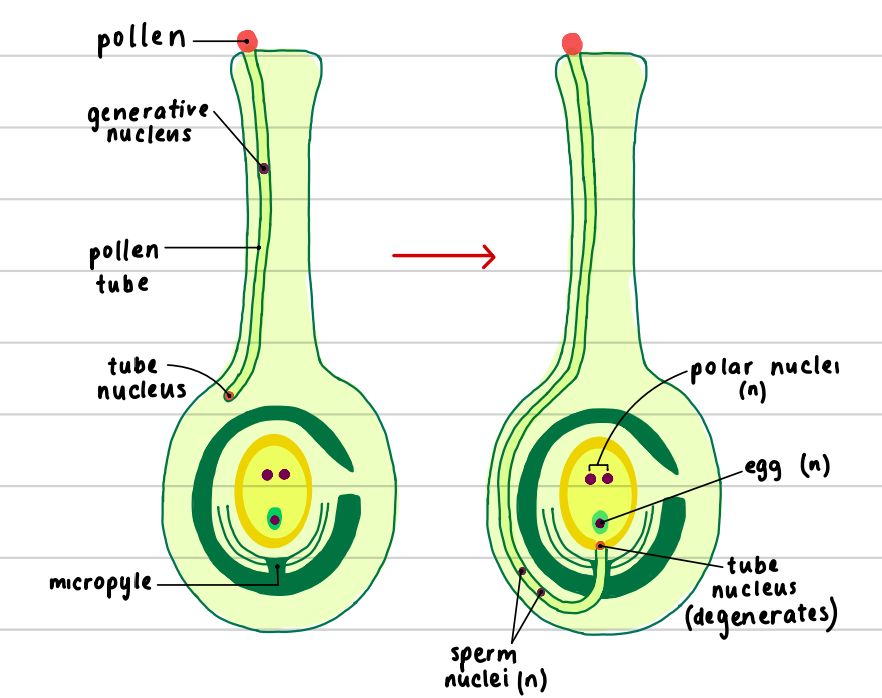
- A pollen grain lands on the stigma.
- The tube nucleus controls growth of a pollen tube, which grows down through the style towards the micropyle (guided by chemotropism).
- The generative nucleus moves down the pollen tube and divides by mitosis, forming two haploid male gametes (sperm nuclei).
- Double fertilisation occurs:
- 1st sperm nucleus (n) + egg nucleus (n) —> zygote (2n)
- 2nd sperm nucleus (n) + 2 polar nuclei (n) —> triploid endosperm (3n)
Germination
Note
Necessary Conditions: 5. Water —> needed for enzyme reactions to occur. 6. Oxygen —> needed for aerobic respiration. 7. Suitable temperature —> needed for enzyme reactions to occur.
- Seed absorbs water, activating enzymes.
- Stored food is digested:
- Oils → Fatty acids + glycerol.
- Starch → Glucose.
- Proteins → Amino acids.
- Products fuel embryo growth:
- Glucose + amino acids —> cell walls + enzymes
- Glucose + fats —(respiration)—> energy
- Dry mass falls due to foods used in respiration. The weight of the embryo increases.
- Radicule bursts through the testa and grows down (geotropism).
- Plumule emerges above ground and leaves are produced.
- When the leaves begin to photosynthesise, the dry mass increases again.