Plant Tissues (Leaving Cert Biology): Revision Notes
📚Revision Notes
Plant Tissues
- Plants belong to the kingdom Plantae.
- They are multicellular organisms that make their own food (autotrophic).
- Flowering plants (angiosperms) are the most diverse members of the plant kingdom.
- Flowering plants are divided into two groups:
- Monocotyledons (e.g., grasses, cereals)
- Dicotyledons (e.g., dandelion, carrot, oak tree)
Note
Autotrophic**:** organisms that produce their own food e.g. plants produce their food through photosynthesis.
What is a Cotyledon?
- A cotyledon is an embryonic seed leaf that stores food.
- Why is this important?
- Seeds planted underground cannot photosynthesize due to lack of sunlight. They use the stored food for growth.
- Once the seed germinates and true leaves develop, cotyledons are no longer needed.
- Monocots have one cotyledon in their seed (e.g., grasses, cereals).
- Dicots have two cotyledons in their seed (e.g., dandelion, carrot, oak tree).
Note
A cotyledon is an embryonic seed leaf that stores food.
Monocots vs Dicots
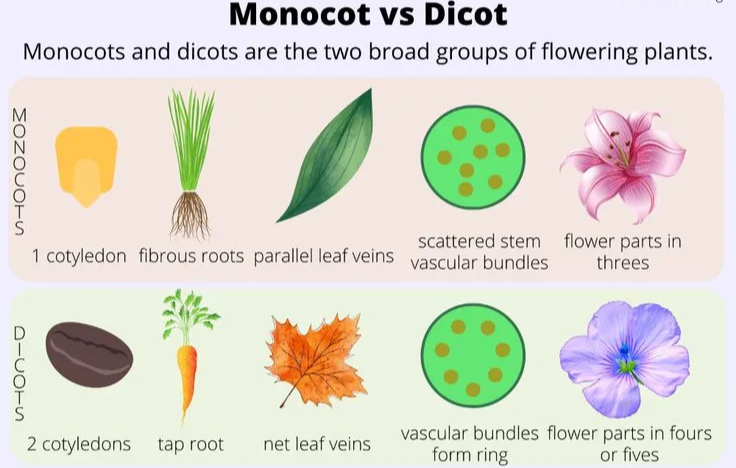
| Monocots | Dicots |
|---|---|
| Seeds contain 1 cotyledon | Seeds contain 2 cotyledons |
| Mainly herbaceous (no woody parts) | Herbaceous or woody |
| Long narrow leaves | Broad leaves |
| Parallel leaf venations | Netted venation |
| Vascular bundles scattered at random in the stem | Vascular bundles form a ring in the stem |
| Flowering parts in multiples of 3 | Flowering parts in multiples of 4 or 5 |
| Fibrous root system | Tap root system |
| E.g., Daffodils, tulips, grasses | E.g., Beans, peas, oak, ash, elm, carrot |
Plant Tissues
There are four main plant tissues:
- Dermal tissue
- Ground tissue
- Vascular tissue
- Meristematic tissue
1. Dermal Tissue
- Forms the outer protective layer of the plant.
- In the roots, dermal tissue is specialised to absorb water.
- In the leaves, it's specialised to secrete a waxy cuticle to prevent water loss.
2. Ground Tissue
- Makes up most of the plant.
- Functions vary depending on its location:
- Photosynthesis in leaves.
- Support in stems.
- Storage in roots.
3. Vascular Tissue
- The plant's transport system. It is made up of:
- Xylem: Transports water and dissolved minerals from the roots upwards.
- Phloem: Transports food from where it is produced to where it is needed.
4. Meristematic Tissue
- Found in root and shoot tips and in all buds.
- Meristematic tissue (meristem) develops into each of the other 3 tissue types.
- Plants only grow at their tips. This happens at apical meristems.
- As a plant grows taller, its stems and roots thicken to provide extra support.
Note
A meristem is composed of unspecialised cells that are continuously dividing by mitosis.