The Structure of a Flowering Plant (Leaving Cert Biology): Revision Notes
📚Revision Notes
The Structure of a Flowering Plant
Flowering plants are divided into two main sections:
- The shoot system
- The root system
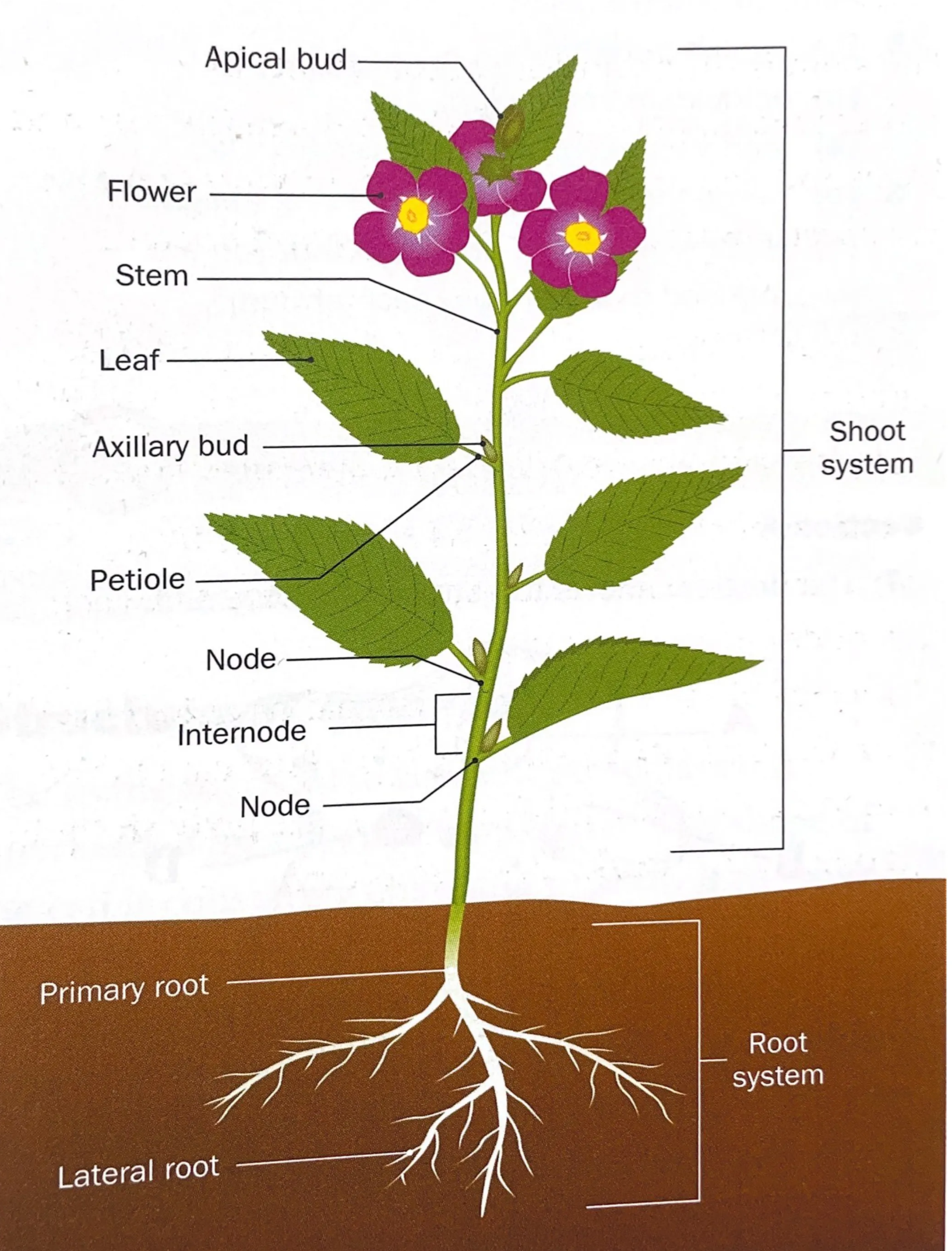
External Structure of a Flowering Plant
- Node: The point on the stem where a side branch grows.
- Internode: The region between two nodes on the stem.
- Petiole: The stalk that attaches the leaf to the stem (not present on all leaves).
Functions of the Shoot System
-
Photosynthesis: Converts carbon dioxide and water into glucose and oxygen using light energy and chlorophyll. Equation: 6CO₂ + 6H₂O →light/chlorophyll→ C₆H₁₂O₆ + 6O₂
-
Reproduction
-
Storage
-
Support
-
Transport
-
Gas Exchange: Occurs through stomata (on the underside of leaves) and lenticels (on stems).
The Root System
The root system is found below the ground.
Functions of Roots:
- Anchors the plant in the soil.
- Root hairs absorb water and minerals from the soil.
- Stores food (e.g., carrots).