Biological Reasoning (LC 2027) (Leaving Cert Biology): Revision Notes
📚Revision Notes
Biological Reasoning
What are phenomena and scientific models?
Understanding phenomena
A phenomenon refers to any observable event or fact that can be studied, particularly those that are unusual or challenging to understand completely. In biology, we focus on biological phenomena - events and processes associated with living organisms.
Note
Biological phenomena are all around us, from the microscopic processes happening inside our cells to the complex interactions we observe in entire ecosystems.
Examples of biological phenomena include:
- How damaged skin cells can repair themselves while brain cells cannot
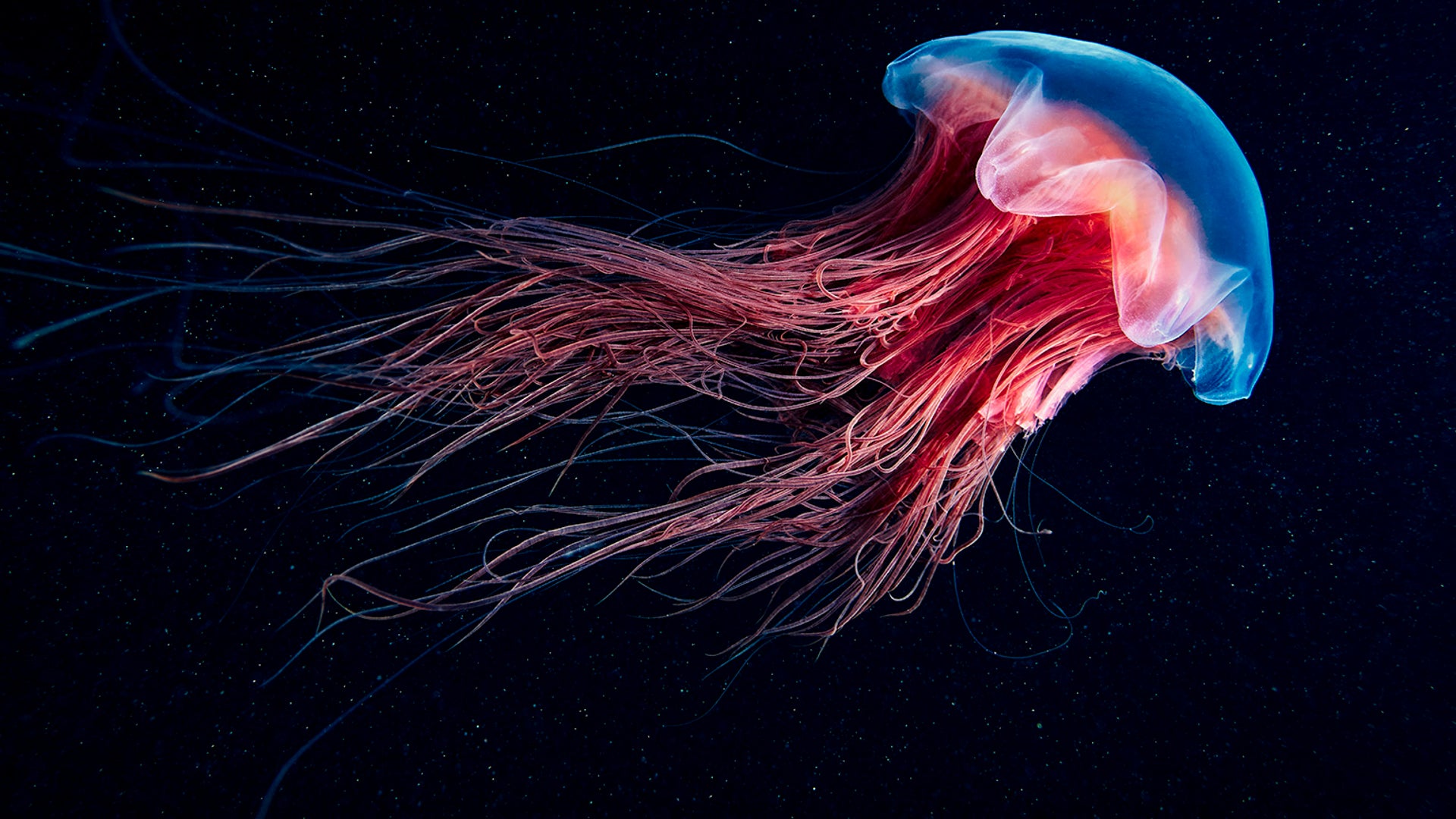
- Why certain sea creatures glow in dark water
- How plants bend towards light sources
- Why some people develop cramps more easily than others
The value of scientific models
Scientists use models to help understand and explain complex biological systems. These models can take various forms, including word descriptions, diagrams, equations, physical representations, or computer simulations.
Scientific models serve three main purposes:
- Describe and explain complex systems or phenomena
- Make predictions about how a system or phenomenon will behave
- Solve problems related to particular systems or phenomena
Example
Worked Example: Using Models in Biology
Consider how scientists study photosynthesis:
- Word model: "Plants convert sunlight, water, and carbon dioxide into glucose and oxygen"
- Diagram model: Visual representation showing chloroplasts, reactants, and products
- Equation model:
- Computer simulation: Digital model predicting photosynthesis rates under different conditions
Models evolve over time
An important characteristic of scientific models is that they are not fixed or permanent. As scientists gather more data and make new discoveries, models must be updated to reflect this new understanding.
Important
Models are not permanent truths but rather our best current understanding of biological phenomena. This means that models often evolve and change as scientific knowledge advances, and what we consider accurate today may be refined or even replaced tomorrow.
Key concepts for explaining biological phenomena
Systems in biology
A system consists of a group of structures (often organs in biology) that collaborate to perform a specific task. Scientists use two main approaches when studying biological systems:
Reductionist approach:
- Takes a top-down perspective by breaking complex systems into increasingly smaller components
- Studies each part individually and in isolation
- Represents the traditional historical method of biological study
- Example: studying muscles by examining individual muscle cells, then investigating the chemicals within those cells
Systems approach:
- Takes a bottom-up perspective by examining how different parts interact as a network
- Considers the system as a whole rather than just individual components
- Has become increasingly popular in recent years, often called systems biology
- Requires collaboration between various specialists including experimental scientists, data analysts, computer experts, and mathematical modellers
Note
The systems studied can vary enormously in scale, from molecular processes (like DNA function) and cellular reactions (such as photosynthesis) to complete body systems (like the digestive system) and even entire ecosystems (including how carbon dioxide affects the planet).
Interdependence
Interdependence describes how living organisms interact with and depend upon each other and their environment for survival. This creates a web of relationships where changes to one component can have significant effects on other parts of the natural world.
Example
Worked Example: The Irish Wolf Extinction
This concept demonstrates the far-reaching effects of interdependence:
Step 1: Wolves became extinct in Ireland around 1786
Step 2: Without natural predators, deer populations increased significantly
Step 3: Increased deer numbers caused damage to woodlands as deer consumed young trees
Result: The loss of one species created a cascade effect throughout the entire ecosystem
This concept is also demonstrated through simpler examples:
- Grass depends on soil nutrients, flowers rely on insects for pollination, and foxes depend on rabbits for food
- Each organism's survival is interconnected with others in complex ways
Unity of life
The unity of life refers to the shared characteristics found across all living organisms. This unity provides evidence that all life forms evolved from common ancestors and passed down similar features through many generations.
Examples of unity in life include:
- All living organisms contain DNA and RNA molecules
- Many different animals (bats, whales, gorillas, and humans) have similar bone structures in their limbs, fins, and arms
- Fundamental biological processes like cellular respiration occur across diverse species
Diversity of life
The diversity of life encompasses the tremendous variety of living organisms found on Earth. This diversity arose through evolutionary processes where species diverged from common ancestors, with each species developing different inherited characteristics over time, resulting in distinct but related species.
Note
Evolution serves as the scientific explanation for both the unity and diversity observed in life. It helps scientists understand almost everything we know about life on Earth through the Grand Unifying Theory of biology.
Form fits function
Form fits function is a fundamental biological principle stating that there exists a clear relationship between the structure (form) of a biological object and its specific role (function).
This concept explains why biological structures are often described in terms of both their physical characteristics and their functional roles:
Example
Worked Example: Form Fits Function in Action
- Enzymes: The specific shape of an enzyme determines which molecules it can interact with - like a lock and key mechanism
- Leaves: The large surface area of a leaf makes it ideally suited for collecting sunlight for photosynthesis
- Red blood cells: The distinctive biconcave shape allows them to absorb maximum amounts of oxygen and flow efficiently through narrow capillaries
Transfer of information
The transfer of information in biology relates to how genetic information is utilised within cells and passed between generations. In biological systems, information is transferred through genes.
Within cells, structures called chromosomes contain a chemical substance called DNA. Each chromosome contains hundreds or thousands of sections called genes, which have two main functions:
- They carry the instructions that allow cells to produce all necessary molecules
- They are passed from parents to their offspring through reproductive cells (sperm and egg), transferring information from one generation to the next and serving as the units of inheritance
Transfer of matter
Matter refers to anything that occupies space and has mass. In biological systems, matter is transferred between the environment and living organisms when they absorb chemicals from air or soil, and this matter is subsequently transferred to animals when they consume plants or other animals.
Plant and animal matter eventually returns to the environment when it breaks down through the action of decomposers (mainly bacteria and fungi). This allows matter to be recycled and reused by plants and later by animals in a continuous cycle.
Note
This process creates chemical cycling within ecosystems, where chemical substances (nutrients) cycle continuously between the environment and living organisms - nothing is truly wasted in nature.
Transfer of energy
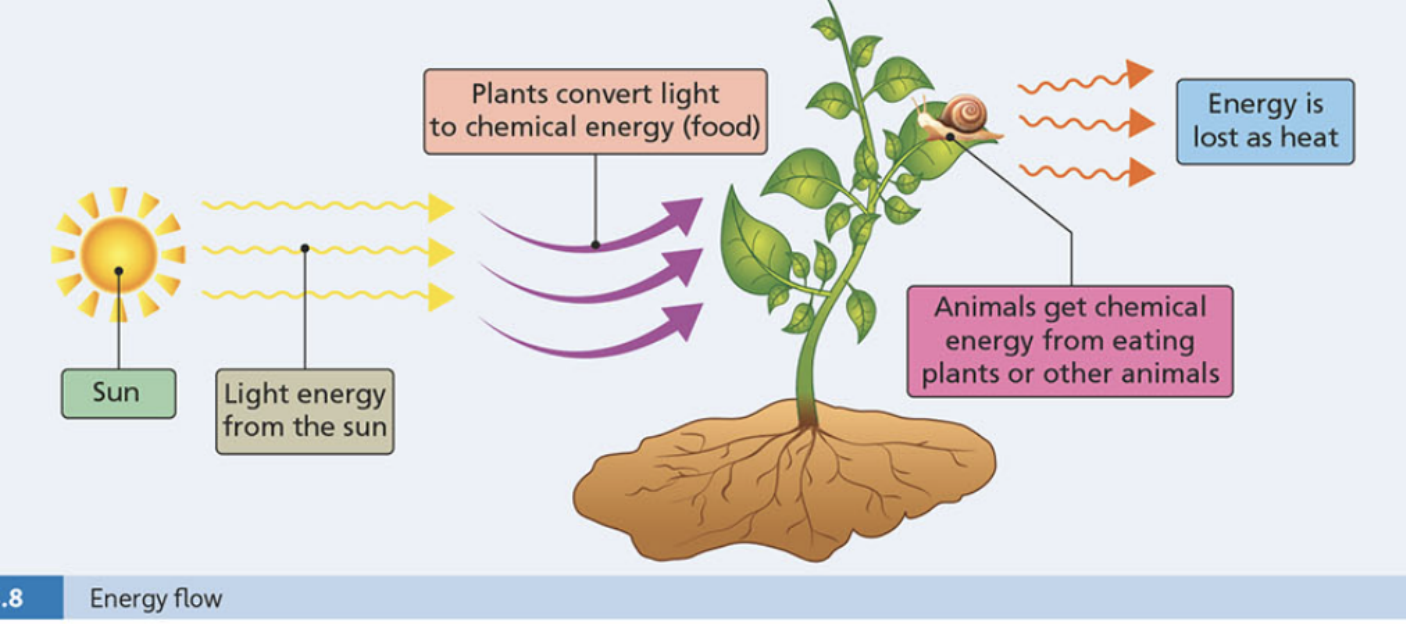
Energy represents the ability to perform work, which fundamentally means the capacity to make things move. Living organisms require energy for cellular processes, movement, growth, reproduction, and various other biological activities. When organisms use chemical energy to carry out processes, they lose some of this chemical energy to their surroundings as heat.
Important
Energy flows in one direction through biological systems and cannot be recycled like matter. This is a fundamental difference between energy and matter transfer in biological systems.
Energy flow follows this pattern:
- Plants capture light energy from the sun and convert it into chemical energy (food) through photosynthesis
- This chemical energy is then passed to other living organisms (such as animals) when they consume plants or their remains
- Unlike matter, energy cannot be recycled and ultimately flows out of biological systems as heat
Remember!
Summary
Key Points to Remember:
- Phenomena are observable biological events that scientists study using evolving models to understand, explain, and predict biological processes
- Systems thinking can use either reductionist approaches (breaking down into parts) or systems approaches (examining interactions between components)
- Interdependence shows how all living things rely on each other and their environment, creating networks where changes affect multiple components
- Unity and diversity of life demonstrate that all organisms share common features due to shared ancestry, while evolution has created tremendous variety through inherited changes
- Form fits function explains why biological structures are perfectly suited to their specific roles and purposes
- Matter cycles through ecosystems between living organisms and the environment, while energy flows in one direction from the sun through living systems and exits as heat
- Information transfer occurs through genes that carry instructions for cellular function and pass characteristics from parents to offspring