The Scientific Method (LC 2026) (Leaving Cert Biology): Revision Notes
📚Revision Notes
The Scientific Method
Note
The Scientific Method: A series of steps for answering questions.
It is a process of investigation in which problems are identified and their suggested explanations are tested by carrying out experiments.
Science: the study of the physical, material and living world.
Biology: the study of living things.
| Areas of Biological Study | Study of |
|---|---|
| Ecology | Organisms and their environment |
| Microbiology | Small organisms – mycology, bacteriology, virology |
| Genetics | Inheritance |
| Anatomy | Overall structure |
| Physiology | Overall function |
| Botany | Plants |
| Biochemistry | Chemical reactions |
| Zoology | Animals |
| Taxonomy | Classification |
| Cytology | Cells |
Scientific Method: The Process
The process is not always linear, but normally involves the following steps:
- Making an observation
- Forming a hypothesis
- Designing a controlled experiment
- Collecting and interpreting data
- Forming a conclusion
- Comparing the conclusion with existing knowledge
- Reporting and publishing the results
- Developing theories and laws/principles
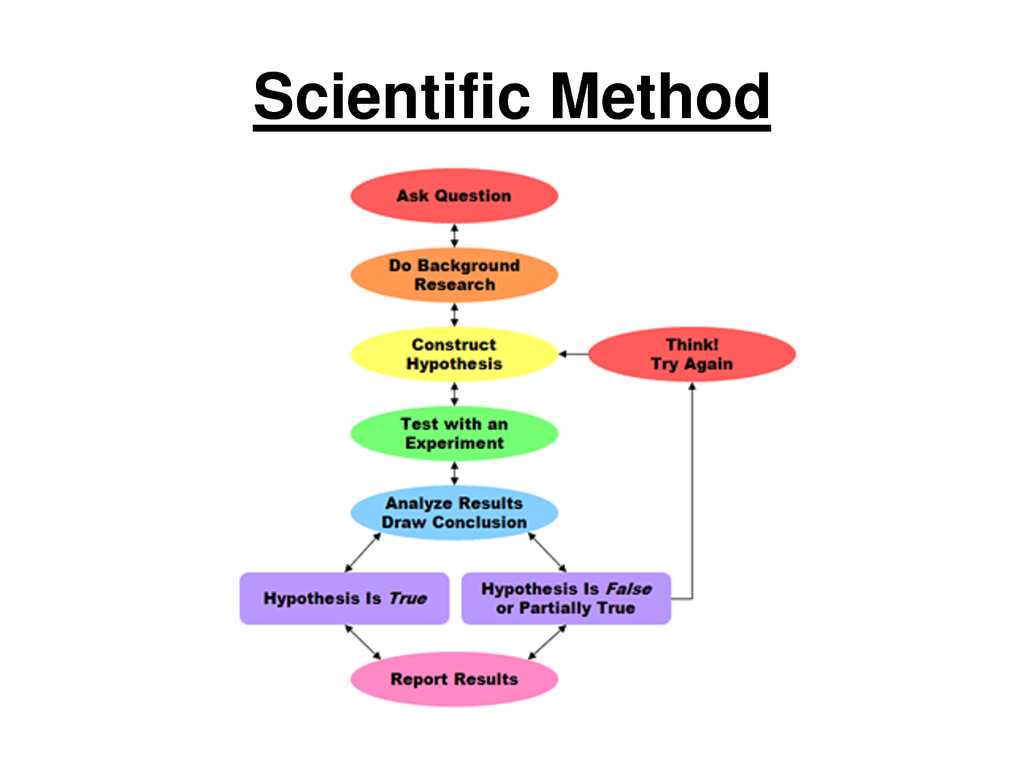
The Scientific Method (Detailed)
1. Making an observation
- An unbiased, accurate report of an event.
- Observations may be made directly using the senses (sight, smell, etc.) or indirectly using equipment (thermometer, microscope, etc.).
2. Forming a hypothesis
- An educated guess based on an observation.
3. Designing a controlled experiment
- A test to determine the validity of a hypothesis.
- Only one independent variable should be changed at a time.
4. Collecting and interpreting data
- Carry out the experiment and record the results, e.g. measurements, time.
- Repeat the experiment to confirm the results.
5. Forming a conclusion
- The conclusion explains the results and links back to the hypothesis.
6. Comparing the conclusion with existing knowledge
- The hypothesis is accepted, rejected or modified.
- Hypothesis confirmed: test further with new experiments or observations. Consistent and accurate results across experiments are required.
- Hypothesis unconfirmed: modify the hypothesis and test again.
7. Reporting and publishing the results
- Reports of the experiment and the results are published, e.g. in a scientific journal.
- This allows the results to be analysed and the experiment to be repeated by others.
8. Developing theories and laws
Theory: A well-supported explanation based on a large body of evidence and repeated testing.
Law/Principle: A statement that describes a consistent pattern or relationship observed in nature.
Note
Exam Focus: These definitions are often examined. Note the importance of observation, hypothesis, theory and law/principle.
The Principles of Experimentation
- Careful planning and design
- Ensure safety, e.g. wearing safety goggles, tying back long hair.
- Control experiment
- Control: Provides a standard against which the actual experiment can be measured.
- There should only be one independent variable between the control and the experimental setup.
- Experiment must be fair
- Sample size: The larger the sample size, the more reliable the result will be.
- Replication: If an experiment can be repeated and produces the same results each time, it shows that the results are reliable and not due to some unknown factor.
- Random selection: Random selection reduces the chance of choosing a biased sample. It reduces bias.
- Double-blind testing: Double-blind testing is when neither the tester nor the person being tested knows who is receiving the real treatment and who is receiving the placebo. It reduces bias.
A placebo is a fake treatment used in an experiment to act as a control.
Limitations of the Scientific Method
- The extent of our knowledge: Forming a hypothesis and designing experiments depends on what we already know.
- The basis of investigation: A poorly designed experiment will yield inaccurate results, e.g. no control available.
The control for an experiment on climate change would be an Earth without human life, which is impossible to design. - Interpreting results: Results that are interpreted incorrectly will lead to false conclusions.
- Changes in the natural world: Living things evolve and change constantly. Results may only apply to a particular time.
- Accidental discoveries: These sometimes occur outside the planned scientific method, e.g. penicillin was discovered accidentally in 1928.
Ethical Issues
Ethics relates to whether actions are right or wrong. There are sometimes arguments about whether the application of the scientific method is acceptable, such as in cloning animals or abortion.
| Term | Definition |
|---|---|
| Observation | An unbiased, accurate report of an event. Observations may be made directly using the senses (sight, smell, etc.) or indirectly using equipment (thermometer, microscope, etc.). |
| Hypothesis | An educated guess based on an observation. |
| Experiment | A test to determine the validity of a hypothesis. |
| Data | The results gathered during an experiment, e.g. measurements. |
| Theory | A well-supported explanation based on extensive evidence and repeated testing. |
| Law/Principle | A statement describing a consistent pattern observed in nature. |
| Control | A standard against which the actual experiment can be measured. |
| Placebo | A fake treatment used in an experiment to act as a control. |