Classification of Life (LC 2027) (Leaving Cert Biology): Revision Notes
📚Revision Notes
Domains of Life
Introduction to the domain system
In 1990, scientist Carl Woese revolutionised how we classify living things by proposing a new system based on molecular evidence. Instead of the traditional five-kingdom system, Woese introduced the concept of domains - the largest possible grouping in the classification of life.
This three-domain system emerged from studying the genetic material and biochemical properties of different organisms, particularly focusing on newly discovered microorganisms that didn't fit neatly into existing categories. The domain represents the highest level of biological organisation, grouping organisms based on their fundamental cellular and molecular characteristics.
Note
Woese's discovery was groundbreaking because it revealed that what scientists previously thought were just "unusual bacteria" were actually an entirely separate domain of life. This discovery fundamentally changed our understanding of life's diversity and evolutionary history.
The three domains of life
Life on Earth is now classified into three major domains: Bacteria, Archaea, and Eukarya. Each domain contains organisms with distinct cellular structures, genetic makeup, and biochemical processes.
Bacteria domain
Bacteria are microscopic, single-celled prokaryotic organisms - meaning they lack a membrane-bound nucleus. These organisms have been known to scientists for much longer than archaea and represent what most people traditionally think of as "germs" or "microbes."
Key characteristics of bacteria include:
- Cell walls made of peptidoglycan (a unique polymer)
- Unicellular organisation
- Found in virtually every environment on Earth
- Many can make their own food (autotrophic) or consume other organisms (heterotrophic)
- Examples include Escherichia coli (E. coli) and Salmonella
Note
Bacteria are incredibly diverse and abundant. A single teaspoon of soil can contain up to one billion bacterial cells! They play crucial roles in ecosystems, from decomposing organic matter to fixing nitrogen for plants.
Archaea domain
Archaea represent one of the most exciting discoveries in modern biology. These microscopic, single-celled prokaryotes were initially mistaken for bacteria but are actually genetically and biochemically distinct.

The image above shows a hot spring environment where many archaea thrive, demonstrating their ability to survive in extreme conditions.
Important
Why Archaea Matter: The discovery of archaea completely changed our understanding of life's evolutionary tree. Despite being prokaryotes like bacteria, archaea are actually more closely related to eukaryotes (including humans) than to bacteria. This discovery helped scientists understand that life's evolutionary history is more complex than previously thought.
Key characteristics of archaea include:
- No peptidoglycan in their cell walls (unlike bacteria)
- Often live in extreme environments such as:
- Very hot conditions (like hot springs)
- Highly salty environments
- Very acidic or alkaline conditions
- Do not cause diseases in humans
- Examples include Methanobacterium (produces methane) and Sulfolobus (lives at high temperatures)
Eukarya domain
The Eukarya domain includes all organisms whose cells contain a membrane-bound nucleus and other membrane-bound organelles. This domain encompasses the organisms most familiar to us in our daily lives.
Key characteristics of eukaryotes include:
- Eukaryotic cells with nuclei and organelles
- Can be unicellular or multicellular
- Cell walls (when present) made of cellulose, chitin, or other materials - never peptidoglycan
- Include four major groups:
- Protists (mostly unicellular, like amoeba)
- Plants (multicellular, make their own food)
- Fungi (like mushrooms, absorb nutrients)
- Animals (multicellular, must consume food)
Comparing the three domains
Understanding the differences between domains is crucial for grasping how life is organised. These fundamental distinctions help scientists classify new organisms and understand evolutionary relationships.
| Feature | Bacteria | Archaea | Eukarya |
|---|---|---|---|
| Cell type | Prokaryotic | Prokaryotic | Eukaryotic |
| Nucleus | Absent | Absent | Present |
| Cell wall | Peptidoglycan | No peptidoglycan (unique composition) | Variable: cellulose (plants), chitin (fungi), none (animals) |
| Chromosomes | Single, circular | Single, circular | Multiple, linear |
| Organelles | None | None | Membrane-bound organelles present |
| Habitats | Common, everywhere | Extreme & normal environments | Wide range, often complex ecosystems |
| Examples | E. coli, cyanobacteria | Methanogens, thermophiles | Humans, plants, fungi, protists |
Note
This comprehensive comparison table is one of the most important tools for understanding the three domains. Notice how archaea and bacteria are both prokaryotic but differ significantly in their cell wall composition and preferred environments. This table demonstrates why the three-domain system is more accurate than older classification methods.
Modern classification methods
Phylogeny and evolutionary relationships
Modern classification is increasingly based on phylogeny - the study of evolutionary relationships between organisms. Rather than just looking at physical similarities, scientists now examine genetic evidence to understand how different species are related through evolution.

Example
DNA Comparison Example
This DNA sequence comparison demonstrates how scientists determine evolutionary relationships:
Step 1: Extract DNA from organisms X, Y, and Z Step 2: Compare identical sequences at the same positions Step 3: Count similarities and differences Step 4: Organisms with more similar sequences are more closely related
In this table, organisms with higher percentages of identical DNA sequences shared a more recent common ancestor.
DNA sequencing in classification
The development of DNA sequencing technology has transformed how we classify organisms. This molecular revolution has made classification more accurate and revealed surprising evolutionary relationships.
Scientists can now:
- Study entire genomes rather than just examining physical characteristics
- Use computer programs to analyse vast amounts of genetic data
- Examine environmental DNA to discover new species without culturing them in the laboratory
- Apply bioinformatics to process huge datasets and identify evolutionary relationships
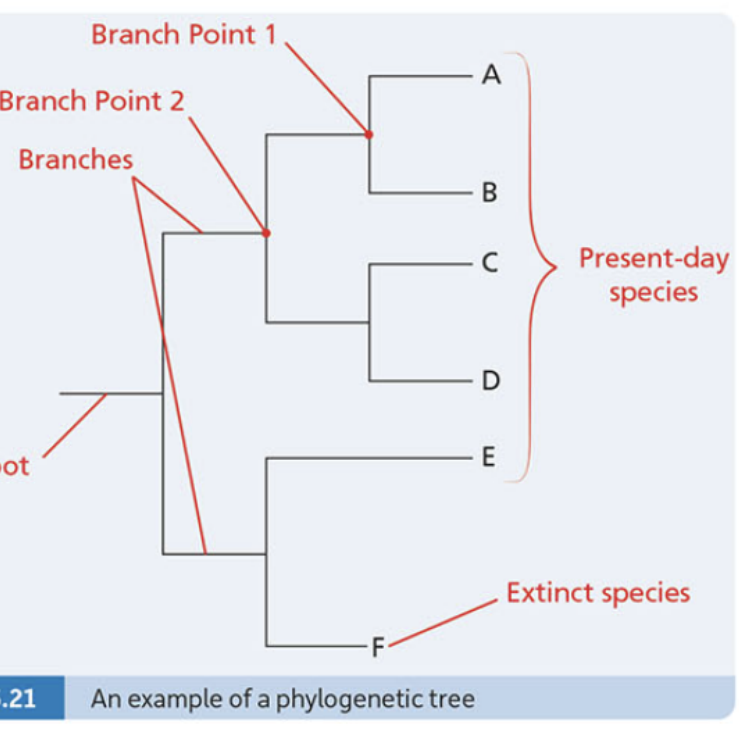
Note
Phylogenetic trees like this one are powerful tools for visualising evolutionary relationships. The branch points represent common ancestors, and the tips represent modern species. The closer two species are on the tree, the more recently they shared a common ancestor. This approach has revealed that many organisms we thought were closely related based on appearance are actually quite different genetically.
This molecular approach has revealed that many organisms we thought were closely related are actually quite different, while others that look very different are genetically similar.
Summary
Key Points to Remember:
-
Three domains exist: Bacteria, Archaea, and Eukarya - representing the largest groupings of life on Earth
-
Carl Woese proposed this system in 1990 based on molecular evidence, revolutionising our understanding of life's diversity
-
Bacteria and Archaea are both prokaryotic but fundamentally different - bacteria have peptidoglycan cell walls while archaea do not and often live in extreme environments
-
Eukarya includes all organisms with nuclei (protists, plants, fungi, and animals) and represents the most complex cellular organisation
-
Modern classification relies heavily on DNA analysis and phylogeny rather than just physical appearance, leading to more accurate evolutionary relationships