Planetary Boundaries (Leaving Cert CASD): Revision Notes
📚Revision Notes
Planetary Boundaries
Introduction to planetary boundaries
Planetary boundaries represent a groundbreaking scientific framework that identifies nine critical Earth system processes essential for maintaining a stable and resilient planet. Think of these boundaries as invisible safety barriers that, when crossed, increase the risk of dramatic and potentially irreversible environmental changes that could threaten human civilisation.
The concept was developed by a team of 28 internationally renowned scientists led by Johan Rockström from the Stockholm Resilience Centre. Their goal was to define a "safe operating space" for humanity - essentially answering the question: how much can we change Earth's natural systems before we trigger dangerous consequences?
Note
The planetary boundaries framework is like having a comprehensive health check for our planet, providing scientists and policymakers with crucial data about Earth's vital signs.
Understanding the framework
The planetary boundaries framework works like a traffic light system for Earth's health. Each boundary represents a different Earth system process, and scientists assign colours to show how close we are to danger:
-
Green zone: Safe operating space where Earth systems remain stable
-
Yellow/orange zone: Zone of uncertainty with increasing risk
-
Red zone: High-risk area where boundaries have been transgressed
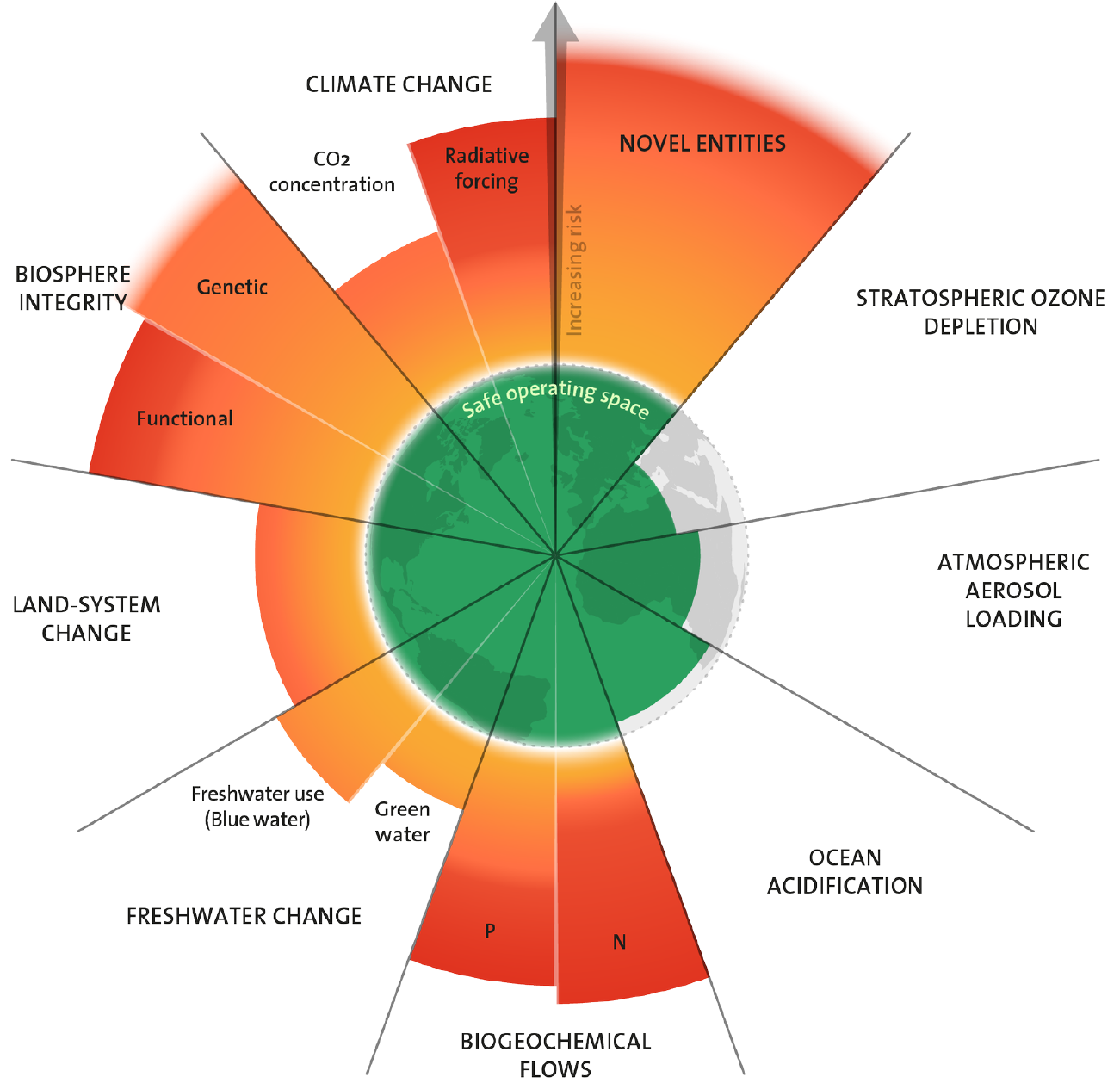
The framework emphasises that these boundaries are deeply interconnected. This means that crossing one boundary increases the risk of crossing others, creating a cascading effect that could destabilise the entire Earth system. For example, climate change affects water cycles, which impacts biodiversity, which in turn affects carbon storage.
Important
The interconnected nature of planetary boundaries means we cannot address environmental challenges in isolation. A holistic approach is essential because environmental problems compound and amplify each other.
Evolution of planetary boundaries (2009-2023)
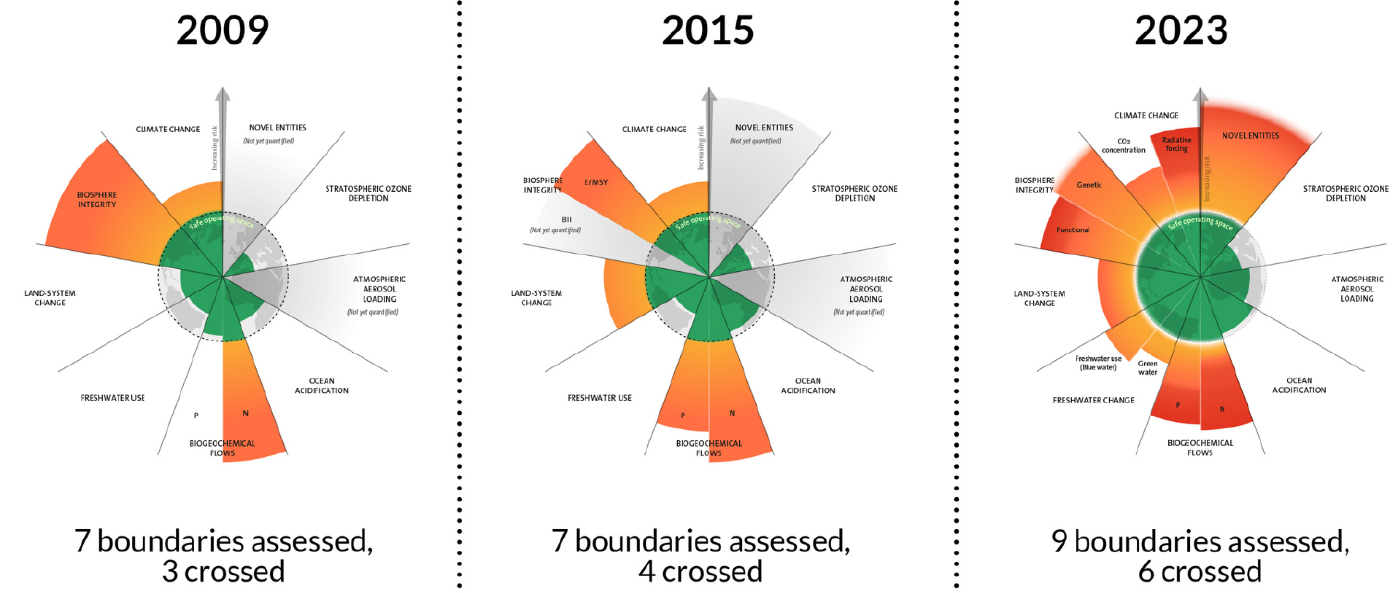
The planetary boundaries assessment has evolved significantly since its introduction in 2009, painting an increasingly concerning picture of Earth's health.
Key changes over time:
-
2009: 7 boundaries assessed, 3 crossed
-
2015: 7 boundaries assessed, 4 crossed
-
2023: 9 boundaries assessed, 6 crossed
This progression shows humanity's growing impact on planetary systems. The 2023 update represents the first time scientists quantified all nine boundaries, revealing that six are now transgressed. This means we're operating in dangerous territory for most of Earth's critical systems.
Important
The trend is clearly worsening - we've gone from 3 transgressed boundaries in 2009 to 6 in 2023. This represents a significant deterioration in planetary health over just 14 years.
The nine planetary boundaries explained
Climate change
Climate change occurs when increased greenhouse gases and aerosols in Earth's atmosphere trap heat that would otherwise escape to space. The boundary measures changes in Earth's energy balance - essentially how much heat comes in versus how much goes out.
Current status: Transgressed. CO₂ concentrations continue rising, causing global temperatures to increase and altering climate patterns worldwide.
Novel entities
Novel entities include technological developments that introduce new synthetic chemicals, modify living organisms' genetics, or mobilise materials in completely new ways. These substances can interfere with evolutionary processes and change how Earth systems function.
Current status: High-risk zone. The massive release of synthetic substances without adequate safety testing places this boundary in the danger zone.
Biosphere integrity
This boundary encompasses both the diversity and health of living organisms and ecosystems. It measures genetic diversity (the variety of species) and functional integrity (how well ecosystems perform their roles in regulating Earth's energy and chemical cycles).
Current status: Transgressed. Both genetic diversity loss and declining ecosystem function have pushed this boundary well beyond safe levels. Scientists believe this boundary was transgressed during the late 19th century.
Note
Biosphere integrity is often considered the most fundamental boundary because healthy ecosystems underpin all other Earth system processes.
Biogeochemical flows
This refers to how essential nutrients like nitrogen and phosphorus cycle through Earth's systems. These elements are crucial for supporting life and maintaining healthy ecosystems.
Current status: Transgressed. Industrial processes and intensive agriculture have severely disrupted natural nitrogen and phosphorus cycles. Too much nitrogen is being converted from stable atmospheric forms to reactive forms, while excess phosphorus flows into oceans.
Example
Worked Example: Nitrogen Cycle Disruption
Natural process: Atmospheric nitrogen (N₂) → Fixed nitrogen compounds → Used by plants → Returns to atmosphere
Human disruption: Industrial fertiliser production → Excess reactive nitrogen → Water pollution and greenhouse gas emissions → Ecosystem damage
Freshwater change
This boundary examines alterations to freshwater cycles, including both "blue water" (rivers and lakes) and "green water" (soil moisture). These changes affect carbon storage, biodiversity, and precipitation patterns.
Current status: Transgressed. Human activities have exceeded safe limits for both surface water and soil moisture changes.
Land system change
Land system change refers to transforming natural landscapes through activities like deforestation and urbanisation. These transformations disrupt habitats, reduce biodiversity, and diminish ecosystem services like carbon storage and water regulation.
Current status: Transgressed. The remaining forest areas in tropical, boreal, and temperate regions have fallen below safe levels.
Ocean acidification
As oceans absorb atmospheric CO₂, they become more acidic (lower pH). This process harms organisms that build shells or skeletons from calcium carbonate, disrupts marine ecosystems, and reduces the ocean's effectiveness as a carbon sink.
Current status: Still within safe operating space, but dangerously close to the boundary due to rising CO₂ levels.
Atmospheric aerosol loading
This boundary considers changes in airborne particles from both human activities and natural sources. These particles influence climate by altering temperature and precipitation patterns.
Current status: Within safe operating space. Despite significant air pollution affecting regional weather patterns and ecosystems, global measurements indicate this boundary hasn't been crossed yet.
Stratospheric ozone depletion
The ozone layer high in the atmosphere protects life on Earth from harmful ultraviolet radiation. Thinning of this layer, primarily due to human-made chemicals, allows dangerous UV radiation to reach Earth's surface.
Current status: Safe operating space. Thanks to international action phasing out ozone-depleting substances since the 1980s, the ozone layer is slowly recovering.
Note
The recovery of the ozone layer demonstrates that global environmental challenges can be successfully addressed through coordinated international action and policy implementation.
Current status and concerns
The 2023 assessment reveals alarming trends. With six out of nine boundaries now transgressed, humanity is operating well outside the safe space that allowed civilisation to develop and thrive.
Crossing these boundaries doesn't necessarily mean immediate catastrophic change, but it significantly increases the risk of triggering large-scale, abrupt, or irreversible environmental shifts. The impacts may not be immediately apparent, but together these boundaries mark critical thresholds for risks to both human societies and the natural world.
The interconnected nature of these systems means that problems compound. Climate change, for instance, affects water availability, which impacts agriculture and biodiversity, which in turn affects carbon storage and climate regulation.
Important
We are currently operating in dangerous territory for most of Earth's critical systems. This doesn't guarantee immediate catastrophe, but it dramatically increases the risk of triggering irreversible changes that could threaten human civilisation.
Applications in policy and business
The planetary boundaries framework has gained significant traction beyond academic circles. Since 2024, the Potsdam Institute for Climate Impact Research uses it for annual Planetary Health Checks. The framework helps inform policy decisions and guides sustainable development strategies.
Major corporations and international organisations increasingly reference planetary boundaries when developing sustainability strategies. The World Business Council for Sustainable Development has used the framework to shape business strategies, recognising that operating within these boundaries is essential for long-term economic stability.
Note
The planetary boundaries framework is increasingly being used as a practical tool for decision-making in both public policy and corporate strategy, moving beyond academic research into real-world applications.
Remember!
Summary
Key Points to Remember:
-
Planetary boundaries define humanity's safe operating space - nine critical Earth system processes that maintain planetary stability
-
Six out of nine boundaries are now transgressed - we're operating in dangerous territory for most Earth systems
-
All boundaries are interconnected - crossing one increases the risk of crossing others through cascading effects
-
The situation is worsening over time - from 3 transgressed boundaries in 2009 to 6 in 2023
-
Action on all boundaries is essential - we cannot focus on just one area while ignoring others if we want to maintain a stable Earth system