Changes in Spin, Tilt & Orbit of Earth (Leaving Cert CASD): Revision Notes
📚Revision Notes
Changes in Spin, Tilt & Orbit of Earth
What are orbital variations?
Earth's position and movement in space isn't constant - it slowly changes over thousands of years. These astronomical changes, known as orbital variations, affect how much solar energy different parts of our planet receive. The gravitational pull from the Sun, Moon, and large planets (especially Jupiter and Saturn) gradually alters three key aspects of Earth's movement: its orbit around the Sun, the tilt of its axis, and the direction its axis points.
Note
These natural factors work on much longer timescales than human activities, taking thousands to hundreds of thousands of years to complete their cycles. Understanding these variations helps us distinguish between natural climate changes and current human-caused global warming.
The three Milankovitch cycles
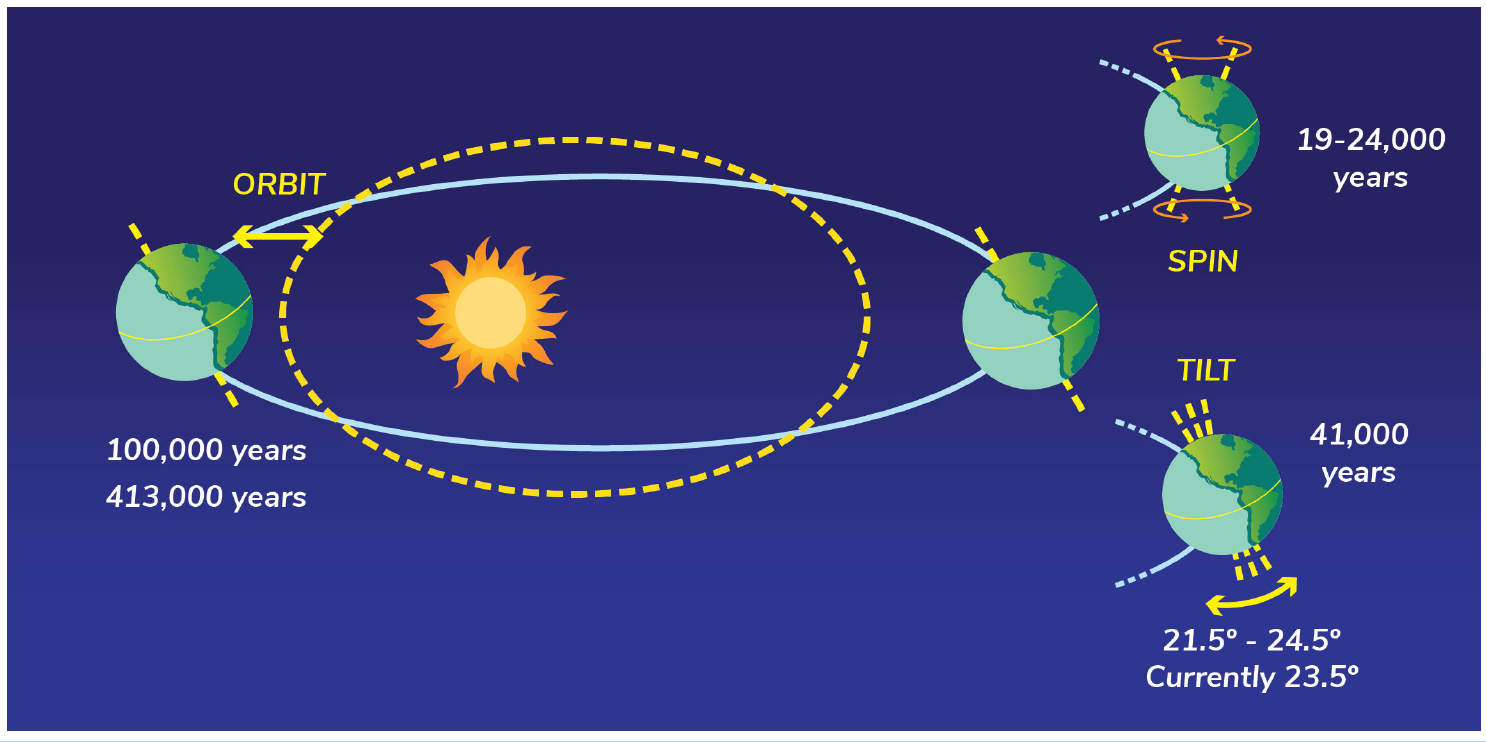
The Serbian scientist Milutin Milankovitch identified three main astronomical cycles that influence Earth's climate over geological time periods. These are now called Milankovitch cycles in his honour.
Important
The three Milankovitch cycles operate on different timescales and work together to create complex patterns of climate change throughout Earth's history. Each cycle affects different aspects of how solar energy reaches our planet.
Orbital eccentricity (100,000 and 413,000 year cycles)
Orbital eccentricity describes how Earth's orbit changes shape over time. Sometimes our planet follows a more circular path around the Sun, while at other times the orbit becomes more elliptical (oval-shaped). This cycle operates over approximately 100,000 years and 413,000 years.
When Earth's orbit is more elliptical, the planet receives different amounts of solar energy at different times of the year, affecting seasonal contrasts and climate patterns globally.
Example
Eccentricity Effects:
Circular orbit: Earth receives relatively constant solar energy throughout the year, with smaller differences between seasons.
Elliptical orbit: Earth receives significantly more energy when closer to the Sun and less when farther away, creating stronger seasonal contrasts and affecting global climate patterns.
Axial tilt or obliquity (41,000 year cycle)
Earth's axial tilt determines the severity of our seasons. Currently, our planet tilts at 23.5° from vertical, but this angle varies between 21.5° and 24.5° over a 41,000-year cycle.
When the tilt angle is greater:
-
Seasons become more extreme (hotter summers, colder winters)
-
Higher latitudes receive more solar energy during summer
-
This can prevent ice sheets from forming or cause existing ones to melt
When the tilt angle is smaller:
-
Seasons become milder
-
Less summer melting allows ice sheets to grow and persist
Precession or axial wobble (19,000-24,000 year cycle)
Precession refers to the slow wobble of Earth's rotational axis, like a spinning top that's slowing down. This cycle takes between 19,000 and 24,000 years to complete.
Precession changes which hemisphere receives more intense solar radiation during different seasons. For example, currently the Northern Hemisphere summer occurs when Earth is furthest from the Sun, but this wasn't always the case due to precession.
Note
Think of precession like a slowly spinning top - as it wobbles, different parts of the top point in different directions over time. Similarly, Earth's axis slowly wobbles, changing which hemisphere receives more intense seasonal radiation.
How orbital variations affect climate
These astronomical cycles work together to alter the amount of solar radiation (also called insolation) that reaches different parts of Earth's surface. Over periods of 10,000 to 100,000 years, small changes in Earth's position relative to the Sun can significantly impact regional climates.
The key effects include:
Changes in temperature patterns
Different regions receive varying amounts of solar energy, leading to warming or cooling trends that can last for thousands of years. These temperature changes affect where ice can form and persist.
Variations in ice cover
When high-latitude regions (near the poles) receive less summer solar energy, ice sheets can grow because there isn't enough heat to melt them completely each year. The reflexion of sunlight by ice and snow creates a feedback loop - more ice means more reflexion, which leads to further cooling.
Note
Ice-Albedo Feedback Loop:
This is one of Earth's most important climate feedback mechanisms. When ice covers more surface area, it reflects more sunlight back to space (high albedo), which cools the planet further and allows more ice to form - creating a self-reinforcing cycle.
Impacts on the carbon cycle
Changes in ice cover and temperature affect how carbon moves between the atmosphere, oceans, and land. During ice ages, more carbon becomes locked away in the ocean, reducing atmospheric greenhouse gas concentrations and reinforcing the cooling trend.
Connection to ice ages
Milankovitch successfully predicted that glacial periods (ice ages) occur when high-latitude regions in the Northern Hemisphere receive reduced summer solar energy. Under these conditions, ice sheets can survive from year to year without completely melting, gradually building up into massive continental glaciers.
The geological record shows clear evidence of these cycles preserved in:
-
Ocean sediment layers
-
Fossil records
-
Chemical signatures in ancient atmospheres
Important
Geological Evidence:
These natural cycles explain the pattern of glacial and interglacial periods that have occurred throughout Earth's history. The evidence is preserved in multiple geological records that scientists can analyse to understand past climate patterns.
Why orbital variations don't explain current climate change
While Milankovitch cycles have been major drivers of climate change throughout geological history, they operate far too slowly to account for the rapid warming we're experiencing today. The current rate of climate change is happening over decades, not millennia.
Important
Critical Time Scale Differences:
-
Orbital cycles work over 10,000-400,000 year timescales
-
Current climate change is occurring over 50-100 years
-
These natural cycles continue today but their effects are minimal compared to human activities
-
Scientists can measure current orbital parameters and confirm they don't match the rapid warming pattern we observe
Effects on Earth's systems
Orbital variations influence multiple interconnected Earth systems:
Energy balance
Changes in solar radiation received affect global and regional temperature patterns, influencing weather systems and ocean currents.
Cryosphere (ice systems)
Variations in ice cover create feedback mechanisms that amplify or reduce climate changes through altered reflexion of solar energy.
Note
The cryosphere includes all of Earth's frozen water - ice sheets, glaciers, sea ice, snow cover, and permafrost. Changes in any of these components can have cascading effects on global climate through feedback mechanisms.
Carbon cycling
Ice ages and interglacial periods involve major shifts in where carbon is stored - in the atmosphere, oceans, or locked in ice and vegetation.
These long-term natural changes provide important context for understanding how Earth's climate system responds to different forcings, helping scientists better predict future climate responses to human activities.
Summary
Key Points to Remember:
-
Three orbital cycles: Earth's orbit shape (100,000+ years), axial tilt (41,000 years), and axial wobble (19,000-24,000 years)
-
Milankovitch cycles explain ice ages through changes in solar energy received at high northern latitudes
-
These natural cycles operate too slowly to cause current rapid climate change
-
Ice-albedo feedback: More ice reflects more sunlight, leading to further cooling
-
Geological evidence in sediments and fossils confirms these cycles influenced past climate