The Carbon Cycle (Leaving Cert CASD): Revision Notes
📚Revision Notes
The Carbon Cycle
What is the carbon cycle?
The carbon cycle describes how carbon moves between different parts of our planet - the atmosphere, soils, living creatures, oceans, and human activities. Carbon is the fourth most abundant element in the universe and plays a crucial role in making life on Earth possible. It forms complex molecules like DNA and proteins that are essential for all living things.
Note
Definition: The carbon cycle is the process that moves carbon between plants, animals, and microbes; minerals in the earth; and the atmosphere. This continuous movement is essential for maintaining life on Earth.
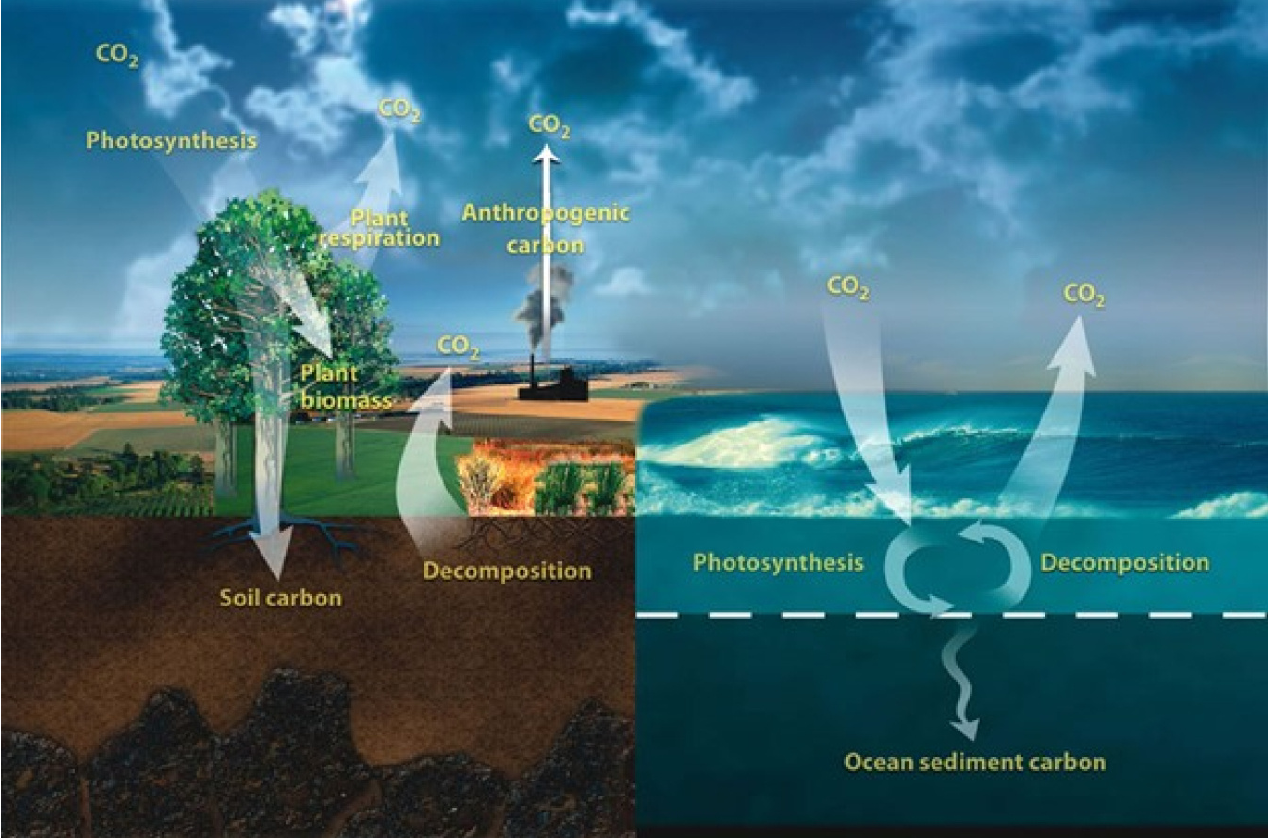
Carbon exists in our atmosphere mainly as carbon dioxide (CO₂), which helps control Earth's temperature. Understanding how carbon moves through this cycle is vital for understanding climate change and our planet's future.
Earth as a closed system
Important
Earth operates as what scientists call a closed system when it comes to carbon. This means that virtually no new carbon atoms arrive from space, and none leave our planet. The total amount of carbon on Earth remains constant - it simply moves around between different storage locations.
Most of Earth's carbon is stored in:
-
Rocks and sediments (the largest store)
-
Oceans
-
Atmosphere
-
Living organisms
How carbon moves through the cycle
Terrestrial processes
Plants and photosynthesis: Plants constantly exchange carbon with the atmosphere through photosynthesis. During this process, plants absorb carbon dioxide from the air and convert it into organic compounds. Much of this carbon gets stored in plant tissues like roots, stems, and leaves, as well as in surrounding soils.
Example
Worked Example: Plant Carbon Exchange
Step 1: During photosynthesis
-
Plants absorb CO₂ from the atmosphere
-
Convert it into organic compounds using sunlight
-
Store carbon in roots, stems, and leaves
Step 2: During respiration
-
Plants release CO₂ back to the atmosphere
-
This happens continuously, day and night
-
Net effect depends on balance between photosynthesis and respiration
Respiration and decomposition: Plants and animals release carbon dioxide back to the atmosphere when they breathe (respiration). When plants and animals die and decay, decomposition also releases stored carbon back to the atmosphere as CO₂.
Soil storage: Soils act as major carbon sinks - places where carbon is stored away from the atmosphere. Carbon gets stored in soil through decaying plant matter and can remain there for long periods.
Marine processes
Ocean absorption: The oceans play a massive role in the carbon cycle by absorbing carbon dioxide from the atmosphere. As the ocean water cools, this carbon sinks to deeper levels.
Ocean sediments: Carbon becomes stored in ocean sediments on the sea floor, where it can remain locked away for extremely long periods.
Human influence
Important
Critical Impact: Fossil Fuel Burning
Humans have dramatically affected the carbon cycle by burning fossil fuels like oil, coal, and natural gas. These fuels are made from carbon that was stored underground for millions of years in ancient plants. When we burn them, this stored carbon gets released into the atmosphere as CO₂.
This process adds extra carbon to the atmosphere that would otherwise remain stored underground, disrupting the natural balance of the carbon cycle.
Land use changes: Activities like deforestation also impact the cycle by removing plants that would normally absorb CO₂ from the atmosphere.
Carbon storage and carbon sinks
Scientists use the term carbon sinks to describe places where carbon gets stored away from the atmosphere. The main carbon sinks include:
-
Forests and grasslands: Trees and plants store carbon in their biomass
-
Soils: Contain organic carbon from decomposed plant material
-
Oceans: Both in the water itself and in sediments on the ocean floor
-
Geological deposits: Including coal, oil, and gas formed over millions of years
Note
Carbon Absorption by Natural Systems
Historical data shows that about 25% of carbon emissions from human sources have been captured by forests, grassland, and farms. Additionally, around 30% of the CO₂ we produce gets absorbed by the oceans.
Climate impacts and greenhouse effect
Important
The Greenhouse Effect and Climate Balance
Carbon dioxide is one of the main greenhouse gases - gases that trap heat in Earth's atmosphere. The position of carbon in the cycle directly shapes our climate.
The greenhouse effect creates a delicate balance:
-
Too little CO₂ and other greenhouse gases would make Earth frozen
-
Too much CO₂ turns the atmosphere into a furnace-like environment
This is why understanding the carbon cycle and our role in affecting it is critical for Earth's future climate.
Key carbon cycle facts
-
Main greenhouse gases: Carbon dioxide joins methane, nitrous oxide, and fluorinated gases as the primary heat-trapping gases in our atmosphere
-
Carbon removal technology: Scientists are developing carbon sequestration technologies, including direct air capture systems that can pull CO₂ straight from the atmosphere
-
Natural carbon capture: Historically, natural systems like forests and oceans have captured significant portions of human carbon emissions, but this may change as emissions continue increasing
-
Multiple timescales: Carbon moves through the cycle at different speeds - from quick exchanges between plants and atmosphere to extremely slow geological processes taking millions of years
Remember!
Summary
Key Points to Remember:
-
The carbon cycle moves carbon between the atmosphere, land, oceans, and living things in a continuous loop
-
Plants remove CO₂ during photosynthesis, while respiration and decomposition release it back to the atmosphere
-
Earth is a closed system - carbon doesn't arrive from space, it just moves between different storage locations
-
Human activities, especially burning fossil fuels, add extra CO₂ to the atmosphere and affect the natural balance
-
Carbon dioxide is a greenhouse gas that helps control Earth's temperature - too little or too much can dramatically affect our climate