The Water Cycle (Leaving Cert CASD): Revision Notes
📚Revision Notes
The Water Cycle
What is the water cycle?
The water cycle represents the endless movement of water throughout our planet's systems. Water exists in three states - solid (ice), liquid (water), and gas (water vapour) - and constantly moves between Earth's atmosphere, oceans, rivers, lakes, glaciers, and underground reservoirs.
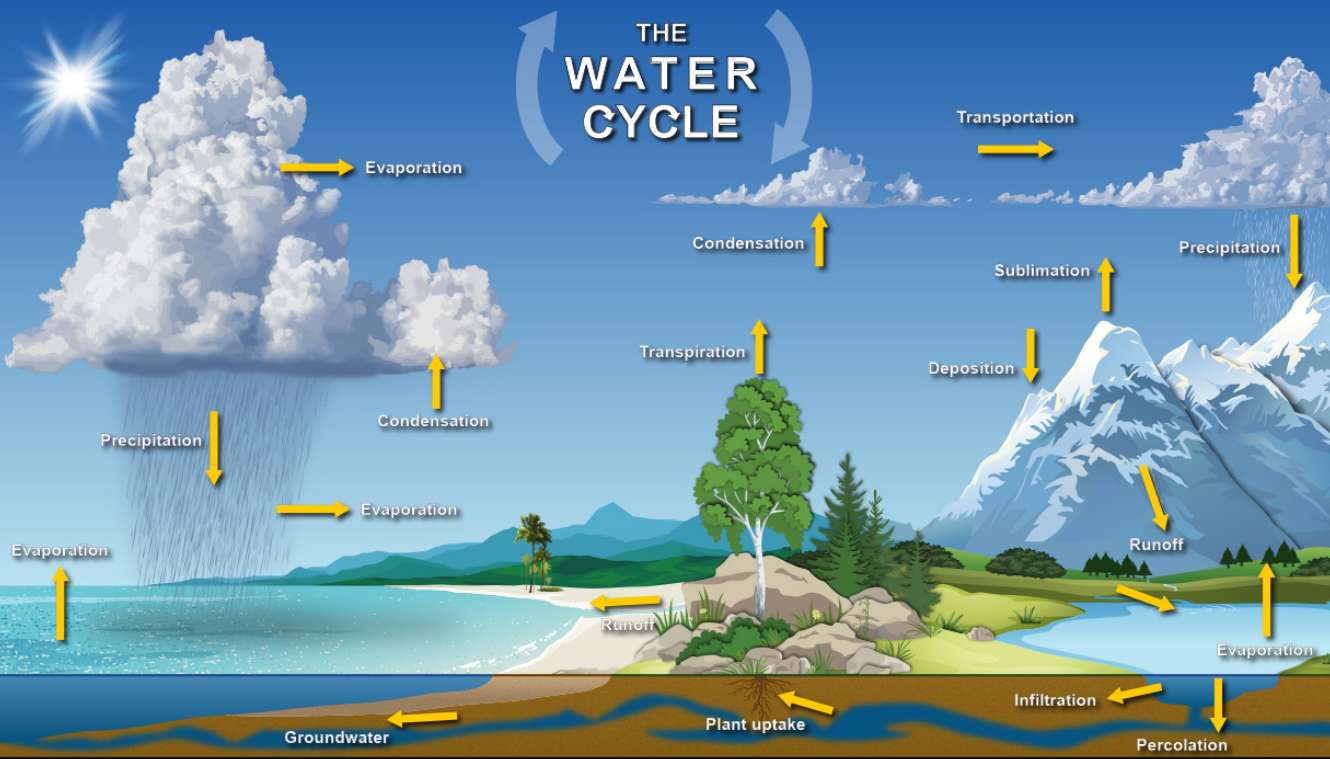
While we often think of the water cycle as a simple circle of evaporation, condensation, and precipitation, the reality is much more complex. Water connects all major parts of Earth's climate system, including the air we breathe, clouds in the sky, vast oceans, freshwater bodies, vegetation, snow and ice, and underground water stores.
Note
Understanding the Water Cycle Framework
The water cycle describes the continuous movement of water within the Earth and atmosphere. This system operates on multiple scales - from local weather patterns to global climate systems - and involves complex interactions between different components of our planet.
To understand the water cycle properly, we need to learn about two key concepts:
-
Pools: These are all the different places where water is stored on Earth, such as oceans, lakes, rivers, glaciers, groundwater, soil moisture, and even water vapour in the atmosphere
-
Fluxes: These are the processes that move water between different pools, including evaporation, condensation, precipitation, and surface flow
The water cycle operates as a continuous system where water moves naturally between these pools, but human activities now play a significant role in influencing these movements.
Where water is stored on Earth
Understanding where Earth's water is located helps us appreciate why freshwater is such a precious resource.
Salt water dominates Earth's water supply
The overwhelming majority of water on our planet - approximately - exists as salt water in the oceans. Only a tiny fraction of Earth's total water is fresh water that we can potentially use for drinking, agriculture, and other human needs.
Freshwater makes up just 2.5% of all water
Important
Critical Water Distribution Facts
Even within this small percentage of freshwater ( of all Earth's water), most is not easily accessible to humans. Surface water sources like rivers and lakes - which we rely on most - represent less than of all freshwater!
Even within this small percentage of freshwater, most is not easily accessible to humans:
-
Glaciers and ice caps store about of all freshwater, locked away as ice in polar regions and mountain peaks
-
Groundwater accounts for roughly of freshwater, existing underground in soil and rock spaces
-
Surface water sources like lakes, rivers, and wetlands represent less than of freshwater, yet these are our most important sources for human use
-
Other pools include small amounts stored as soil moisture, in the atmosphere as water vapour, and within living organisms (including our own bodies!)
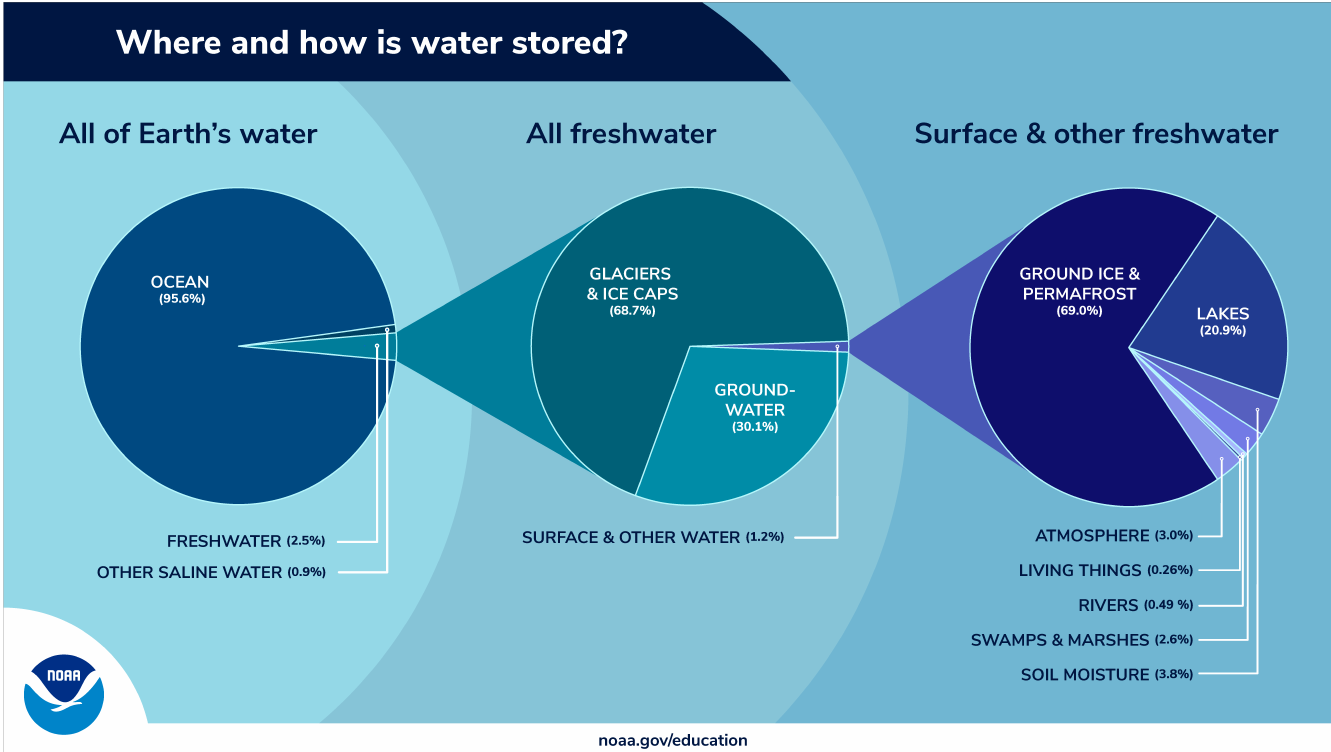
This distribution shows why we must carefully manage our freshwater resources - the water we depend on represents an incredibly small fraction of all water on Earth.
How water moves through the cycle
Water constantly moves between storage pools through various processes. These movements, called fluxes, involve both changes in water's physical state and its location.
Changes between liquid and vapour states
Evaporation occurs when liquid water absorbs energy (usually from sunlight) and transforms into water vapour. This happens from any water surface - oceans, lakes, rivers, or even puddles. The water vapour rises into the atmosphere, carrying energy with it.
Transpiration is water evaporation from plant leaves. Plants absorb water through their roots and transport it upward. Most of this water eventually exits through leaf pores as water vapour, contributing significantly to atmospheric moisture.
Note
The Power of Plant Transpiration
A single large tree can transpire hundreds of litres of water per day! This process not only contributes to atmospheric moisture but also helps cool the surrounding environment, demonstrating how vegetation plays a crucial role in local climate regulation.
Condensation happens when water vapour in the atmosphere cools and transforms back into liquid droplets. This process forms clouds and fog. Condensation occurs when air contains more water vapour than it can hold at a particular temperature.
Direct changes between solid and vapour states
Sublimation allows ice and snow to transform directly into water vapour without melting first. This commonly occurs in cold, dry conditions where snow seems to disappear even when temperatures stay below freezing.
Deposition is the reverse process, where water vapour transforms directly into ice crystals. This creates phenomena like frost forming on cold surfaces.
Physical movement of water
Precipitation returns water from the atmosphere to Earth's surface as rain, snow, sleet, or hail. The type of precipitation depends on atmospheric temperature and conditions.
Surface runoff occurs when water flows over land surfaces towards rivers, lakes, or oceans. This includes water flowing in streams and rivers, as well as melting ice and snow.
Infiltration describes water soaking into soil from the surface. The rate depends on soil type, vegetation cover, and how saturated the ground already is.
Percolation continues this downward movement as water travels deeper through soil layers towards groundwater supplies.
Transportation moves water through the atmosphere as water vapour, liquid droplets in clouds, or ice crystals. Atmospheric rivers represent concentrated streams of water vapour flowing through the sky.
Human interaction with the water cycle
Humans have become major players in the water cycle, significantly altering natural water movements and storage patterns.
How humans disrupt natural water flow
People change where and how water is stored by constructing dams, redirecting rivers, and extracting groundwater faster than natural processes can replenish it. When we use water for drinking, agriculture, industry, or energy production, we move it between different pools in the cycle.
Human activities also affect water quality, which impacts whether water is suitable for human use or ecosystem health. Pollution can make water unusable even when it's physically available.
Understanding water "waste"
Since water continuously cycles through Earth's systems, you might wonder how we can actually "waste" water. The issue isn't that water disappears permanently, but rather:
-
Water isn't always available where and when we need it
-
Some water sources (like deep groundwater) take extremely long periods to naturally refill
-
We must use energy and resources to clean contaminated water before we can safely use it
-
Using water faster than natural systems can restore it disrupts the balance of the water cycle
This is why water conservation remains crucial even though the total amount of water on Earth stays constant.
Climate change impacts on the water cycle
Rising global temperatures are fundamentally changing how the water cycle operates, affecting when, where, and how much water is available in different regions.
Effects of warming temperatures
As Earth's atmosphere warms, several changes occur in the water cycle:
-
Ice stored in glaciers and polar regions melts, moving from solid pools to liquid pools (primarily oceans)
-
Warmer air can hold more water vapour before becoming saturated
-
Higher temperatures increase evaporation rates from water surfaces
-
These changes influence weather patterns and the frequency of extreme events
How warming creates both droughts and intense rainfall
Note
The Climate Change Paradox
Warmer atmospheric conditions create a paradox - they can lead to both longer dry periods and more intense precipitation events. This seemingly contradictory effect occurs because warmer air can hold more moisture before reaching saturation, leading to longer gaps between rainfall, but when precipitation finally occurs, it can be much more intense.
Warmer air increases evaporation and can hold more moisture before condensation occurs. This means longer intervals between rainfall events, potentially causing drought conditions. However, when condensation finally happens, the increased moisture content can produce much more intense precipitation.
Positive feedback loops
Important
Critical Feedback Loop Alert
Water vapour itself acts as a greenhouse gas, trapping heat in the atmosphere. As warming increases evaporation, more water vapour enters the atmosphere, which traps additional heat and causes further warming. This creates a positive feedback loop that accelerates climate change effects - meaning the problem compounds itself!
These temperature changes also influence extreme weather events. Warmer ocean waters provide more energy for hurricanes and storms, while extended dry periods can increase wildfire risks.
Remember!
Summary
Key Points to Remember:
• The water cycle is a continuous system where water moves between the atmosphere, land surface, and underground, changing between solid, liquid, and gas states
• Most of Earth's water is saltwater () stored in oceans, while only is freshwater, and most of that is locked in ice or underground
• Key processes include evaporation, transpiration, condensation, precipitation, and various types of water flow that move water between different storage pools
• Humans significantly impact the water cycle through water use, infrastructure development, and activities that affect water quality and availability
• Climate change is intensifying the water cycle, leading to more extreme weather patterns including both severe droughts and intense precipitation events, creating challenges for water management and ecosystem health