The Greenhouse Effect (Leaving Cert CASD): Revision Notes
📚Revision Notes
The Greenhouse Effect
What is the greenhouse effect?
The greenhouse effect is a natural process in which the Sun’s warmth is trapped in the Earth’s lower atmosphere, helping to keep the planet at a suitable temperature for life.
This happens because the atmosphere is more transparent to visible radiation from the Sun than to the infrared radiation emitted from the Earth’s surface. As a result, heat is retained rather than escaping into space. Without this effect, Earth would be much colder — about -18°C on average — making it impossible for most life forms to survive.
Note
This natural warming process is absolutely essential for life on Earth. Without it, our planet would be a frozen, lifeless world completely unable to support the diverse ecosystems we see today.
Greenhouse gases are special types of gases in our atmosphere that can absorb heat energy. They act like a blanket around Earth, trapping some of the heat that would otherwise escape to space. This natural process is essential for maintaining the warm temperatures we need for life.
How does the greenhouse effect work?
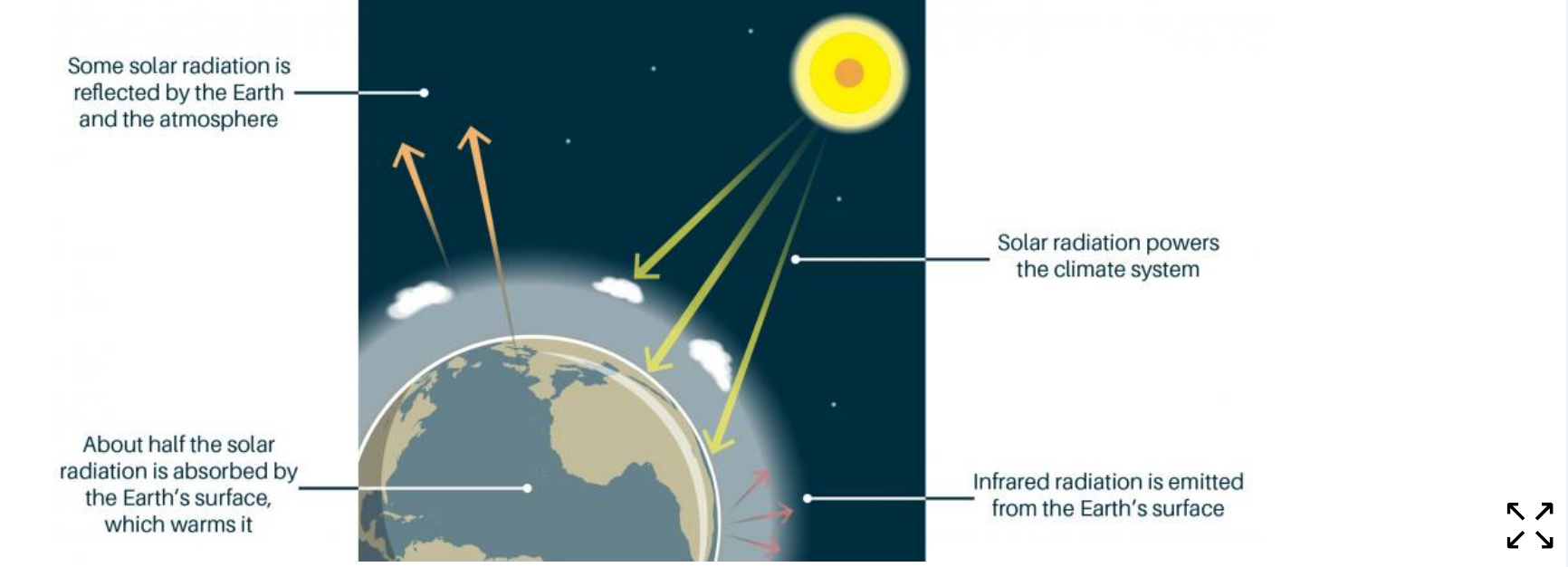
The greenhouse effect involves several key steps that work together to warm our planet:
Note
Understanding the Step-by-Step Process
The greenhouse effect works through a continuous cycle of energy absorption, emission, and re-absorption that maintains Earth's temperature balance.
The process works like this:
- Solar radiation arrives: Energy from the Sun travels to Earth as solar radiation, which powers our entire climate system
- Some energy is reflected: Part of this solar radiation bounces back to space from Earth's surface and atmosphere - this is called reflexion
- Energy absorption occurs: About half of the solar radiation is absorbed by Earth's surface, which warms it up
- Infrared radiation is emitted: The warmed Earth's surface gives off heat energy in the form of infrared radiation
- Greenhouse gases trap heat: Some of this infrared radiation is absorbed by greenhouse gas molecules and clouds in the atmosphere, then re-emitted in all directions. This effect warms both the Earth's surface and the lower atmosphere.
Greenhouse gases
Main greenhouse gases
Important
Three Key Factors for Greenhouse Gas Impact
The contribution each greenhouse gas makes to the greenhouse effect depends on three main factors:
-
How much heat it can absorb
-
How much heat it re-radiates
-
How much of that gas exists in the atmosphere
The main greenhouse gases, listed in order of their contribution to Earth's greenhouse effect, are:
- Water vapour () - the most important greenhouse gas
- Carbon dioxide () - second most important contributor
- Nitrous oxide () - third most significant
- Methane () - fourth in importance
- Ozone () - fifth contributor
Global warming potential
Different greenhouse gases have different abilities to trap heat. Scientists measure this using global warming potential (GWP):
- Methane () is 23 times more effective at trapping heat than
- Nitrous oxide () is 296 times more effective than
Note
Even though methane and nitrous oxide are more powerful per molecule, there is much more in Earth's atmosphere than or . This is why is often considered the most important greenhouse gas when discussing climate change.
It's also important to know that not all greenhouse gases stay in the atmosphere permanently. For example, can dissolve into ocean waters, creating a balance between the air and water at the sea surface.
Anthropogenic greenhouse gases
Anthropogenic means "caused by human activities." Since the Industrial Revolution began in the mid-18th century, human activities have dramatically increased the concentrations of greenhouse gases in our atmosphere. Current levels are many times higher than they were before industrial times.
Main sources of human-caused greenhouse gases
The primary sources of anthropogenic greenhouse gases include:
- Burning fossil fuels - This is the largest source, including coal, oil, and natural gas burned for energy
- Agriculture, forestry and other land use - Farming practices, deforestation, and land-use changes
- Cement manufacture - The production process releases significant amounts of
- Aerosols - Various industrial processes that release greenhouse gases
Enhanced greenhouse effect
The released from burning fossil fuels is building up like an insulating blanket around Earth, trapping more of the Sun's heat in our atmosphere. When human actions increase greenhouse gas concentrations beyond natural levels, this creates what scientists call the enhanced greenhouse effect.
Important
Climate Change Connection
This enhanced effect leads to additional warming beyond what would occur naturally. The extra and other greenhouse gases from human activities contribute to current climate change by increasing the amount of heat trapped in Earth's atmosphere.
Remember!
Summary
Key Points to Remember:
-
The natural greenhouse effect is essential - without it, Earth would be about -20°C and unable to support most life
-
Greenhouse gases work by absorbing infrared radiation - they trap heat that would otherwise escape to space
-
The main greenhouse gases in order are: water vapour, carbon dioxide, nitrous oxide, methane, and ozone
-
Human activities since the Industrial Revolution have greatly increased greenhouse gas concentrations in the atmosphere
-
The enhanced greenhouse effect occurs when human activities add extra greenhouse gases beyond natural levels, contributing to climate change