Activities Causing Enhanced Greenhouse Effect (Leaving Cert CASD): Revision Notes
📚Revision Notes
Activities Causing Enhanced Greenhouse Effect
What is the enhanced greenhouse effect?
While the natural greenhouse effect is essential for life on Earth, human activities have dramatically intensified this process since the Industrial Revolution around 1750. This intensification is called the enhanced greenhouse effect.
The enhanced greenhouse effect occurs when human activities release additional greenhouse gases into the atmosphere, trapping more heat than normal and causing global warming.
Since the Industrial Revolution, carbon dioxide concentrations have risen from 280 parts per million (ppm) to over 410 ppm in just 150 years - a massive increase in geological terms.

Note
This enhancement has slowed the rate at which heat escapes Earth's atmosphere, leading to measurable warming. Global surface temperatures have risen by approximately 1.18°C from the late 1800s to 2020.
Major human activities driving greenhouse gas emissions
Transport sector
Cars, lorries, ships, and aeroplanes are major contributors to greenhouse gas emissions. These vehicles burn petrol, diesel, and jet fuel, releasing large amounts of CO₂. Transport accounts for around one-quarter of global CO₂ emissions, with road transport being the largest contributor within this sector.

Industrial activities
Manufacturing and heavy industry produce significant emissions through multiple pathways:
- Manufacturing processes - producing goods requires energy, often from fossil fuels
- Mining and cement production - these emit CO₂, CH₄, and N₂O through both energy use and chemical processes
- Heavy industries like steel and concrete production are especially carbon-intensive
Note
Industrial activities are particularly significant because they often involve both direct emissions from manufacturing processes and indirect emissions from the energy required to power these operations.
Burning fossil fuels for energy
Fossil fuels power much of our modern world and are the largest single source of human-caused emissions. Coal, oil, and natural gas are burned to power homes, factories, and electricity generation, producing vast amounts of CO₂. Coal is particularly carbon-intensive compared to other fossil fuels.
Deforestation and forest destruction
Cutting down forests contributes to the enhanced greenhouse effect through a dual impact:
- Releases stored carbon - trees contain carbon that is released as CO₂ when they're cut down
- Reduces Earth's ability to absorb CO₂ - fewer trees mean less photosynthesis to remove CO₂ from the atmosphere
Note
Deforestation accounts for about 10% of total global emissions, making it a significant contributor despite being smaller than fossil fuel burning.
Agricultural practices
Farming contributes around one-third of total greenhouse gases through several key processes:
- Livestock digestion - cows and sheep produce methane (CH₄) as they digest grass
- Rice cultivation - waterlogged rice fields produce methane
- Fertiliser use - artificial fertilisers release nitrous oxide (N₂O)
Technology and energy consumption
Our digital world increasingly contributes to emissions as digital technologies, data centres, and cryptocurrency mining consume huge amounts of electricity. Much of this electricity still comes from fossil fuel power stations, making the technology sector an emerging and significant growing emissions source.
Land use changes
How we use land affects the enhanced greenhouse effect by replacing forests or wetlands with cropland, grasslands, or urban developments. This changes how the land reflects sunlight and stores carbon, leading to additional warming beyond just the loss of trees.
Evidence of human causation
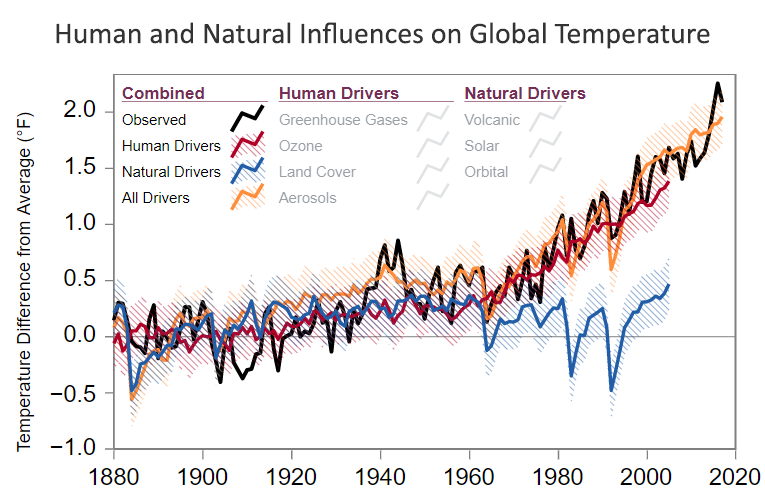
Scientists have overwhelming evidence that today's climate change is primarily caused by human activities:
Important
Rate of change: The Earth's climate has changed naturally in the past, but the current rate of change is far faster than natural variations. This rapid change coincides with the Industrial Revolution and increasing human emissions.
Important
Computer model evidence: Climate models show that natural influences alone (such as volcanic eruptions and solar fluctuations) cannot explain current warming. When human emissions are included in models, they accurately predict observed warming.
Important
Chemical fingerprints: CO₂ from burning fossil fuels has a different isotopic signature than CO₂ from natural sources. Measurements confirm that rising atmospheric CO₂ comes from human activities, not natural sources.
Scientific consensus
The Intergovernmental Panel on Climate Change (IPCC), involving over 500 scientists worldwide, concluded in their 2021 Sixth Assessment Report:
Important
"It is unequivocal that human influence has warmed the atmosphere, ocean and land."
The IPCC identifies that human-caused emissions from transport, industry, agriculture, fossil fuels, deforestation, technology, and land use change are driving the climate crisis. Without rapid and large-scale reductions in these emissions, global warming will continue to disrupt ecosystems, economies, and societies.
Summary
Key Points to Remember:
-
Enhanced greenhouse effect = human activities intensifying the natural greenhouse effect since the Industrial Revolution
-
Major emission sources include transport (cars, planes), industry (manufacturing, mining), fossil fuel burning, deforestation, agriculture, and technology
-
CO₂ concentrations have risen from 280 ppm to over 410 ppm in just 150 years due to human activities
-
Scientific evidence from models, chemical analysis, and rate of change all confirm human causation
-
IPCC consensus states it is "unequivocal" that human influence has warmed the planet